





 Portuguese
  English
  Spanish
  3 min of reading
  5 comments


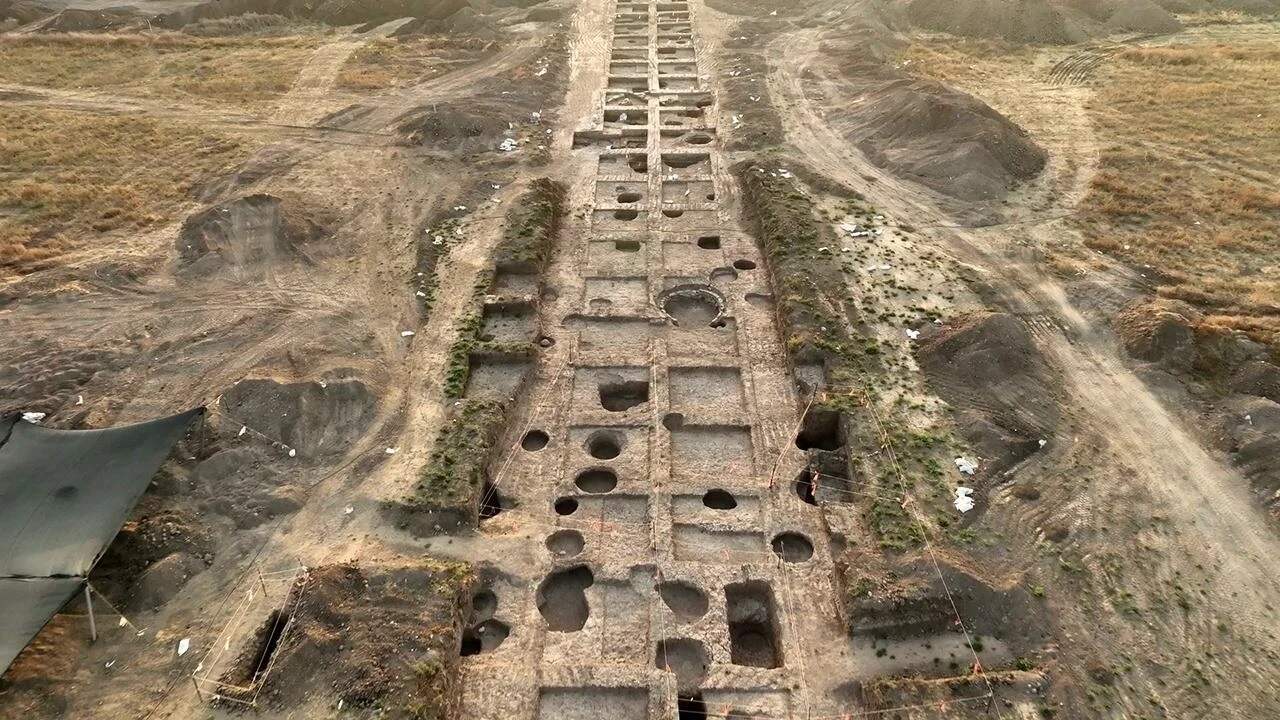


Discovery Reveals 5,500-Year-Old Canaanite Workshop in Southern Israel, Featuring Advanced Flint Production and Specialized Social Structure
Archaeologists have found in Naḥal Qomem the first recorded Canaanite flint production workshop in southern Israel. The site, located near Kiryat Gat, revealed a tool manufacturing facility about 5,500 years old. The discovery occurred before the construction of a new residential neighborhood called Carmei Gat.
The excavation was funded by the Israel Land Authority and conducted by researchers from the Israel Antiquities Authority (IAA). The archaeological site is dated to the Early Bronze Age.
Sophisticated Tools and Use of Advanced Techniques
The discovered workshop shows that the local community already had an advanced social structure. Large flint cores and finely crafted blades were found.
-
Motorola launched the Signature with a gold seal from DxOMark, tying with the iPhone 17 Pro in camera performance, Snapdragon 8 Gen 5 that surpassed 3 million in benchmarks, and a zoom that impresses even at night.

-
Satellites reveal beneath the Sahara a giant river buried for thousands of kilometers: study shows that the largest hot desert on the planet was once traversed by a river system comparable to the largest on Earth.

-
Scientists have captured something never seen in space: newly born stars are creating gigantic rings of light a thousand times larger than the distance between the Earth and the Sun, and this changes everything we knew about stellar birth.

-
Geologists find traces of a continent that disappeared 155 million years ago after separating from Australia and reveal that it did not sink, but broke into fragments scattered across Southeast Asia.

These tools were used for cutting, harvesting, and performing daily tasks, functioning similarly to modern knives and sickles.
The level of technical sophistication surprised the archaeologists. The evidence points to the use of a controlled pressure device, similar to a rudimentary type of crane, to shape the blades with precision.
According to prehistorians Dudu Biton and Dr. Jacob Vardi from the IAA, this was an “advanced industry, known only to exceptional individuals.”
For them, the findings show that there was already professional specialization at that time, with technical knowledge restricted to certain groups.
Mass Production for Levant Communities
The tools and stone cores found are now being displayed at the National Campus Jay and Jeanie Schottenstein of Archaeology of Israel in Jerusalem.
The directors of the excavation, Dr. Martin David Pasternak, Shira Lifshitz, and Dr. Nathan Ben-Ari, state that the site was a center for producing and distributing tools to other Levant communities.
Residential structures, underground pits, and work areas were identified in an area of more than half a square kilometer.
According to the researchers, this is the first specialized workshop for the systematic production of blades discovered in the southern part of the country.
Although similar objects have been found in northern and central Israel, this is the first site that shows large-scale manufacturing with evident planning.
Technical Knowledge Was Protected
Another highlighted aspect was the presence of production debris, called debitage, which was stored on-site and not discarded outside of it.
For the archaeologists, this may indicate an effort to preserve technical knowledge within a closed group.
In addition to the tools, the excavation revealed underground structures made with mud bricks. These chambers may have had various uses, such as storage, housing, rituals, or social activities.
The construction method and organization of the spaces indicate a society with a clear division of tasks.
“What we are seeing here is an economy based on specialization — a workshop operating regularly, producing tools not only for the local community but also for regional export,” states Dr. Vardi. He compares the site to a prehistoric production line.
Continuous Occupation and New Studies
The research also revealed that the area was occupied for centuries, from the Chalcolithic period to the Early Bronze Age. This shows the strategic and economic importance of the site over time.
With the conclusion of this phase, the archaeologists plan to continue laboratory analyses to better understand the techniques used in manufacturing.
Investigations into distribution routes and possible trade connections with other Levant communities are also planned.
With information from Aventuras na História.






¿****ál Israfake? Esto es en PALESTINA OCUPADA
ISRAEL É DE DEUS TUDO DE BOM PARA ISRAEL
O Israel de Deus e todo aquele que receber seu filho como único Salvador e não uma nação ****
Israel é de ****
Sírio arqueológico Cananeu. Nada haver com o estrupício que veio a ser Israel.