





 Portuguese
  English
  Spanish
  7 min of reading
  0 comments


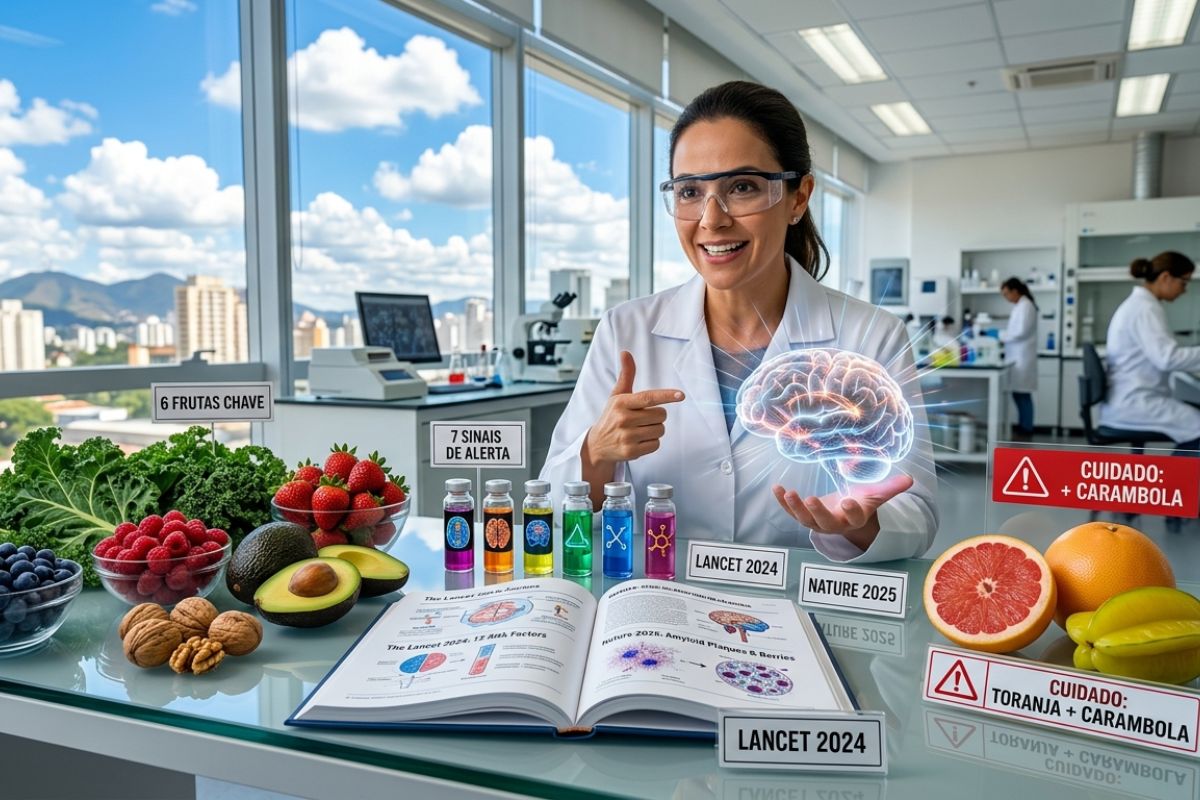
Alzheimer and dementia in daily life with warning signs, flavonoids, and anthocyanins in 6 fruits, plus care with grapefruit and star fruit
Alzheimer’s is one of the most feared diseases of our time, and the worst part is that it can start silently long before symptoms become obvious. The good news is that simple choices in daily life, including what you put on your plate, truly enter the conversation about the prevention of Alzheimer’s and dementia.
According to The Lancet in 2024, 45% of dementia cases can be prevented with simple lifestyle changes, and diet appears as an important piece of this puzzle. Next, you will see 6 fruits that help protect the brain against Alzheimer’s and dementia, 7 warning signs to watch closely, and essential care, especially with grapefruit and star fruit.
What The Lancet 2024 points out about preventing dementia and Alzheimer’s
The Lancet in 2024 brings an attention-grabbing number: 45% of dementia cases can be prevented with lifestyle changes. This does not mean a promise of cure or individual guarantee, but it reinforces something decisive: the risk is not a “sentence,” and repeated choices over the years weigh heavily.
-
Scientists launched a bait camera to the bottom of the Pacific Ocean and saw something that no one expected.

-
Is a smart plug worth it in a regular home? What does it offer: turns on and off via smartphone, creates routines by schedule, prevents forgotten devices, sometimes monitors consumption, and improves habits without renovation or miracles.

-
Airbus and Mercedes take the G-Class to the skies: the ACH145 helicopter priced at R$ 78 million debuts in São Paulo, unit goes to Brazilian, AMG cabin, 5-blade rotor, and a 2-year wait.

-
New material could change everything: it is the thickness of an atom, 200 times stronger than steel, and 100,000 times thinner than a human hair.


Among these changes is the dietary pattern. The central idea is simple: a more colorful and consistent plate, with fruits and protective compounds, helps reduce inflammation and oxidative damage in the brain, factors that accompany cognitive decline and connect to the discussion about Alzheimer’s.
7 warning signs of dementia that many people overlook
Not all forgetfulness is Alzheimer’s, but some signs deserve attention, especially when they become frequent, progressive, or start to interfere with daily life.
- Forgetting the names of very close people and this becoming a pattern
- Difficulty finding words, that feeling of “it slipped from the tip of the tongue”
- Forgetting recent conversations and frequently repeating questions
- Sudden difficulty with previously automatic tasks, such as operating a microwave, following an old recipe, or organizing bills
- Spatial and temporal disorientation, such as getting lost in places known for years
- Unusual mental confusion, not explained solely by fatigue or distraction
- Personality and mood changes, such as irritability, apathy, discouragement, or depression appearing markedly
If these signs appear, the safest path is to seek professional evaluation, because the sooner you understand what is happening, the more care options there are.
Why flavonoids and anthocyanins enter the conversation about Alzheimer’s
The logic behind the fruits is less “mystical” and more chemical. The foundational text explains that, within the brain, processes of inflammation and oxidative damage occur that, over time, wear down neurons and synapses.
In this scenario, compounds such as flavonoids and anthocyanins come into play:
Flavonoids have anti-inflammatory action, helping to “put out internal fires.”
Anthocyanins act as antioxidants, helping to reduce oxidative “pollution.”
And there is a data point cited from JAMA that reinforces the point: people who consumed six daily servings of foods rich in flavonoids had 28% less risk of developing dementia. This is not a detail; it is direction.
6) Avocado and the focus that suffers when the brain inflames

Avocado appears as a fruit not commonly associated with the brain, but for a strong reason: it brings monounsaturated fats, the same ones that are cited as valuable in olive oil. And the brain, according to the text, is 60% fat, so quality matters.
Additionally, avocado is highlighted for its magnesium, linked to communication between brain cells and anti-inflammatory action.
The message here is direct: if concentration and focus start to decline, it cannot be treated as “normal” and that’s it. Nutrition comes in as real support.
5) Apples and pears: when the word disappears in the middle of a sentence

That annoying forgetfulness, where you are talking and the word disappears, is treated as a sign of synapses “flickering” more than they should.
In the foundational text, apples and pears are highlighted due to a 40-year follow-up with 2,801 people, where they stood out.
The “secret” mentioned is in the skin, rich in quercetin, a flavonoid with antioxidant action that helps protect synapses from oxidative stress and inflammation. Here, one detail changes everything: eat with the skin, when possible and well cleaned.
4) Grapes and raisins: resveratrol and the risk of missing the target

Grapes are connected to a rather alarming sign: sudden difficulty with tasks that were previously automatic, such as using appliances, cooking a familiar recipe, or managing bills.
The text cites the Framingham Heart Study, with over 80 years of data, stating that adults who consumed more dark grapes in middle age, between 45 and 59 years, had 44% less risk of cognitive decline decades later.
The star compound is resveratrol, concentrated in the skin. But there is an important warning: the recommendation is to eat the fruit, not to resort to supplements, because the text warns that supplements can have undesirable effects.
And pay attention to the practical detail: raisins have 107 g of sugar per cup, while fresh grapes, for comparison, have 15 g. If you are diabetic, the text advises preferring fresh grapes.
3) Orange, tangerine, and grapefruit: the brain’s “GPS” and a mandatory care

Here the focus is on the risk of spatial and temporal disorientation, such as not remembering the way to a place known for decades. Citrus fruits appear as allies due to vitamin C and citrus flavonoids against Alzheimer’s.
The text cites the Nurses Health Study, with 25,000 women followed for 25 years, pointing out that higher consumption of citrus flavanones, especially from oranges and grapefruits, was associated with a significant reduction in the risk of dementia. It also reinforces that vitamin C protects the hippocampus, linked to memory consolidation.
Practical guidance from the text: eat the whole fruit, not juice, because fiber regulates sugar absorption and maximizes benefits.
And here comes a warning that cannot be ignored: grapefruit interferes with more than 85 medications, including blood pressure, cholesterol, and anticoagulant medications. If you are on continuous medication, the text advises avoiding grapefruit or preferring orange and tangerine.
2) Blueberries and açaí: anthocyanins that reach the brain

Blueberries are presented as “absolute power” for being rich in anthocyanins, and the text states that they cross the blood-brain barrier, reaching the brain.
A study from the University of Cincinnati is cited involving people with mild cognitive decline: in 12 weeks, those who consumed blueberries showed improvement in working memory, processing speed, and executive function.
The text also states an increase in cerebral blood flow by up to 15% and protection against the accumulation of beta-amyloid plaques.
Regarding açaí, the text highlights: Brazilian açaí would have 3 times more anthocyanins than American blueberries, and recommends pure açaí, without added sugar and without guarana.
1) Strawberries and the silent signal that destroys relationships

The text places at the top a little-discussed but devastating signal: personality and mood changes, such as irritability, apathy, and depression. The explanation presented links this to inflammation affecting regions related to emotion and impulse control.
The cited study also involves the University of Cincinnati, with people aged 50 to 65 years, overweight, and insulin resistant. Half received a placebo, while half consumed strawberries equivalent to one cup per day for 12 weeks. The text describes that the placebo group worsened, while the strawberry group showed improvement in memory and mood, with a reversal from depression to disposition and from irritation to calm.
The highlighted compound is ellagic acid, linked to improved communication between the prefrontal cortex and amygdala, helping with emotional balance.
Extra care with grapefruit and star fruit, and with hidden sugar

The foundational text is very direct: not every fruit is safe for everyone.
Grapefruit: interferes with more than 85 medications, so it requires caution for those on continuous medication.
Star fruit: contains neurotoxin and the text warns that it can be fatal for people with compromised kidneys, kidney disease, dialysis, or altered creatinine.
If there is a kidney problem, the guidance is not to consume.
Raisins: high sugar per serving, and the recommendation in the text is to prioritize fresh grapes, especially for diabetes.
This part is essential for discussing Alzheimer’s responsibly, because prevention does not combine with avoidable risk.
The finding in Nature 2025 that opened a new avenue in the laboratory


The text mentions a study published in Nature in August 2025, associated with researchers from Harvard, suggesting that lithium deficiency in the brain may be related to Alzheimer’s.
In tests with mice, scientists used a compound referred to as lithium orotate, and the text describes results such as reversal of disease pathology, prevention of neural damage, and restoration of memory in the animals.
At the same time, it makes the essential warning: it was not in humans, so it is still not a magic solution, but a promising line that needs confirmation in clinical studies.
The synthesis is simple: there is hope in research, but what exists today that is most concrete continues to be consistency in lifestyle, including sleep, movement, and a dietary pattern rich in protective compounds.
More accessible fruits and consistency that does not depend on perfection
If the six main fruits do not fit your budget or palate, the text suggests cheaper and more common alternatives: banana, papaya, guava (highlighted for vitamin C), mango, in addition to buying seasonal fruits and freezing them when on sale.
Other items with flavonoids also appear: green tea, 70% dark chocolate, red onion, broccoli, and hibiscus tea. The central idea is one: the secret is not perfection, it is consistency, starting with three servings of fruit per day and gradually increasing.
Now tell me so I can understand your situation: which of these fruits do you already eat frequently, and which do you find most difficult to incorporate into your routine to help prevent Alzheimer’s?





Seja o primeiro a reagir!