Portuguese
  Spanish


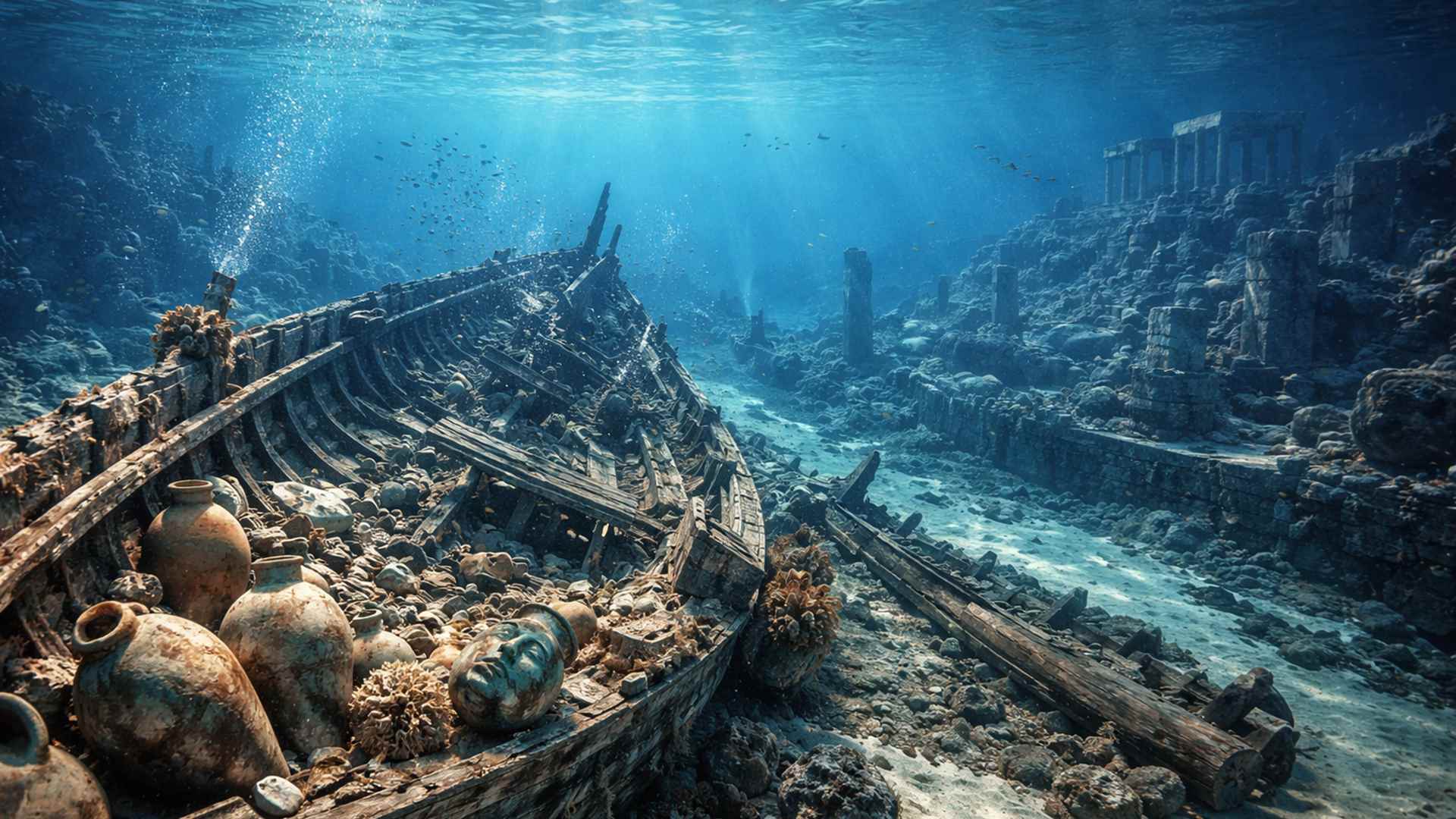

Discovery of a ship graveyard about 100 meters offshore of Ptolemaida, in Libya, reveals successive shipwrecks, preserved cargo, and new indications about the operation of the ancient Greek port submerged after centuries of earthquakes and advancement of the Mediterranean.
Maritime archaeologists have identified a 100-meter-long ship graveyard off the ancient port city of Ptolemaida, in Libya, a site with about 2,000 years of history. The discovery was made on the submerged coast of the Greek city and has become the main highlight of research resumed after a 13-year interruption caused by the civil war in the country.
According to researchers, the find is located in a shallow rock formation and contains remains of various vessels.
The collection indicates a sequence of shipwrecks of merchant ships that likely failed while trying to reach the coast through an area considered treacherous.
-
Sixth-grader in Miami wins Lemelson Young Inventor Prize for creating water-absorbing concrete using discarded oyster shells and charcoal.

-
Brazilian Researchers Develop Portable, Painless, Radiation-Free Breast Cancer Tracker Using Microwaves, Costing Around $200 and Potentially Replacing $240,000 Mammograms
-
Beer as a Vaccine? Scientist Develops Experimental Method with Live Yeasts, Tests Own Brew, and Publishes Results on Zenodo

-
Brazilian Researchers Develop ‘Rapha’ Device Using Natural Latex and LED Light to Heal Diabetic Foot Ulcers and Prevent 50,000 Annual Amputations


Over the centuries, earthquakes have caused the rise of the Mediterranean Sea level, ultimately submerging the ancient port of Ptolemaida. With the return of excavations in 2023, archaeologists from the University of Warsaw have resumed investigating the ruins of one of the largest cities of Ancient Greece in the Cyrenaica region.
Ship graveyard reveals interrupted route before the port
In the last two years, teams have located a series of structures and objects in the submerged surroundings of the city. Among the finds are ancient port infrastructure, columns, remnants of underwater roads, numerous discarded anchors, and probes used to explore the seabed in antiquity.
However, the ship graveyard has concentrated the most attention of researchers so far. The site extends for hundreds of meters on the seabed and records multiple failed attempts of vessels that never managed to dock in Ptolemaida.
The remains found at the site help reconstruct the commercial activity that existed in these waters. Fragments of cargo, amphorae, and other artifacts have begun to provide new clues about the goods transported to the ancient port city.
Recovered objects help detail ancient trade
Among the items carried by these ships were amphorae, including one that contained crystallized wine. Archaeologists also recovered a bronze weight, described as a Roman balance weight in the shape of a woman’s head and filled with lead.
The collected pieces are still under analysis, and researchers are awaiting the results of studies on this material. The objects are seen as an important source to enhance understanding of commercial activities and the circulation of goods in a still underexplored sector of the Greek empire.
Archaeologists stated that the city is still far from being fully known. “Practically the entire city still needs to be discovered,” the researchers said while commenting on the current stage of the investigations.
Discoveries on land expand the picture of Ptolemaida
The research has not been limited to the underwater environment and has also produced results on solid ground. A separate team identified a road leading to the Acropolis and possible watchtowers that were part of the city’s defensive walls.
Additionally, a Greek inscription from the Severan dynasty, dated to the 3rd century AD, was found. These elements reinforce the urban and military dimension of Ptolemaida and expand the body of evidence regarding the organization of the ancient city.
The ancient Ptolemaida was named in reference to Ptolemy III, described as its prosperous ruler. In antiquity, the city was an important defensive capital of Cyrenaica and remains a relevant archaeological site for understanding Greco-Roman urbanization in North Africa.
Research should continue for many years
According to the assessment published by Science in Poland, the former disaster zone for vessels arriving from the east has now transformed into a promising site for long-term underwater research in Ptolemaida. The same location that marked successive navigation failures is now treated as a valuable base for maritime archaeology.
Chief researcher Piotr Jaworski stated that the team is working in an area where monuments of great ancient art, mosaics, and paintings frequently appear and require extensive conservation work. Alongside archaeologists from the University of Warsaw, conservators are working to preserve and restore paintings and artifacts found at the site.
Jaworski also emphasized that the work is just beginning and is expected to last for many years. “We have many years of work ahead for future generations of archaeologists, so we want to start as many research topics as possible,” he told Science in Poland.