





 Portuguese
  English
  Spanish
  4 min of reading
  0 comments


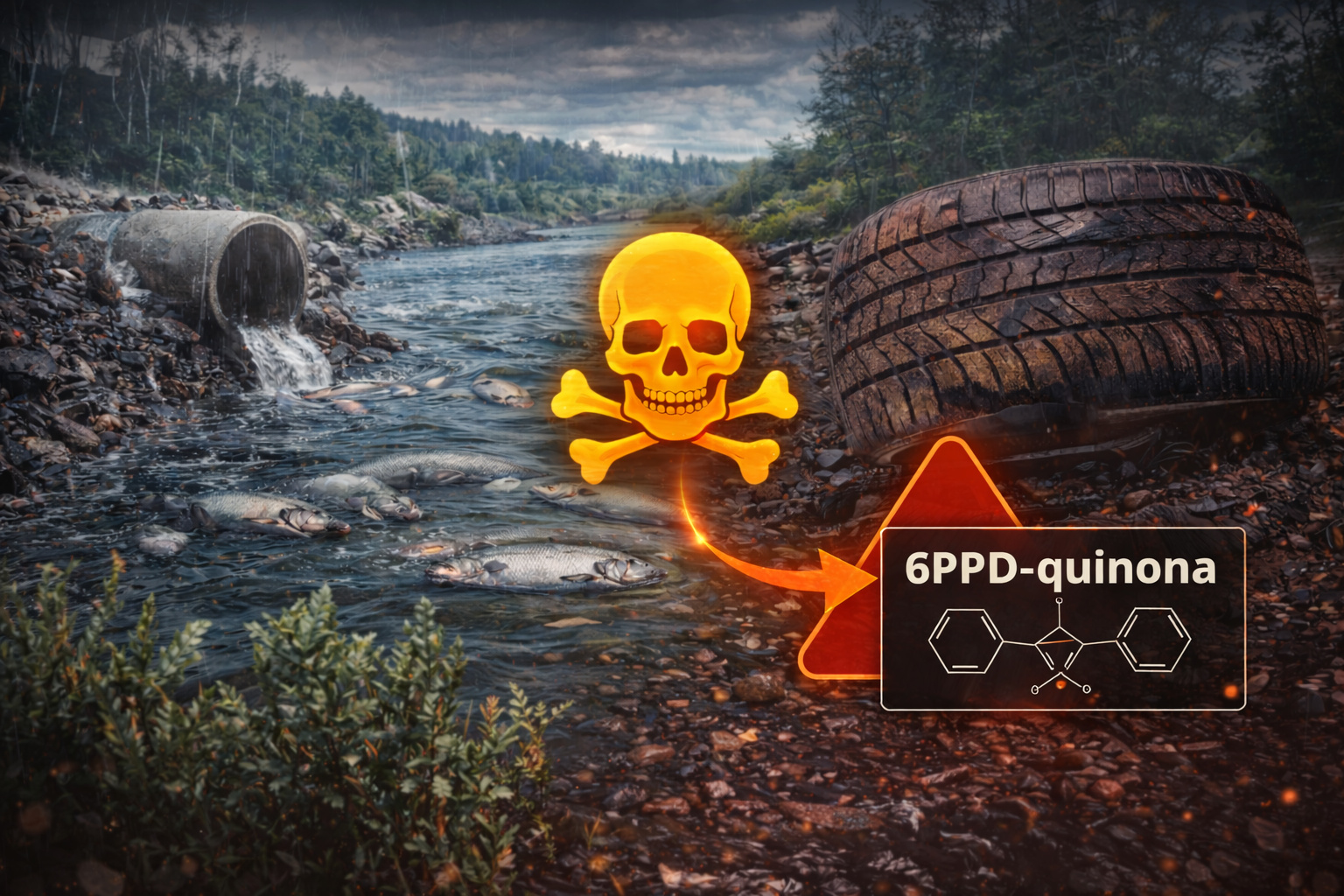
Scientific Studies Identified 6PPD-Quinone, Derived from Tire Wear, as Responsible for Massive Salmon Deaths in Urban U.S. Rivers After Intense Rains.
According to studies published in the scientific journal Science and in environmental journals such as Environmental Science & Technology Letters, researchers identified a chemical compound derived from tire wear as responsible for mass mortality events in salmon in urban rivers in the northwestern United States. The substance, known as 6PPD-quinone, is formed when the antioxidant 6PPD — a widely used additive in tire manufacturing — reacts with ozone in the atmosphere.
The phenomenon has been associated with the so-called “Urban Runoff Mortality Syndrome,” a condition observed for years in which salmon died within hours after heavy rains in urbanized areas, even before being able to spawn.
What is 6PPD and How Does it Turn into a Toxin
6PPD (N-(1,3-Dimethylbutyl)-N’-phenyl-p-phenylenediamine) is a chemical compound used in the tire industry to protect rubber from cracking caused by ozone and oxidation. It prolongs the lifespan of the tire and is considered essential for road safety.
-
Friends have been building a small “town” for 30 years to grow old together, with compact houses, a common area, nature surrounding it, and a collective life project designed for friendship, coexistence, and simplicity.

-
This small town in Germany created its own currency 24 years ago, today it circulates millions per year, is accepted in over 300 stores, and the German government allowed all of this to happen under one condition.

-
Curitiba is shrinking and is expected to lose 97,000 residents by 2050, while inland cities in Paraná such as Sarandi, Araucária, and Toledo are experiencing accelerated growth that is changing the entire state’s map.

-
Tourists were poisoned on Everest in a million-dollar fraud scheme involving helicopters that diverted over $19 million and shocked international authorities.



When tires wear down on asphalt, they release microparticles known as “tire wear particles.” These particles contain 6PPD. When reacting with the ozone present in the air, the compound converts to 6PPD-quinone, a highly toxic oxidized form to certain aquatic species. This chemical transformation occurs outside of the tire, already in the urban environment, even before reaching the rivers.
How the Toxin Reaches the Rivers
During rains, particles accumulated on streets and highways are carried away by stormwater runoff. In many cities, rainwater flows directly into streams and rivers without treatment.
Thus, 6PPD-quinone is transported from roadways to urban waterways. Research conducted by scientists from the US Geological Survey (USGS) and universities in the state of Washington detected concentrations of the compound in stormwater and rivers immediately after storms.
Direct Impact on Coho Salmon
Studies have shown that 6PPD-quinone is particularly lethal to coho salmon (Oncorhynchus kisutch). In laboratory experiments, very low concentrations of the compound were sufficient to cause disorientation, loss of balance, and death within a few hours.
In the field, observations indicated that 40% to 90% of adult salmon returning to spawn in urban rivers died within 24 hours of intense rain events.
This pattern has been repeatedly documented in rivers in the state of Washington, especially in the Puget Sound region.
Urban Runoff Mortality Syndrome
The phenomenon was named “Urban Runoff Mortality Syndrome” even before the identification of the responsible substance. For years, researchers observed that seemingly healthy salmon entered rivers but quickly died after storms.
The fish exhibited acute neurological symptoms, including loss of motor coordination and erratic swimming.

The identification of 6PPD-quinone as the causative agent was considered a milestone in environmental research, as it solved a persistent ecological mystery.
Affected Species and Variable Sensitivity
Although coho salmon are the most affected, research indicates that other species of salmon and trout may also be sensitive to 6PPD-quinone, albeit at different levels of toxicity.
Studies continue to evaluate the effects on other aquatic species and potential cumulative impacts. Toxicity appears to vary among species, but coho have demonstrated extreme sensitivity to the compound.
Global Dimension of the Problem
Chemical analyses have detected 6PPD-quinone in urban water samples in different countries, including Canada, Germany, and China.
The presence of the compound in urban environments worldwide suggests that the problem is not restricted to the United States.

The global production of tires is estimated to be billions of units per year, and natural wear on roadways generates tons of microscopic particles.
Regulatory Challenge
6PPD is widely used by the tire industry due to its effectiveness in preventing structural failures. Replacing the compound requires alternatives that maintain vehicle safety standards.
Environmental agencies in the U.S. have begun reviews and studies to assess ecological risks associated with the compound. Indigenous tribes in the Pacific Northwest have also pushed for regulatory actions due to the impact on culturally and economically important salmon populations. The challenge involves balancing automotive safety with environmental protection.
Research and Possible Solutions
Among the solutions under study are:
- Stormwater filtration systems
- Green infrastructure for runoff retention
- Development of chemical alternatives to 6PPD
- Modifications in urban paving
Researchers are evaluating whether filter materials can capture particles before they reach waterways.
Ecological Importance of Salmon
Salmon play a crucial role in the ecosystems of the Pacific Northwest. They transport nutrients from the ocean to rivers and forests when they return to spawn.
The decline in populations may impact predators such as bears, birds, and other fish, as well as human communities that depend on fishing.
What Still Needs to Be Investigated
Although the link between 6PPD-quinone and salmon mortality is well documented, studies continue to determine:
- Chronic effects from prolonged exposures
- Impact on other aquatic species
- Safe concentration levels
- Viable chemical alternatives
Research is ongoing at universities and environmental agencies.

The identification of 6PPD-quinone as a toxic agent derived from tire wear brings a new dimension to the debate on invisible urban pollution. The substance, formed from an essential tire safety additive, revealed unexpected impacts on aquatic ecosystems.
With reports of up to 90% mortality of coho salmon within 24 hours after intense rains, the phenomenon highlighted the direct link between urban traffic and environmental health.
The case demonstrates how everyday processes — such as the natural wear of tires — can lead to significant ecological consequences when combined with urban infrastructure and stormwater runoff.










-

Uma pessoa reagiu a isso.