





 Portuguese
  English
  Spanish
  6 min of reading
  0 comments


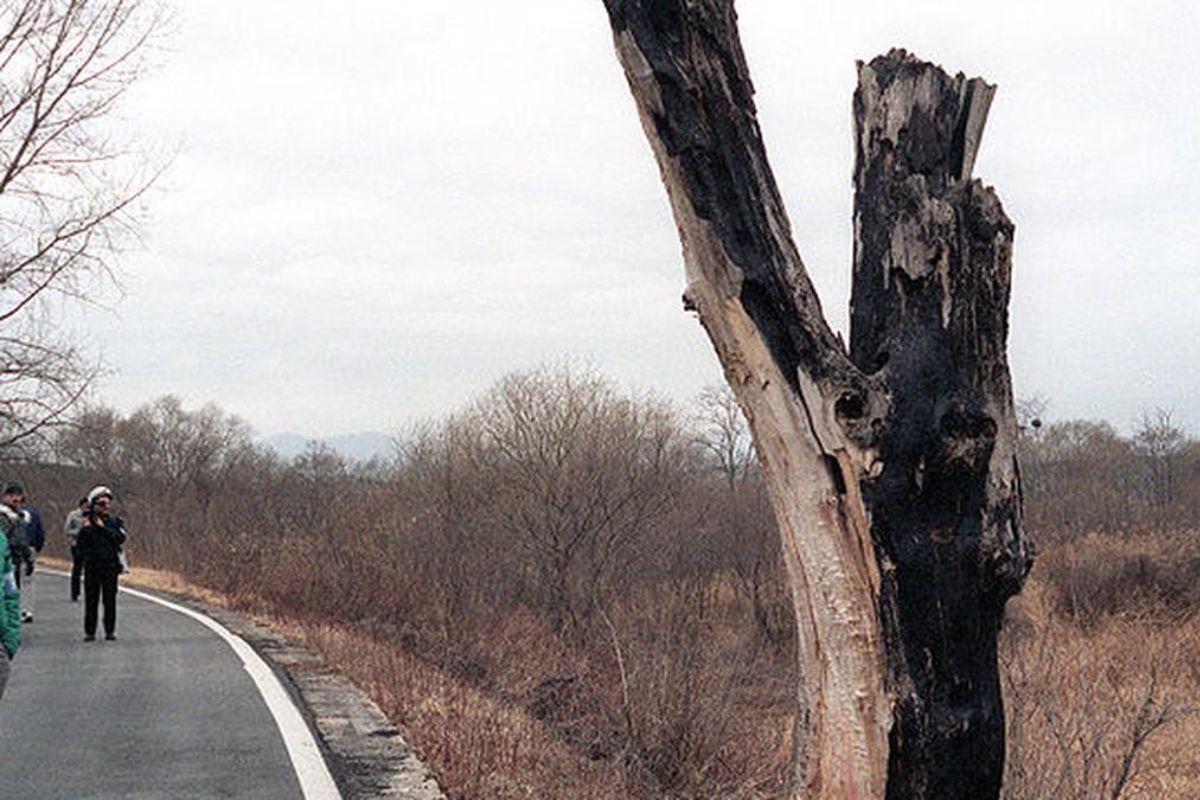
No Tourist Saw, But a Single Tree in the Tensiest Gorge in the World Almost Brought the United States and North Korea to a Direct Confrontation in the Middle of the Cold War, in the Heart of the DMZ Between the Two Koreas.
In August 1976, after two American soldiers were killed while trying to trim this tree in the Joint Security Area, the U.S. and South Korea responded with an operation as disproportionate as it was calculated: 813 men, fighters, bombers, attack helicopters, and a carrier battle group mobilized to ensure that the tree was cut down without a single shot being fired. It was a show of force, but also a clear political message to Pyongyang.
A Tree in the Tensiest Gorge on the Planet

At the end of the Korean War, in 1953, the armistice created the Demilitarized Zone, a strip about 4 km wide cutting across the peninsula from east to west.
In the middle of this strip lies the Joint Security Area, a village where soldiers from North Korea, South Korea, and the U.S. operate side by side, separated by only a few meters and an imaginary line.
-
He started running at 66 years old, broke records at 82, and is now a subject of study for having a metabolic age comparable to that of a 20-year-old, in a case that is intriguing scientists and inspiring the world.

-
Oldest tree on the planet reappears after 130 years of searches: Wattieza, 385 million years old, was 10 meters tall and had no leaves or seeds; Gilboa fossils in New York solved the mystery in 2007.

-
A 48-square-meter house assembled in hours with 4,000 bricks made of recycled plastic that does not absorb moisture, has natural thermal insulation, and costs less than 90,000 reais in a complete kit.

-
Luciano Hang revealed that Havan’s air fleet has already accumulated more than 20,000 landings, 10,000 flight hours, and 6 million kilometers traveled, and he says that without the planes, the company would never have grown so quickly.


There, every detail matters. The poplar tree that became the protagonist of this story was located at a sensitive point: it obstructed the line of sight between a UN observation post and another strategic point within the JSA.
In a place where every movement is monitored, having a tree blocking the field of vision was seen as a security risk.
The tension was so high that there were strict rules for everything: which weapons could enter, who could carry them, and under what circumstances.
For a long time, each side could only have one weapon there. The result was that, without being able to be “full of rifles,” the American strategy included even the height of the soldiers: the policy was to send men at least 6 feet tall, because if you can’t show weapons, show physical presence.
In this context, tampering with the tree was not just a simple gardening task: it was a highly symbolic gesture right in the heart of an explosive chessboard.
The Brutal Axe Incident

Before the major operation, there was a much more modest attempt to trim the tree. In August 1976, a team of 10 American soldiers and 5 South Koreans was tasked with trimming the branches of the poplar that were blocking the view. It was supposed to be a routine job, with few men and simple tools.
But the tree was also important to the North Korean side. According to their narrative, the North Korean leader, Kim Il-sung, either planted or blessed that tree, which made it a political symbol.
When the team started trimming, North Korean soldiers appeared to observe. Before long, the group increased.
After a few minutes of escalating tension, about 20 North Korean soldiers, armed with iron bars and clubs, surrounded the group.
The lieutenant leading the North Koreans reportedly gave the direct order to attack. The chaos was quick and brutal: two American officers, leaders of the team, were killed by blows from their own pruning tools, and several others were severely injured.
The footage captured by cameras showed that it was not a symmetrical confrontation but an attack on a group with work tools, not combat weapons.
Still, Pyongyang attempted to frame the episode as an aggression by the Americans. In Washington, the episode was reported as the “Axe Murder Incident.”
The world might not have known, but that tree now carried blood, symbolism, and geopolitical risk.
Planning Operation Paul Bunyan
In light of the death of the two officers, the White House needed to respond. President Gerald Ford faced two opposing pressures: showing strength to avoid appearing weak in front of North Korea and, at the same time, avoiding any step that might seem like the beginning of a war in the midst of the Cold War.
Figures like Henry Kissinger advocated for something that “would make bleed,” but Ford pulled the brakes: it was necessary to punish the act, reinforce the American position in the DMZ, and at the same time send a calculated message to Pyongyang and Moscow.
The solution was as symbolic as the tree itself: Operation Paul Bunyan, named after the giant lumberjack from North American folklore.
The central mission was simple on paper: return to the JSA, cut the tree down to the ground, and make it clear that the U.S. would not accept being prevented from controlling its own security.
The key was how this would be done: with overwhelming force, but without firing the first shot.
813 Men to Cut Down a Tree
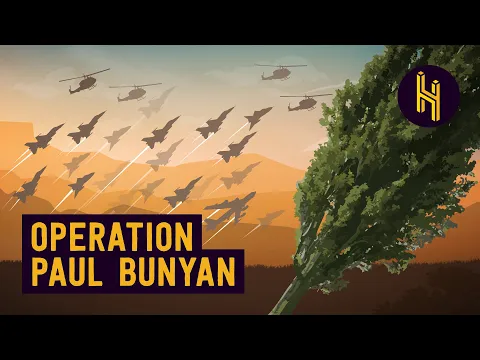

On the morning of August 21, 1976, the DMZ witnessed one of the most impressive displays of force in peacetime. To ensure that the tree fell without repeating the previous massacre, the U.S. and South Korea mobilized:
Combat engineers tasked with operating chainsaws and cutting the poplar down to just a stump.
South Korean special forces, equipped with pistols and axe handles, protecting the immediate perimeter.
AH-1 Cobra attack helicopters, hovering on alert over the area.
Strategic B-52 bombers on a support route, symbolizing that any escalation would meet heavy response.
American F-111 and F-4 Phantom II fighters, along with South Korean planes, ready to intervene if there was an attack.
Trucks carrying soldiers, some with unreported heavy weaponry and Claymore mines installed and camouflaged under sandbags, should it become necessary to turn the area into a deadly trap.
In total, 813 men were positioned directly or indirectly around the mission. It’s an absurd scale if you think that the practical objective was “just” to cut down a tree, but it’s precisely this contrast that demonstrates the true function of the operation: it was not just about wood, it was about deterrence.
The choice of tools was also calculated. Instead of bringing heavy tree-cutting equipment, the team used portable chainsaws, for a simple reason: if something went wrong, it would be possible to drop everything and run to the trucks in seconds.
When the engineers began to work, North Korean troops emerged again, this time in greater numbers, with mounted machine guns.
The atmosphere became extremely tense. It was at that moment that the command signaled, and helicopters and aircraft appeared on the horizon, making clear the extent of American backup.
In the face of that show of strength, the North Korean soldiers retreated, watching from a distance. In about 40 minutes, the tree that caused deaths and a diplomatic crisis had been reduced to a stump of just over two meters. No shots were fired. No one was hurt. But the message had been sent.
The Message Sent to Pyongyang
The outcome of Operation Paul Bunyan was a quiet relief for those closely watching the board. There was no military escalation.
On the contrary: Kim Il-sung sent a rare statement of regret over the previous events, something quite uncommon in North Korean official rhetoric.
In the JSA, the rules also changed. The demarcation line was adjusted to reduce direct physical contact between soldiers from both sides, minimizing the chance of new face-to-face confrontations.
The stump of the tree was kept for a time as a reminder and later replaced by a memorial honoring the two officers killed in the axe incident.
The Crisis Left Some Clear Lessons
In zones of extreme tension, a simple tree can become the centerpiece of a global power game.
Showing force does not necessarily mean firing the first shot: sometimes, the military choreography is the message.
Miscalculations, impulses, and local decisions can drag major powers into situations that no one really wants.
Today, when looking at the DMZ and the history of the Cold War, Operation Paul Bunyan stands out as one of those moments when the world could have taken a much darker path, and did not.
In the end, it all started with the decision to trim a tree in a place where nothing is simple.
And you, do you think the U.S. response to that tree was necessary to prevent something worse or did it go too far and almost push the world into an even greater conflict?







-

-

2 pessoas reagiram a isso.