





 Portuguese
  English
  Spanish
  4 min of reading
  1 comment


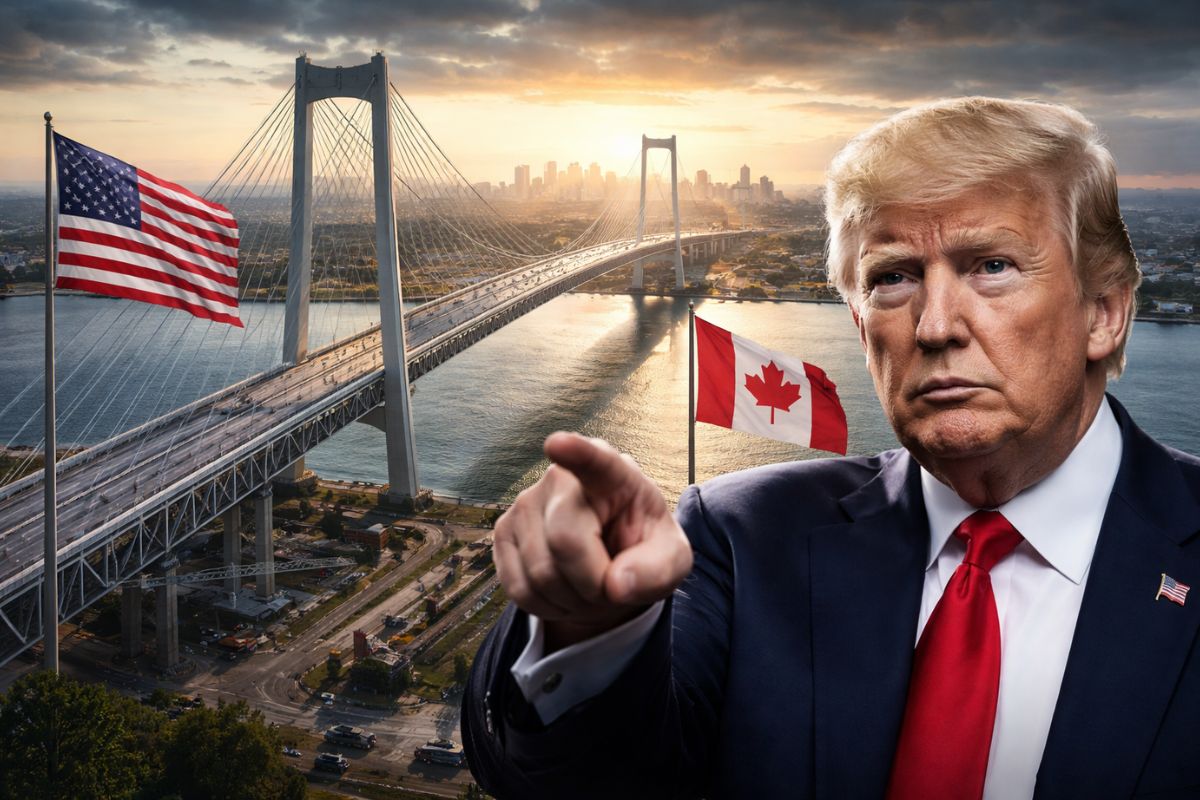

The Gordie Howe International Bridge, valued at US$ 4.7 billion and funded by Canada, was designed to alleviate the burden on the Ambassador Bridge and the Detroit–Windsor Tunnel. Now, the planned opening in 2026 is at the center of a crisis, after Donald Trump demanded at least 50% of the asset.
The bridge is not just concrete and cables. It is critical infrastructure in a corridor where trade and logistics concentrate, and any delay increases costs, regulatory uncertainty, and political disputes. When a completed project becomes a tool of pressure, the risk shifts from engineering to diplomacy.
The threat, made on Monday (9), pits a project built under a previous agreement against the aggressive stance of the U.S. government in Trump’s second term. The issue is not just “to open or not to open,” but who commands, who operates, and who captures the benefits of the flow.
What Is the Bridge and Why Has It Become the Target of Dispute

The Gordie Howe International Bridge began construction in 2018, after an agreement was signed during the administration of then-Governor of Michigan Rick Snyder.
-
The government requests the Federal Revenue Service for a new system to automate the income tax declaration, reducing errors, time, and bureaucracy for millions of Brazilians.

-
Pix in installments, international Pix, and contactless payment without internet: the Central Bank revealed the new features coming to the tool that is already used by almost every adult in Brazil.

-
Mercado Livre has just started selling medications with delivery in up to three hours to your door, and this move could completely change the way Brazilians buy medicines on a daily basis.

-
In Dubai, rising tensions from the war in the Middle East are causing super-rich individuals to leave the Gulf and direct their fortunes to a new financial refuge in Asia.


It connects Detroit, Michigan, to the Canadian city of Windsor and was designed to reduce the bottleneck of the old Ambassador Bridge and the Detroit–Windsor Tunnel, routes that carry a significant portion of the trade flow between the two countries.
The project was valued at roughly US$ 4.7 billion and, according to available information, was fully funded by the Canadian government.
The original logic was clear: to relieve pressure on saturated crossings and offer a high-quality alternative for cargo and passengers, with an inauguration scheduled for 2026.
What Trump Said and Why the Demand Weighs on the Scenario
Donald Trump stated that he could block the opening of the bridge and conditioned its opening on a change of ownership: the United States should hold at least half of the structure.
The justification he presented was the idea that the U.S. “will receive nothing” with the new bridge, in addition to criticism that Canada did not use American steel in the construction.
The sensitive point is that the demand for “half of the asset” breaks the logic of a project funded by Canada and supported by a previous agreement.
When the dispute shifts from being technical to becoming property-related, the debate migrates to sovereignty, contracts, and precedents, with effects that extend beyond a single bridge.
Where the Diplomatic Crisis Enters and How This Connects to Trade
The threat arises amid the cooling of relations between Washington and Ottawa during Trump’s second term.
The trade agreement between the United States, Mexico, and Canada, the USMCA, is under review this year, and the American president has adopted a more aggressive stance, with threats of new tariffs against Canadian products.
Tension increased after Canadian Prime Minister Mark Carney’s visit to China, where he signed a preliminary trade agreement with Beijing. Trump responded by raising the stakes, threatening tariffs of up to 100% and calling into question the historical relationship between the two countries.
A bridge in this context ceases to be a “mobility project” and becomes a piece on a commercial pressure board.
The Immediate Economic Impact That Concerns Michigan and the Logistics Corridor
The potential non-inauguration has provoked a reaction in Michigan.
Democratic Senator Elissa Slotkin classified the project as a “huge benefit” for the state’s economy and criticized the threat to block the opening.
She mentioned a logistical effect: it would be possible to transport cargo from Montreal to Miami without stopping at a single traffic light, and threatening the bridge would be a “shot in the foot.”
Even with Canadian funding, the operation was designed to function under a joint management model between Canadian authorities and the American state.
In practice, this means that the bridge depends on binational coordination to turn real flow, and any political interference at the final moment pushes companies to more expensive and slower routes.
What Is Still Undefined: Legal Power, Agreements, and the Risk of Paralysis
So far, it is unclear how Trump could legally prevent the opening, or if the White House has formal tools to block a project that has already been completed and backed by international agreements.
There has also been, as reported, no official stance detailing the threat from the White House or the Canadian embassy in Washington.
This uncertainty is, in itself, a cost.
When the rules of the game are not explicit, the market prices in risk, and the risk here is not of a project being delayed due to failure, but of the inauguration becoming a bargaining chip between governments.
The Gordie Howe International Bridge was planned to unlock a critical corridor between Detroit and Windsor, with an investment of US$ 4.7 billion and an inauguration scheduled for 2026.
Now, the bridge has entered the center of a dispute over ownership and influence, as the U.S. and Canada navigate a phase of tariff tension and USMCA revision. If infrastructure becomes leverage, the real impact shows up in freight, time, and trade predictability.
For you, what is more serious in this case: blocking a completed bridge due to political dispute, demanding half of the ownership even with Canadian funding, or using a bridge as a message in a trade war? If it were a binational project in Brazil, would you find it acceptable?









Uma c…. atrás da outra