





 Portuguese
  English
  Spanish
  6 min of reading
  2 comments


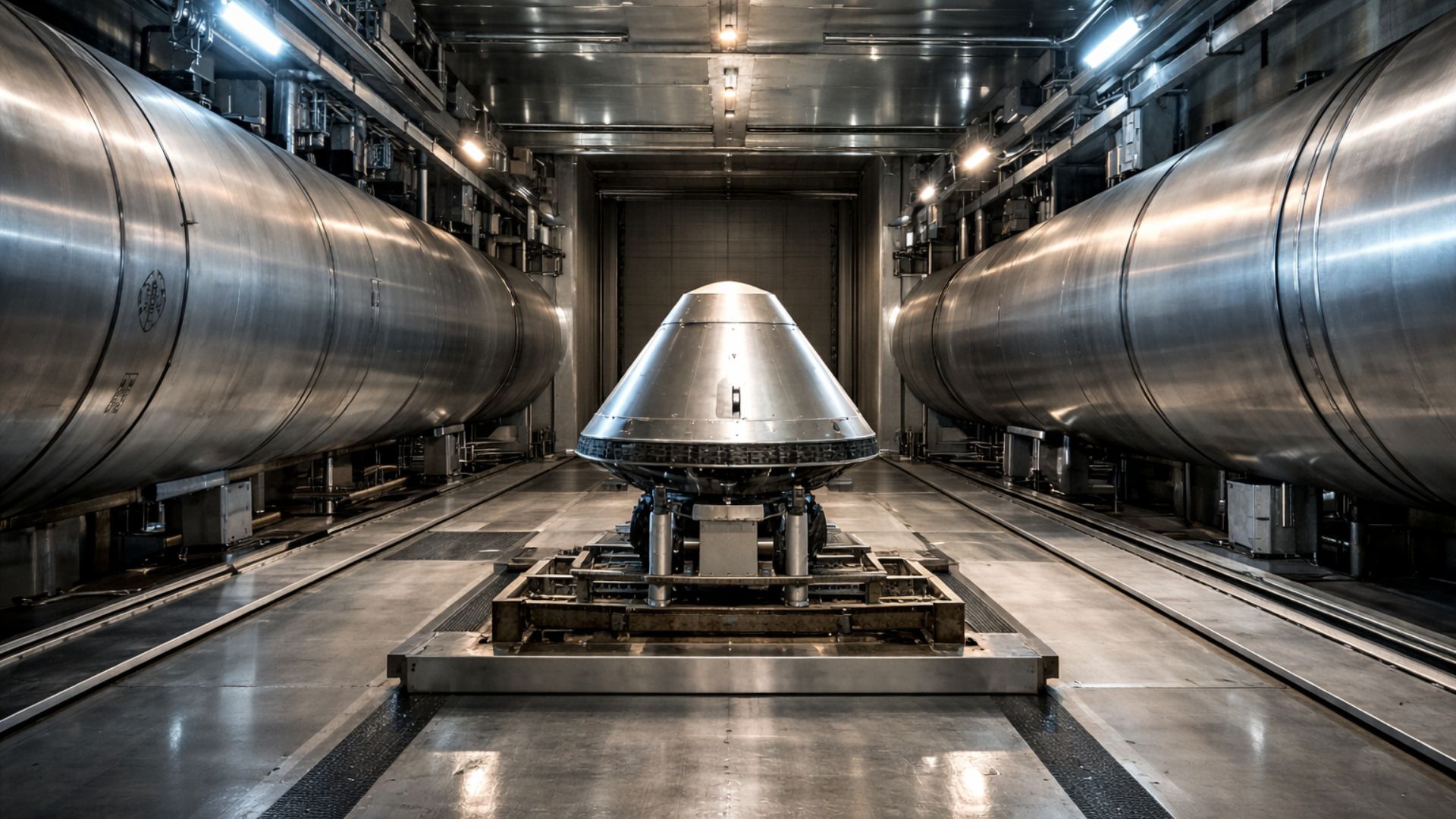


Ultrashort Pulses, Hypersonic Speeds, and Extreme Heat Turn the T3 Into One of the Most Impressive Facilities in Brazil to Reproduce Atmospheric Reentry Conditions in the Lab, with High-Speed Records and Applied Research in Aerothermodynamics, Materials, and Shock Phenomena of Global Interest.
An air pulse that lasts less than a blink of an eye but reaches speeds capable of reproducing extreme flight conditions is the principle behind the T3, the hypersonic wind tunnel installed at the Institute of Advanced Studies (IEAv), a unit linked to the Aerospace Technology Command of the Brazilian Air Force, in São José dos Campos (SP).
Instead of maintaining a continuous flow, the facility fires ultra-high-speed bursts that can reach about 25 thousand kilometers per hour, equivalent to Mach 25, a level associated with situations where aerodynamics and air heating become central challenges for satellites, capsules, and vehicles crossing the atmosphere in extreme regimes.
What Does Hypersonic Mean and Why Mach 25 Draws Attention
The scale of what is attempted to be reproduced within this laboratory starts with the very definition of hypersonic.
-
Scientists have captured something never seen in space: newly born stars are creating gigantic rings of light a thousand times larger than the distance between the Earth and the Sun, and this changes everything we knew about stellar birth.

-
Geologists find traces of a continent that disappeared 155 million years ago after separating from Australia and reveal that it did not sink, but broke into fragments scattered across Southeast Asia.
-
Samsung launches cordless vertical vacuum cleaner with up to 400W of suction and relies on AI to automatically recognize corners, carpets, and different surfaces.

-
The lost continent beneath Europe: separated from North Africa about 240 million years ago, comparable in size to Greenland, Greater Adria was crushed over 40 million years and left geological marks from the Alps to the Balkans.


According to explanations gathered in a report by the magazine Pesquisa FAPESP, the movement of air is considered hypersonic when it represents at least five times the speed of sound, estimated at about 1,155 km/h at sea level.
By approaching the conditions of a flow at Mach 25, the T3 enters a territory where shock waves, air compression, and thermal effects begin to dominate the behavior of the flow around a body, as occurs in atmospheric reentries and in studies of extreme performance aircraft.
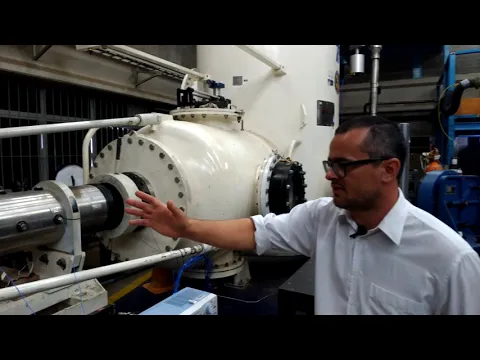

How the Hypersonic Tunnel T3 Works in Practice
The operation of the tunnel differs from facilities used to test commercial airplanes, automobiles, or civil structures.
In the T3, the air stream is not maintained for long periods, but is released in pulses.
Pesquisa FAPESP reports that the test can last from 100 microseconds to 10 milliseconds, a range that requires capturing physical phenomena in a very brief window, yet sufficient to observe, measure, and compare the flow behavior over prototypes and scaled models.
This pulsed nature reflects a technical commitment.
To achieve very high speeds and thermal conditions, even for a short time, in order to make observable processes that do not appear in slower regimes.
To generate the pulse, the T3 uses a storage system that alternates high and low pressure mechanisms and releases air over a prototype installed in the test chamber.
The report describes that, when interacting with the surface of the model, the hypersonic flow can form a layer associated with shock waves and air heating phenomena, including the production of plasma around the object.
The same source reports that the involved temperature can reach around 2,000°C during the process, a figure that helps illustrate why reentry and hypersonic are areas where materials, geometry, and thermal protection need to be studied with care.
High-Speed Filming and Observing Shock Waves
The instrumentation used to observe what happens during the pulse also draws attention.
Pesquisa FAPESP mentions the use of a high-speed camera capable of recording up to 2 million frames per second, a resource that allows visualization of the moment when the layer around the model forms and changes under the action of the flow.
In hypersonic environments, phenomena such as shock waves emerge, stabilize, and reorganize rapidly, and a slow capture would be unable to record useful details for analysis.

The combination of pulse generation and high-speed recording is part of what transforms the tunnel into an applied research tool, where images and measurements can feed technical interpretations about the flow behavior.
Capsules, Microsatellites, and Tests Linked to Sara
The T3 is not limited to simulating abstract conditions of speed.
Pesquisa FAPESP reports that, within the analysis chamber of the tunnel, replicas of capsules linked to the microsatellite Sara, an acronym for atmospheric reentry satellite, are installed, a project cited as a reusable platform studied by the Brazilian Space Agency.
The reference is important because reentry is one of the most critical phases of a space mission.
It is when high speeds and intense heating act on the vehicle’s surface.
By observing how air behaves around a capsule and how the shock wave forms, researchers seek to better understand flight conditions that, in the real world, are difficult to instrument comprehensively.
Scramjet, Hypersonic, and International Examples Cited in the Research
Another axis associated with the tunnel involves studies of propulsion in extreme regimes.
Pesquisa FAPESP contextualizes that technological research at high speed includes alternatives such as the scramjet, a type of combustion where air enters and is compressed by the vehicle’s geometry and speed, without relying on moving parts like traditional turbine blades.
In the same report, the example of the X-43, a prototype from NASA, which flew for about 10 seconds in 2004 at Mach 10, around 11,500 km/h, is highlighted as a milestone in experiments that help illustrate why interest in hypersonics has grown.
By mentioning this type of reference, the text points to the logic that underpins facilities like the T3.
Create a controlled environment on land to observe processes that would be costly, risky, or technically limited if they depended solely on flight tests.
The History of the T3 at IEAv and Associated Projects
The existence of the T3 is also linked to a local research trajectory.
The report from Pesquisa FAPESP describes that the tunnel was named T3 and cites researchers and planners associated with the Division of Aerothermodynamics and Hypersonics at IEAv, in addition to mentioning smaller previous hypersonic tunnels as part of the laboratory’s history.
In the same context, the article notes the reference to the demonstrator 14-X, cited as a model developed in Brazil and related to studies of supersonic combustion, with approximate dimensions of 1.5 meters in length and 80 centimeters in width.
The presence of this type of information reinforces that, beyond the laboratory itself, the T3 is part of an agenda of experiments and prototypes that depend on measurements and observations under high-speed conditions.
Why a So Short Pulse Generates Valuable Data
Although the pulse lasts fractions of a second, what is extracted from it is not negligible.
In hypersonics, critical processes such as shock wave formation, air heating, and flow interaction with the surface happen rapidly, and a short window can be sufficient to capture visual signatures and data from sensors that support engineering analyses.
Pesquisa FAPESP relates this type of experiment to reentry situations and research on aircraft much faster than the speed of sound, connecting the tunnel to a frontier where aerodynamics, energy, and materials become a single technical problem.
Inauguration Milestone and Support for Research
The temporal milestone of the installation appears in the necessary context to understand its implementation, without altering the perennial character of the theme.
Pesquisa FAPESP records that the tunnel was inaugurated in December 2006 and informs that associated projects and research lines received support from the foundation itself.
In the magazine’s PDF, the highlight “Preliminary Experimental Investigation into Supersonic Combustion” appears as an example of a supported project, with coordination indicated for IEAv and detailed investment figures, illustrating that building experimental capacity in hypersonics involves resources, infrastructure, and a research design aimed at measuring phenomena difficult to observe outside the laboratory.
In the reader’s daily life, it is rare to find a Brazilian machine capable of compressing, accelerating, and heating air to the point of reproducing, in a controlled environment, the effects that surround capsules and vehicles when they cross the atmosphere at extreme speeds.
By turning milliseconds — or even microseconds — into measurable information, the T3 poses as an infrastructure piece that sparks global curiosity precisely for bringing into a laboratory phenomena that, in popular imagination, belong to space and the limits of the possible.
If a pulse of air lasting a few microseconds already allows observing shock waves and temperatures in the order of thousands of degrees, what other “impossible conditions” can be reproduced in the laboratory to test extreme flight technologies?






Na prática o seu uso seria para que,não entendi bem?!…seria usado para avanços no programa espacial brasileiro com veiculos fazendo a reentrada?!…desculpe não entender,mas fiquei curioso.
Afinal…