





 Portuguese
  English
  Spanish
  3 min of reading
  0 comments


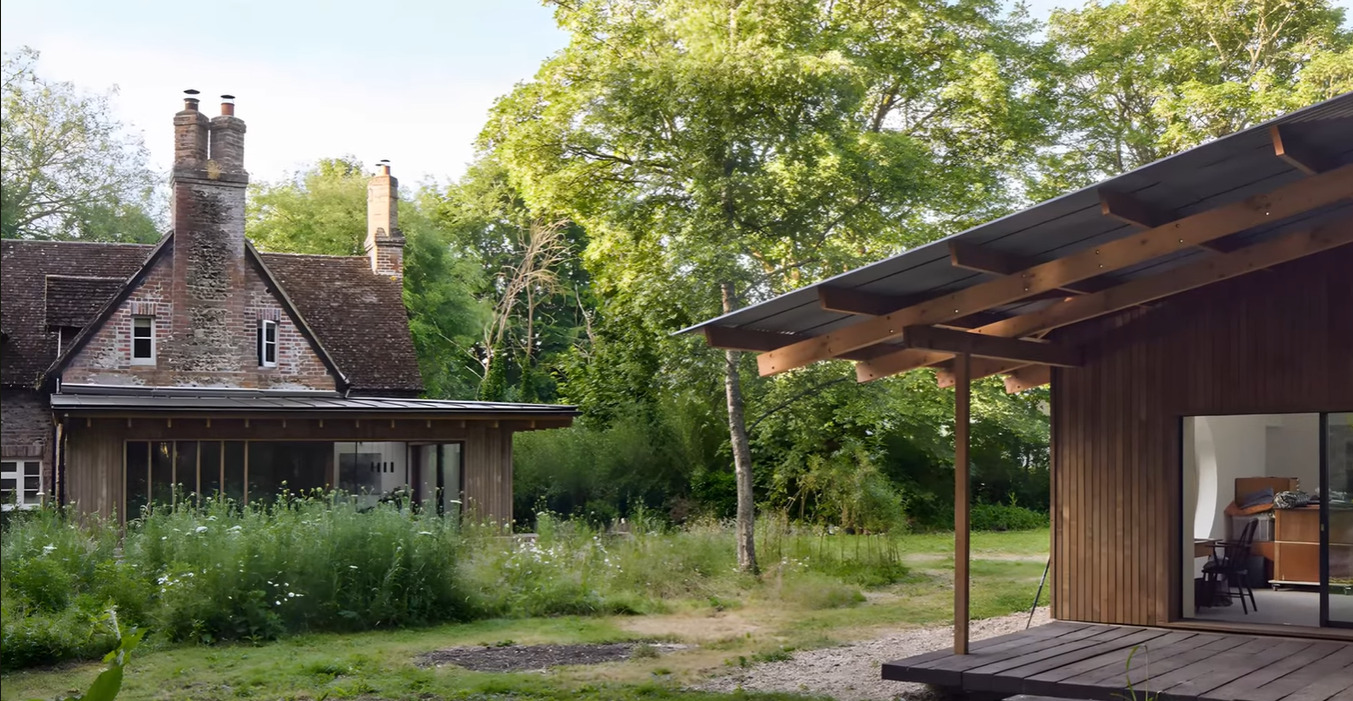
17th Century Mill on the Banks of the River Test in Hampshire’s Protected Area Has Been Rehabiliated for Residential and Professional Use, Preserving the Original Structure, Milling Mechanism, and Architectural Dialogue
Water mills shaped human history by enabling the grinding of grains for flour production, the basis of bread. With industrialization, many were abandoned, but some survived and today have new residential and hotel functions.
Historic Mill in a Protected Area
Located on the banks of the River Test in Hampshire County, southern England, the complex integrates a Site of Special Scientific Interest and includes a 17th-century mill registered as grade II.
These legal protections required a sensitive design capable of preserving the historic building and the surrounding landscape without compromising the new residential and professional functions intended by the owners.
-
He started running at 66 years old, broke records at 82, and is now a subject of study for having a metabolic age comparable to that of a 20-year-old, in a case that is intriguing scientists and inspiring the world.

-
Oldest tree on the planet reappears after 130 years of searches: Wattieza, 385 million years old, was 10 meters tall and had no leaves or seeds; Gilboa fossils in New York solved the mystery in 2007.

-
A 48-square-meter house assembled in hours with 4,000 bricks made of recycled plastic that does not absorb moisture, has natural thermal insulation, and costs less than 90,000 reais in a complete kit.

-
Luciano Hang revealed that Havan’s air fleet has already accumulated more than 20,000 landings, 10,000 flight hours, and 6 million kilometers traveled, and he says that without the planes, the company would never have grown so quickly.


The London studio Cooke Fawcett was responsible for the rehabilitation, developing a proposal that respected the heritage and environmental restrictions imposed on the architectural ensemble.

A Project Designed for Living and Working
The house was designed for a visual designer who sought to live and work outside of London, balancing professional and family life with direct contact with nature.
The intervention occurred in three distinct phases: internal reorganization of the historic house, expansion of living areas, and creation of an independent studio in an adjacent annex.
According to the studio, the reorganization faced simple yet essential challenges, such as installing bathrooms on the upper floor while preserving spacious rooms for clients, two children, and guests.
Opening to the Natural Landscape
A central goal was to open the old brick house to the garden and the landscape, visually integrating the interior and exterior continuously.
To achieve this, the extension was positioned in one of the corners, incorporating glass-walled living and dining rooms, with a wooden structure and fan-shaped oak panels.
The solution allowed for the expansion of social spaces without interfering with the original volume, maintaining the dialogue between contemporary architecture and the preserved historic building.
Original Mechanism Preserved
The mill retains its original milling mechanism intact, which required the project to strictly respect the location and integrity of this historic structure.
This condition posed a functional problem, as the space could not be converted into a workshop, one of the initial needs of the residential project.
The alternative was to build a workshop and an independent studio in front of the house, ensuring professional use without interfering with the existing heritage.
The result combines historical preservation, contemporary adaptation, and everyday use, demonstrating how ancient structures can gain new life without losing identity or enduring cultural value.
With information from Idealista.








-

Uma pessoa reagiu a isso.