





 Portuguese
  English
  Spanish
  4 min of reading
  2 comments


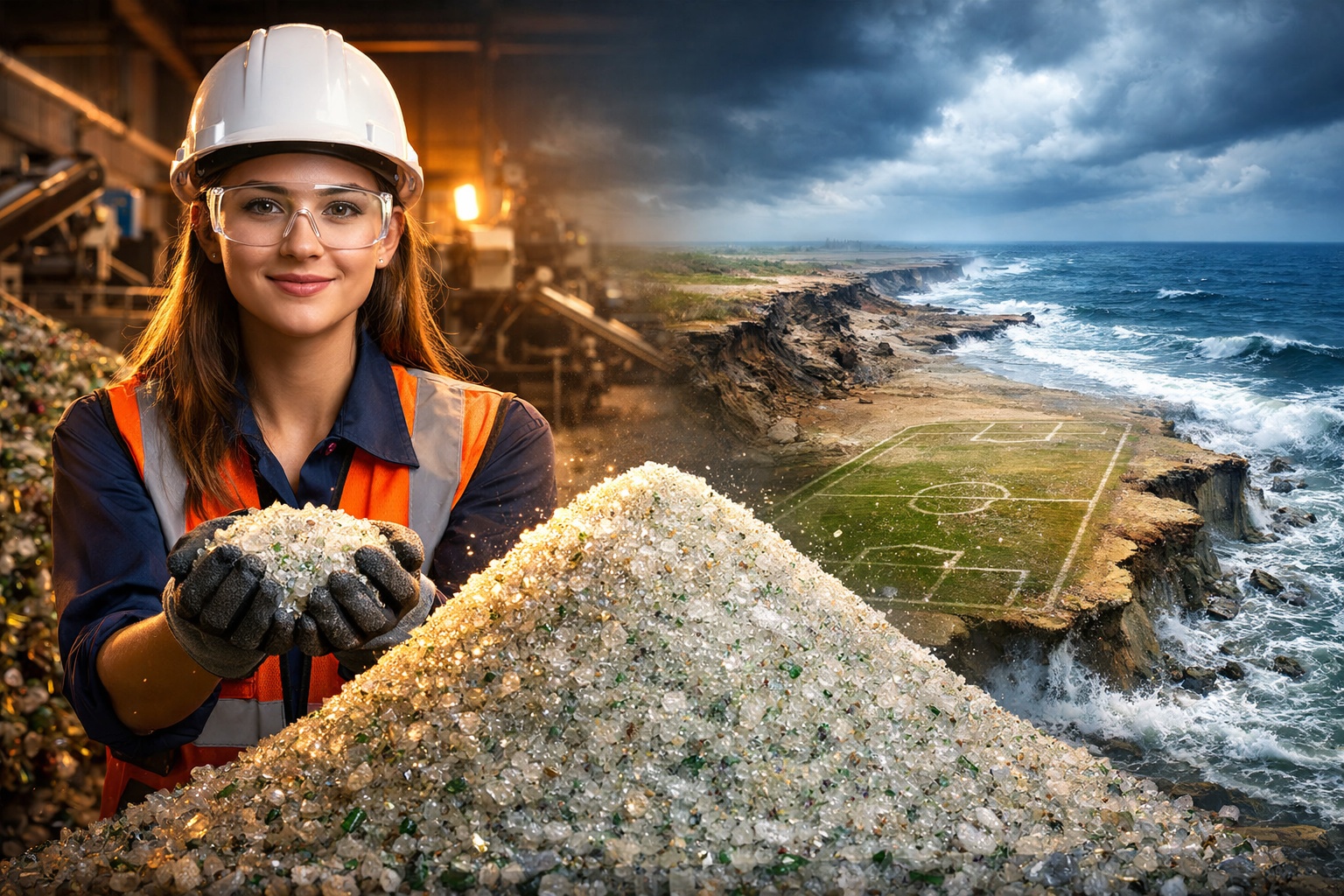


Glass Recycling Becomes a Solution Against Coastal Erosion in Louisiana: How Glass Half Full Transforms Discarded Bottles into Sand to Restore the Coastline
Glass recycling in Louisiana practically did not exist until 2020. While millions of bottles were sent to landfills, the state imported sand from outside to try to combat coastal erosion that has been advancing on the coastline since the 1930s. It was in this structural void that Glass Half Full was born, a startup created by Franziska Trautmann, a chemical engineering student at Tulane University, who decided to transform discarded bottles into recycled sand for coastal restoration projects.
The idea arose almost casually — during an ordinary night, in front of a wine bottle that would inevitably end up in the trash. New Orleans did not have the infrastructure to recycle glass. The entire Louisiana practically depended on one facility in Texas, economically unviable for local volumes.
Trautmann researched how to recycle glass. She discovered that crushed glass is essentially silica, the same basic component of natural sand. And she realized the paradox: the state was losing coastline due to lack of sediment while burying tons of “potential sediment” daily.
-
Motorola launched the Signature with a gold seal from DxOMark, tying with the iPhone 17 Pro in camera performance, Snapdragon 8 Gen 5 that surpassed 3 million in benchmarks, and a zoom that impresses even at night.

-
Satellites reveal beneath the Sahara a giant river buried for thousands of kilometers: study shows that the largest hot desert on the planet was once traversed by a river system comparable to the largest on Earth.

-
Scientists have captured something never seen in space: newly born stars are creating gigantic rings of light a thousand times larger than the distance between the Earth and the Sun, and this changes everything we knew about stellar birth.

-
Geologists find traces of a continent that disappeared 155 million years ago after separating from Australia and reveal that it did not sink, but broke into fragments scattered across Southeast Asia.

Why Glass Recycling Failed in Louisiana
The problem was not lack of environmental awareness. It was infrastructure. Glass does not decompose. A discarded bottle can remain intact for hundreds of thousands of years.
In New Orleans, even when the material was sorted for recycling, it often ended up in the regular landfill because there was no local processing system.
This generated two structural costs:
- Payment for landfill disposal (by weight).
- Purchase of imported sand for coastal restoration.
Louisiana was facing one of the largest coastal erosion crises in the United States. Since the 1930s, the state has lost extensive areas of swamps and wetlands due to the disruption of the natural sediment flow from the Mississippi River, caused by levees and navigation channels.
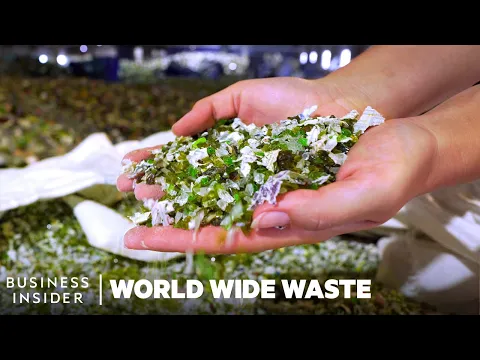

Without sediment replenishment, the coastline recedes. Without natural barriers, storms hit urban areas with greater intensity. Hurricane Katrina highlighted the human impact of this territorial loss.
How Recycled Glass Becomes Sand for Coastal Restoration
Glass Half Full started with a small machine installed in the backyard of a university fraternity. With US$ 20,000 raised via crowdfunding, the project began manually crushing bottles.
Today, the process is industrial. The collected glass — bottles, jars, containers — goes through:
- Color separation
- Crushing in hammer mills
- Screening to remove contaminants
- Classification by grain size
The result is different types of recycled sand. Fine sand is used in biodegradable bags for flood control during hurricanes. Medium grain size is used in coastal restoration projects, serving as a base for planting native grasses that stabilize sediments.
So far, the company has completed multiple projects, restoring about 1,700 meters of coastline in Louisiana.
Scientific Validation of Recycled Glass Sand
Environmental sustainability needed technical validation. The National Science Foundation (NSF) funded research with Tulane University to test the feasibility of recycled sand in coastal restoration. The investment exceeded US$ 5 million over three years.
Researchers analyzed:
- Chemical contaminants
- Settling behavior
- Structural stability
- Interaction with native vegetation
The studies confirmed that recycled glass sand can be safely used in certain environmental contexts, enhancing the project’s credibility.
A comparative experiment was conducted in the Bay of Bienvenue, where islands were constructed with dredged sand from the Mississippi and with recycled sand. Data continues to be monitored to assess technical equivalence.
New Factory Expands Glass Recycling Capacity in the U.S.
In March 2025, Glass Half Full opened an industrial plant in Chalmette, Louisiana. The US$ 6.5 million investment allowed the installation of optical sorting equipment and expansion of capacity to 300,000 pounds of glass per day, about 600,000 bottles daily.
Since 2020, over 10 million bottles have been diverted from landfills, representing more than 7 million pounds of recycled glass.
With the new infrastructure, the company began expanding operations to Mississippi and Alabama, establishing itself as a regional model of circular economy applied to coastal engineering.
Circular Economy Applied to Environmental Crisis
The case of Glass Half Full does not represent a groundbreaking chemical innovation. Glass has always been able to turn into sand. The difference was logistical and systemic.

By creating a local system for collection, processing, and reapplication, the startup connected two structural problems:
- Lack of glass recycling in Louisiana
- Sediment deficit for coastal restoration
Instead of importing sand while burying glass, the state began converting urban waste into environmental input.
Glass recycling ceased to be just a symbolic environmental practice and began to integrate real coastal protection projects.
The Structural Impact on Combating Coastal Erosion
Coastal erosion in Louisiana remains a large-scale challenge, but initiatives like Glass Half Full introduce a replicable model:
- Local processing
- Reduction of landfills
- Generation of environmental input
- Application in natural infrastructure
This is not just about urban sustainability, but about applied environmental engineering. A wine bottle that once went to the landfill can now become part of a natural barrier against storms.
And what started in the backyard of a university fraternity now operates on an industrial scale, placing glass recycling at the center of the debate on coastal restoration in the United States.








a long time ago, >than 25 years, when I was on my local council, we had an environmental engineer, I think his name was Kerry Black, I think from Waikato University (NZ), who proposed to Council, a use for large pillows made from geotechnical membrane fabric filled with sand, placed carefully after study of the local currents, to manage beach erosion at a particular local site. We did not proceed due to other reasons. But the technique was previously used to shape the surfing beach at Surfers Paradise, Gold Coast, Queensland. Very successfully. Geotechnical fabric filled with this glass material, would permanently address your erosion problems, and these bags accumulate fill behind them.
I have seen reports of Reef Balls (hollow concrete spheres) used to manage beach erosion in hurricane affected areas, as well.
Eu já tinha pensado nisso já um bom tempo, e surge lá de longe, estrangeira engenheira com essa façanha, só que a areia de vidro, tem que ser bem moída, para ficar melhor e homogênea.