





 Portuguese
  English
  Spanish
  5 min of reading
  0 comments


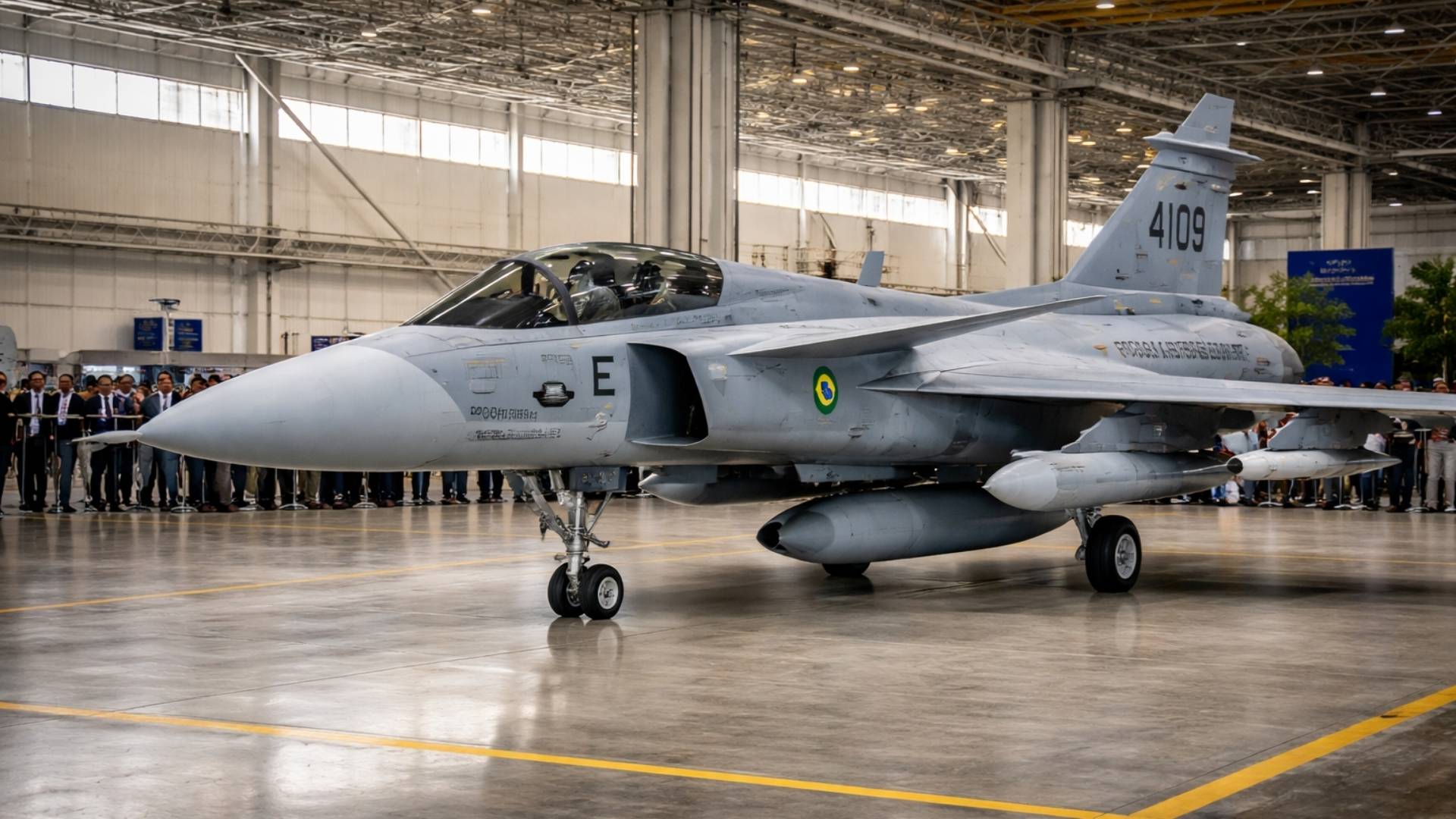
Presentation of the first supersonic fighter assembled in Brazil marks industrial advancement, technology transfer, and a new phase in national air defense with direct participation of Brazilian industry in a high-complexity strategic project.
Brazil presented this Wednesday (25), in Gavião Peixoto, in the interior of São Paulo, the first supersonic fighter F-39E Gripen assembled on national territory.
The aircraft, registered as FAB 4109, is part of the Brazilian Air Force’s combat aviation renewal program and marks the country’s entry into a restricted group of nations with industrial capacity to produce high-complexity fighter jets.
The ceremony took place at Embraer’s facility that concentrates the central part of Brazilian production for the program and gathered representatives from the FAB, Saab, and the federal government.
-
Two meteor showers will occur simultaneously at the turn of July to August, and those who look at the sky on the night of July 30th to 31st will have the chance to see meteors from the Delta Aquariids and the Alpha Capricornids crossing the sky simultaneously, with privileged visibility in the Southern Hemisphere and without needing any special equipment.

-
The submerged city of Siderópolis in Southern Santa Catarina is home to an intact church tower that has become a postcard image amidst the Rio São Bento Dam, a 450-hectare lake created to solve the water crisis of coal mining.

-
From Salvador to China: get to know the subway stations that impress with their depth, with up to 116 meters underground, an 8-minute walk to the train, and Brazilian projects that will exceed 60 meters.

-
What do the colors of USB ports mean? Do blue, black, red, and yellow have different functions?





More than the symbolic delivery of an aircraft, the event consolidated a phase anticipated since the signing of the contract with the Swedish manufacturer, formalized in 2014, when Brazil decided to acquire 36 Gripen fighters, of which 15 would be produced in the country under a technology transfer agreement.
National production of the Gripen and advancement of Brazilian industry
The presentation of FAB 4109 represents the transition from a phase centered on importation and knowledge absorption to another, where the local industry participates directly in the assembly of a new generation supersonic vector.
According to the FAB, the roll out of the aircraft confirms the maturity of the program and translates, in practice, the transformation of planning into installed production capacity. This advancement also has regional significance.
Reuters reported that Brazil has become the first country in Latin America to assemble a supersonic fighter of this size, while Saab highlighted that this is the first time, since the company’s founding in 1937, that one of its fighters is manufactured outside Sweden.

This data reinforces the strategic value of the industrial arrangement built with Embraer and Brazilian companies associated with the project.
In practice, local production reduces dependence on external suppliers in critical stages, expands the knowledge base in military aerospace engineering, and opens up space for maintenance, integration, and technical support services on Brazilian soil.
At the same time, it inserts the country into a more sophisticated global chain, with potential industrial developments beyond the operational use of the aircraft.
Technology transfer and job creation in the FX-2 program
The most sensitive axis of the program remains technology transfer.
Information released by the FAB indicates that the project has already involved training of 350 Brazilian engineers in Sweden and has boosted the formation of an industrial ecosystem generating more than 12,000 jobs, with about 2,000 direct and 10,000 indirect.
These numbers help explain why the Gripen is treated, within the sector, as a defense program with long-term industrial effects.
Among the Brazilian companies involved are Embraer, AEL Sistemas, Akaer, and Atech, partners of Saab in different fronts of development and production.
In the case of AEL, participation includes high-value-added items, such as the HUD, the helmet with integrated visor, and the WAD, the intelligent panoramic cockpit display, systems that are among the most relevant components of the interface between pilot and aircraft.
The presence of this national content alters the quality of Brazil’s involvement in the project.
Instead of merely receiving a ready platform, the country now masters parts of the production process and system integration, something especially relevant in long-duration military programs.
Still, the model remains based on international cooperation, with Saab supplying the platform and coordinating the transfer of knowledge alongside local partners.
Role of the F-39 Gripen in Brazilian air defense
The F-39 Gripen was chosen to replace old FAB aircraft and enhance response capability in air defense, interception, reconnaissance, and attack missions.

The aircraft can operate in different profiles and, according to information from the federal government, the multi-role model is capable of acting in aerospace control, interdiction, intelligence, force protection, and ground attack, among other missions.
The incorporation of the fighter occurs at a time when the FAB has already been expanding the operational use of the model.
In February 2026, the Air Force itself reported the start of Gripen use in Air Defense Alert missions, a step considered important for the consolidation of the aircraft in the country’s readiness system.
This means that the presentation of the first unit assembled in Brazil did not happen in isolation, but within a broader process of operational maturation of the program.
The political and economic dimension of the project was also evident during the event in Gavião Peixoto.
In statements released by Agência Brasil, Defense Minister José Múcio stated that investment in defense marks a maturation of the national industry, while Saab President Micael Johansson said that the Brazilian line is the only one of the company outside Sweden and associated this advancement with the industrial maturity achieved by the country and Embraer.
There is also an external component in this equation.
Reuters reported that Saab sees the Brazilian structure as a possible export hub, an expectation strengthened by recent advances of the company in the regional market.
Although this movement depends on commercial and geopolitical decisions that escape the Brazilian program, it enhances the relevance of the line installed in São Paulo and reinforces the strategic weight of the partnership established with the FAB over a decade ago.
In the short term, the most concrete data is that FAB 4109 symbolizes a change in scale.
The country ceases to be merely a customer of a supersonic aircraft and begins to participate in the assembly of a high-performance defense system, with effects on workforce formation, technological capacity, and industrial densification.
It is this set, more than the ceremony itself, that transforms the first F-39E assembled in Brazil into a milestone for Brazilian military aviation.





Be the first to react!