





 Portuguese
  English
  Spanish
 3 min of reading
  0 comments


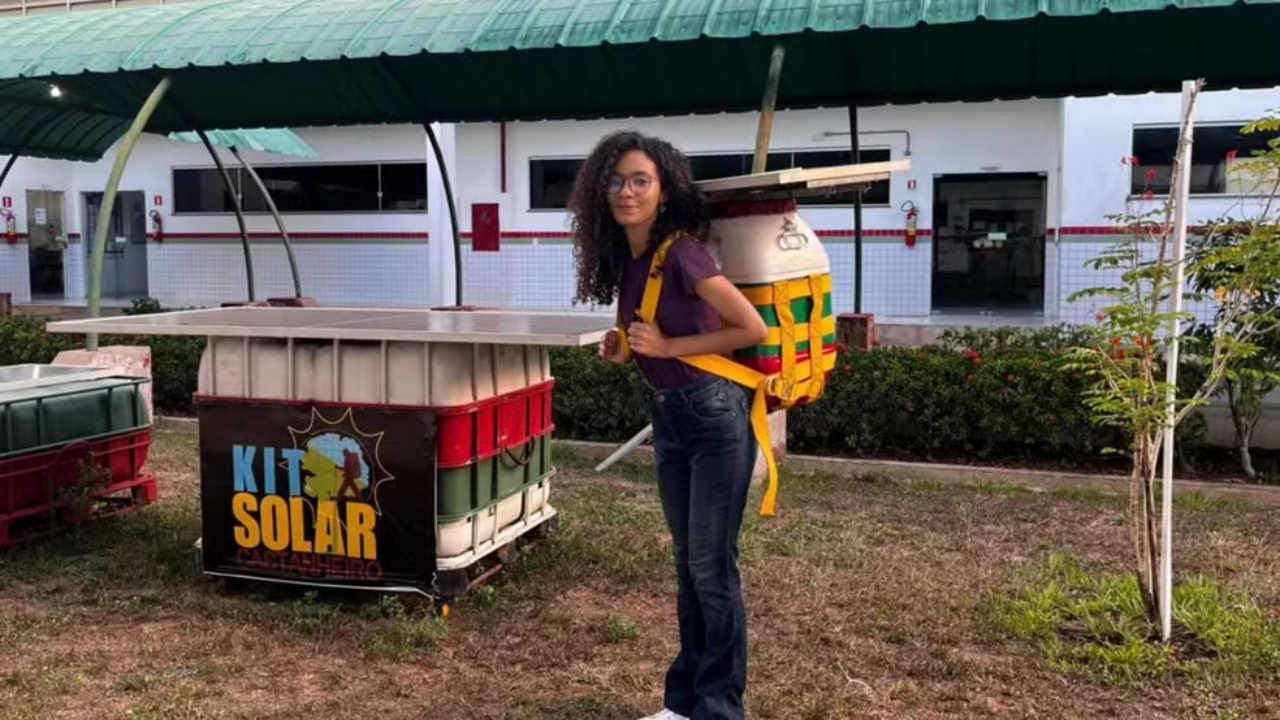
Federal Institute of Amapá Student Wins Young Scientist Award with Portable Solar Kit for Amazon Brazil Nut Harvesters, Replacing Diesel Engines and Reducing Environmental Impacts.
A simple, portable solution, designed for the reality of the forest, has placed Amapá at the center of Brazilian science. 23-year-old student Manuelle da Costa Pereira has become the first researcher from Amapá to win the Young Scientist Award. The ceremony took place on Thursday (26) in Brasília.
She won in the Higher Education category with a portable solar kit aimed at Amazon Brazil nut harvesters. The project was developed at the Federal Institute of Amapá (Ifap) and arose from real demands of extractive communities.
“This project has a lot of identity. It speaks a lot about who I am, where I come from. It was born in the heart of the Amazon, in Laranjal do Jari, where I was born and raised. Receiving this award is an enormous joy and a pleasure to represent the Federal Institute of Amapá, being the first student to win an award of this magnitude,” said the researcher.
-
Friends have been building a small “town” for 30 years to grow old together, with compact houses, a common area, nature surrounding it, and a collective life project designed for friendship, coexistence, and simplicity.

-
This small town in Germany created its own currency 24 years ago, today it circulates millions per year, is accepted in over 300 stores, and the German government allowed all of this to happen under one condition.

-
Curitiba is shrinking and is expected to lose 97,000 residents by 2050, while inland cities in Paraná such as Sarandi, Araucária, and Toledo are experiencing accelerated growth that is changing the entire state’s map.

-
Tourists were poisoned on Everest in a million-dollar fraud scheme involving helicopters that diverted over $19 million and shocked international authorities.


Solar Replaces Diesel and Reduces Weight from 1,000 to 50 Liters
The key feature of the project is its practicality. The solar kit was created to replace diesel engines used by extractivists. These engines are heavy, expensive, and polluting. Furthermore, they make transportation within the forest difficult.
During development, the equipment underwent several prototyping phases. The volume, which initially was 1,000 liters, has been reduced to just 50 liters. Now, it can be carried in a backpack. The estimated cost is around R$ 2,800, with the reuse of discarded containers.
According to Manuelle, the kit meets basic needs such as lighting, food preparation, and communication. Previously, most workers relied on diesel generators, which increased costs and heightened environmental impact.
International Recognition and Institutional Support
The project was also presented at COP 30, a UN conference on climate change held in Belém (PA). The proposal aims to reduce carbon footprints and strengthen the socio-bioeconomy of the Amazon.

“Our goal is to turn expectation into reality: an accessible device, adapted to local needs and capable of reducing the carbon footprint. For this, obtaining funding and institutional support will be essential,” stated Manuelle.
The research began in 2022 with a Technological Initiation scholarship from the National Council for Scientific and Technological Development (CNPq). In 2023, the kit was registered as a utility model with the National Institute of Industrial Property (INPI). The development also received support from the Amapá Research Support Foundation (Fapeap).
The next stage foresees technical improvements to enhance the efficiency of the solar system in extractive communities, aligning the project with the principles of Amazon 4.0 and the UN Sustainable Development Goals.









-

-

-

5 pessoas reagiram a isso.