





 Portuguese
  English
  Spanish
 3 min of reading
  1 comment


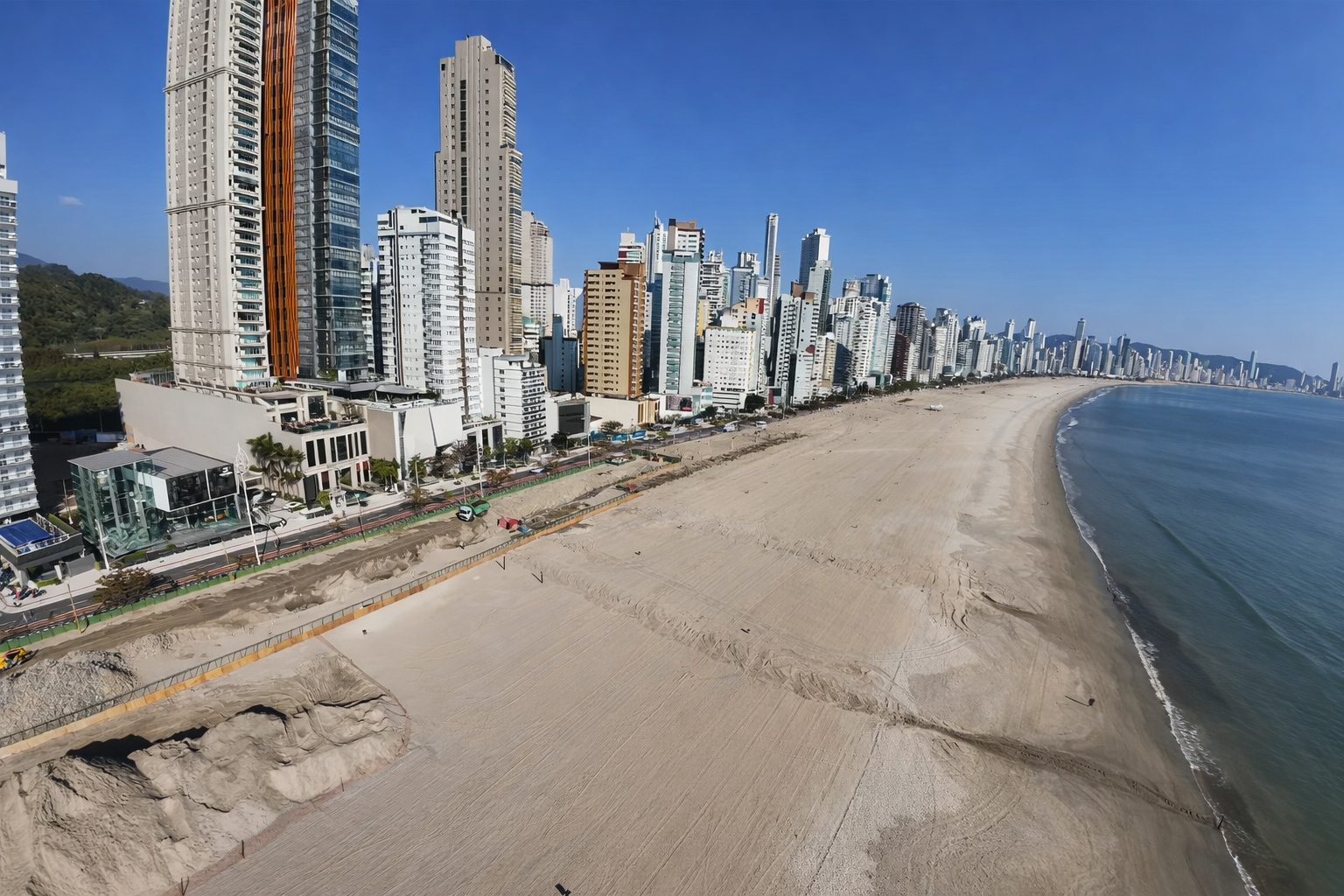


Technical Project Bets on Buried Coastal Engineering to Protect the Beach in Santa Catarina, Ensure Urban Safety, and Maintain the Balance Between Tourism, High-End Real Estate, and Environmental Preservation
A highly relevant environmental and economic urban intervention was recently authorized in Balneário Camboriú, attracting national attention.
The city hall approved the construction of a subterranean containment wall under the Central Beach, aimed at stopping the advance of the sea and reducing coastal erosion.
The initiative arises, above all, as a technical response to the impacts recorded after the widening of the beach completed in 2021.
Since then, recurring episodes of high tide and swells have caused flooding and soil instability, requiring a long-term structural solution.
Technical Project Defines Buried and Invisible Structure on the Beach
The proposal establishes that the wall will be entirely buried under the sand, with no visual impact for residents or tourists.
According to technical parameters adopted by the municipality, the structure will be approximately two meters deep.
Additionally, reinforced concrete and stone base will be used, chosen for their high resistance to saltwater.
In this way, the containment acts directly against the infiltration of tides while preserving the seaside landscape.
Swells After 2021 Accelerated the Adoption of a Structural Solution
After the widening work was completed in 2021, the behavior of the sea showed more intense effects during periods of swell.
As a result, puddles, ditches, and waterlogged areas became frequent, especially in sections close to the boardwalk.
In light of the increase of these episodes throughout 2022, 2023, and 2024, the city hall decided to move forward with a definitive solution.
Thus, the subterranean wall was chosen as an alternative capable of protecting the urban space, tourism, and high-end real estate in the region.
-
The government opens the vault and deposits R$ 2.6 billion for the construction of Brazil’s first underwater tunnel, with a length of 1.5 km, 870 m under the sea, a total project cost of R$ 6.8 billion, and a 30-year concession.
-
Only 46 meters remain for Brazil and Paraguay to connect via the Bioceanic Route bridge, the project that will link the Atlantic to the Pacific by land and change the logistical map of four countries in South America.
-
The bridge that holds the largest stone railway arch in the world: built over 100 years ago, destroyed in the war, and rebuilt to continue operating to this day, it still carries trains over the Soča River in Slovenia.
-
Italian giant of 130 tons arrives at the Senna Tower construction site and accelerates foundations: Mite CFA 3436 drills up to 50 m, 750 hp engine, investment of R$ 20 million, unique in Latin America.
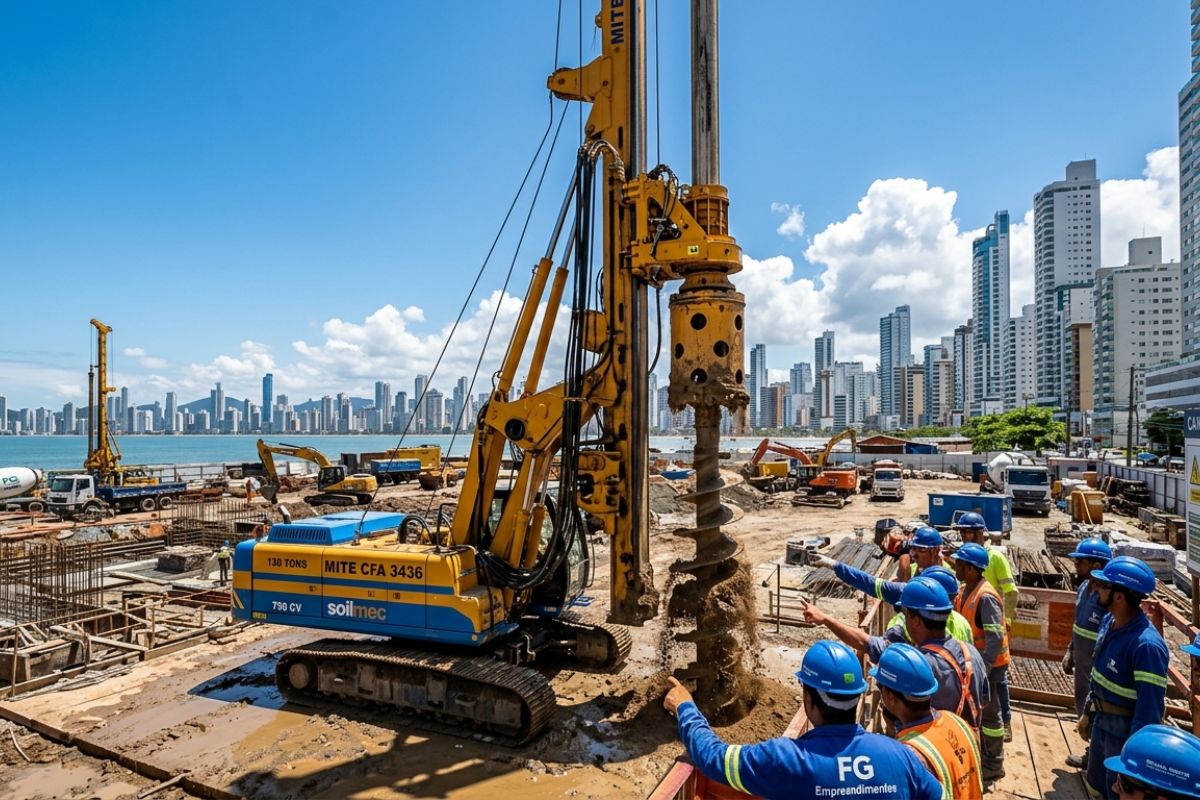

The Work Integrates Seaside Reurbanization and Climate Adaptation Strategy
Besides the function of maritime containment, the work is part of a broader seaside reurbanization project.
The plan includes improvements to the boardwalk, bicycle paths, leisure areas, public lighting, and landscaping.
According to the City Hall of Balneário Camboriú, the intervention seeks long-term safety in light of the rising sea levels associated with global climate change.
Thus, the proposal combines coastal engineering, urban enhancement, and environmental protection.
Central Beach Sustains Tourism, Real Estate Market, and Local Economy
Currently, Balneário Camboriú is recognized as one of the most luxurious cities in Brazil, concentrating some of the tallest residential buildings in Latin America.
During the high season, the floating population exceeds one million people, putting pressure on infrastructure and services.
Therefore, the preservation of Central Beach is considered strategic for tourism, the real estate market, and municipal revenue.
Any significant reduction of the beach could, therefore, have direct impacts on property values and the local economy.
Coastal Adaptation Advances, but Does Not Replace Environmental Policies
Coastal management experts emphasize that containment works do not replace long-term environmental policies.
Still, they function as adaptation measures in the face of an increasingly challenging climate scenario.
With the subterranean wall, Balneário Camboriú bets on technical planning, urban engineering, and environmental prevention to protect its main landmark.
To what extent should coastal cities invest in large adaptation works to ensure urban development without compromising environmental futures?








This is utter nonsense.