





 Portuguese
  English
  Spanish
  5 min of reading
  0 comments


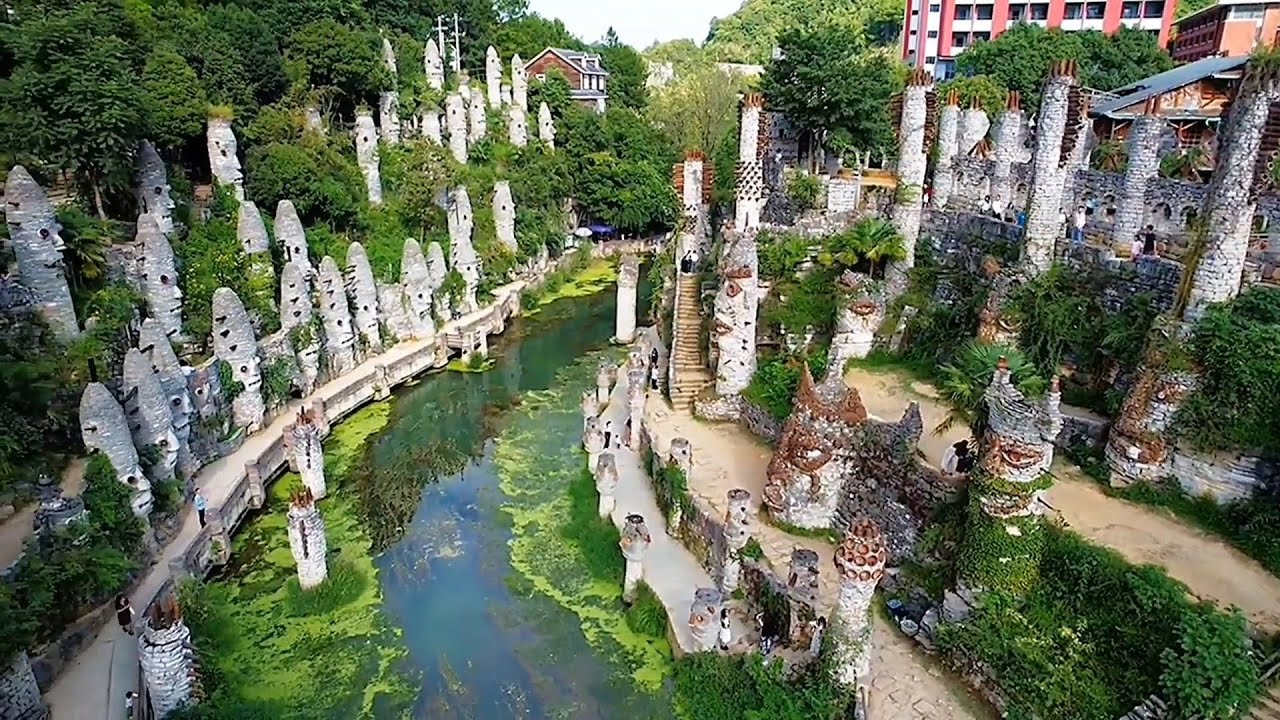
In Southwest China, the Yelang Valley Was Built By Hand By Song Peilun Over 20 Years, Transforming Ancient Mythology Into A Unique Monumental Complex.
In southwest China, far from major urban centers and outside traditional tourist routes, there exists a place that seems to have come straight out of an ancient mythology book. This place is the Yelang Valley, a monumental complex almost entirely built by hand by the artist Song Peilun over more than two decades in the province of Guizhou. What now impresses visitors and researchers began in an almost improbable way: a personal project, without state funding, without heavy machinery, and without a formal architectural plan. Just stones, fragments of pottery, basic concrete, and a clear obsession — to materialize on a monumental scale the regional mythology of the ancient Kingdom of Yelang, which existed in China over two thousand years ago.
Where It Is And How The Yelang Valley Came To Be
The complex is located in the Huaxi District, in the city of Guiyang, the capital of Guizhou province, a historically marginalized mountainous region in Chinese development.
Song Peilun, a trained sculptor and art professor, returned to his hometown in the 1990s after traveling the world. Observing how ancient great civilizations immortalized their myths in stone — from Egypt to Mesoamerica — he decided to do the same with the spiritual traditions of southwest China, especially those linked to Nuo Opera, an ancestral ritual with masks and symbolic characters.
-
Friends have been building a small “town” for 30 years to grow old together, with compact houses, a common area, nature surrounding it, and a collective life project designed for friendship, coexistence, and simplicity.

-
This small town in Germany created its own currency 24 years ago, today it circulates millions per year, is accepted in over 300 stores, and the German government allowed all of this to happen under one condition.

-
Curitiba is shrinking and is expected to lose 97,000 residents by 2050, while inland cities in Paraná such as Sarandi, Araucária, and Toledo are experiencing accelerated growth that is changing the entire state’s map.

-
Tourists were poisoned on Everest in a million-dollar fraud scheme involving helicopters that diverted over $19 million and shocked international authorities.


From there, he began building the valley practically alone, occasionally receiving local help, but without large teams, strict timelines, and without interruptions, working continuously for over 20 years.
A “Castle” That Is Not A Castle
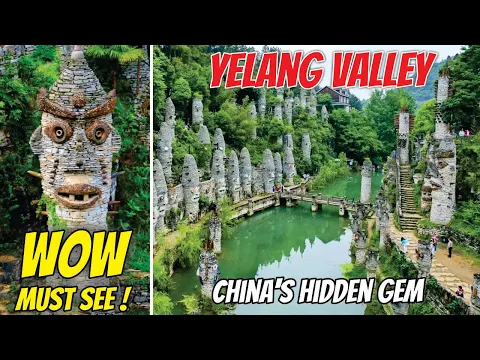

Despite often being called a “stone castle,” the Yelang Valley does not follow classic defensive or architectural standards. What exists there is a sculptural open-air labyrinth, featuring:
- Symbolic towers and walls
- Irregular staircases hand-carved
- Raised platforms
- Ceremonial portals
- Internal courtyards
- Massive structures resembling ancient ruins
Everything was made organically, without perfect symmetry, creating the feeling that the place has always been there, like a lost city slowly revealed by time.
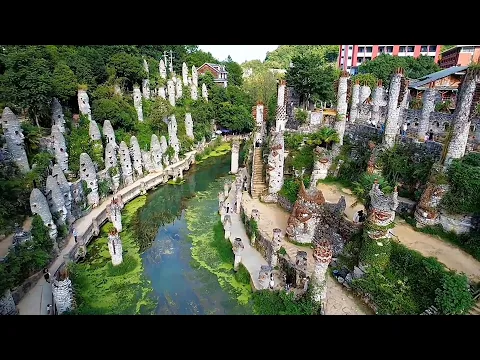
The estimated total area of the complex exceeds 200,000 square meters, according to surveys published by outlets such as China Daily and Atlas Obscura, placing the project on par physically with great historical sites, even though it was created by a single contemporary artist.
Giant Faces And Forgotten Gods
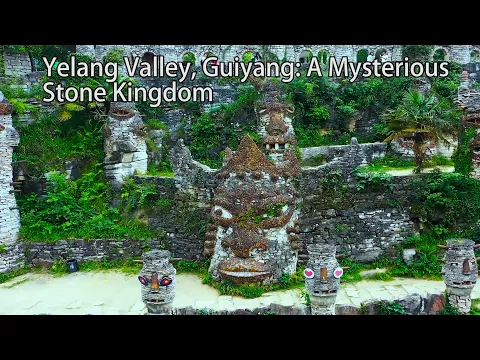
The most striking element of the Yelang Valley is the colossal faces carved in stone, many of which are several meters high. They represent figures from local mythology associated with Nuo Opera, a symbolic system that blends religion, theater, spiritual protection, and ethnic identity.
Among these figures are:
- Protective gods
- Mountain spirits
- Entities related to fertility and harvest
- Characters symbolizing order, chaos, life, and death
The sculptures do not follow a “polished” aesthetic. On the contrary: they are raw, asymmetrical, and intentionally primitive, reinforcing the idea of ancestry and symbolic strength.
According to Song Peilun himself, the intention was never to create something “beautiful” in the modern sense, but rather something that carried cultural and spiritual weight.
Manual Construction And Technical Choices
From a construction standpoint, the Yelang Valley draws attention for having been built using simple yet extremely labor-intensive techniques:
- Manual stacking of stones
- Minimum use of concrete only for stabilization
- Reusing discarded pottery
- Almost total absence of heavy machinery
- Total adaptation to the natural terrain
This explains why the project took more than two decades to reach its current form. Each sculpture, wall, or staircase required years of cumulative work, respecting the physical pace of the builder himself.
From Personal Project To Alternative Cultural Heritage
For many years, the Yelang Valley was virtually unknown outside Guizhou. However, reports from BBC Culture, China Daily, and Atlas Obscura began to draw international attention to the site, describing it as one of the most extreme examples of environmental art and self-taught architecture of the 21st century.
Today, the space:
- Receives visitors
- Is studied by anthropologists and art historians
- Has begun to integrate alternative cultural tourism circuits
- Is seen as a rare case of mythological preservation outside the official circuit of the Chinese state
Despite this, Song Peilun has always made it clear that he did not build the valley for tourism, but to ensure that the regional mythology would not disappear with the rapid modernization of China.
Why The Yelang Valley Draws So Much Attention
The impact of the project lies not only in its size or construction time but in the absolute contrast with the surrounding world.
While China constructs entire cities in just a few years using concrete, steel, and state planning, one man spent decades slowly building a symbolic universe of his own, using stone, memory, and persistence.
The Yelang Valley has become an extreme example of:
- Monumental works do not depend solely on technology
- Scale can arise from patient repetition, not haste
- Immaterial culture can be transformed into physical architecture
- A single individual can create something comparable to historical sites
It is not an exaggeration to say that the site functions as an open-air museum, a permanent art installation, and a cultural manifesto carved into the mountain.
A “Lost World” Created In The 21st Century
Walking through the Yelang Valley, the most common sensation reported by visitors is one of temporal displacement. Nothing there seems modern, yet everything is contemporary. Nothing is ancient, yet everything feels ancestral.
This paradox, a site that feels millennia old but was built in the last 30 years, is precisely what has transformed Song Peilun’s project into one of the most curious cases of artistic architecture in the world.
A lost world that, unlike the legends, was not found. It was built, stone by stone, by a single person.










-

Uma pessoa reagiu a isso.