





 Portuguese
  English
  Spanish
  4 min of reading
  0 comments


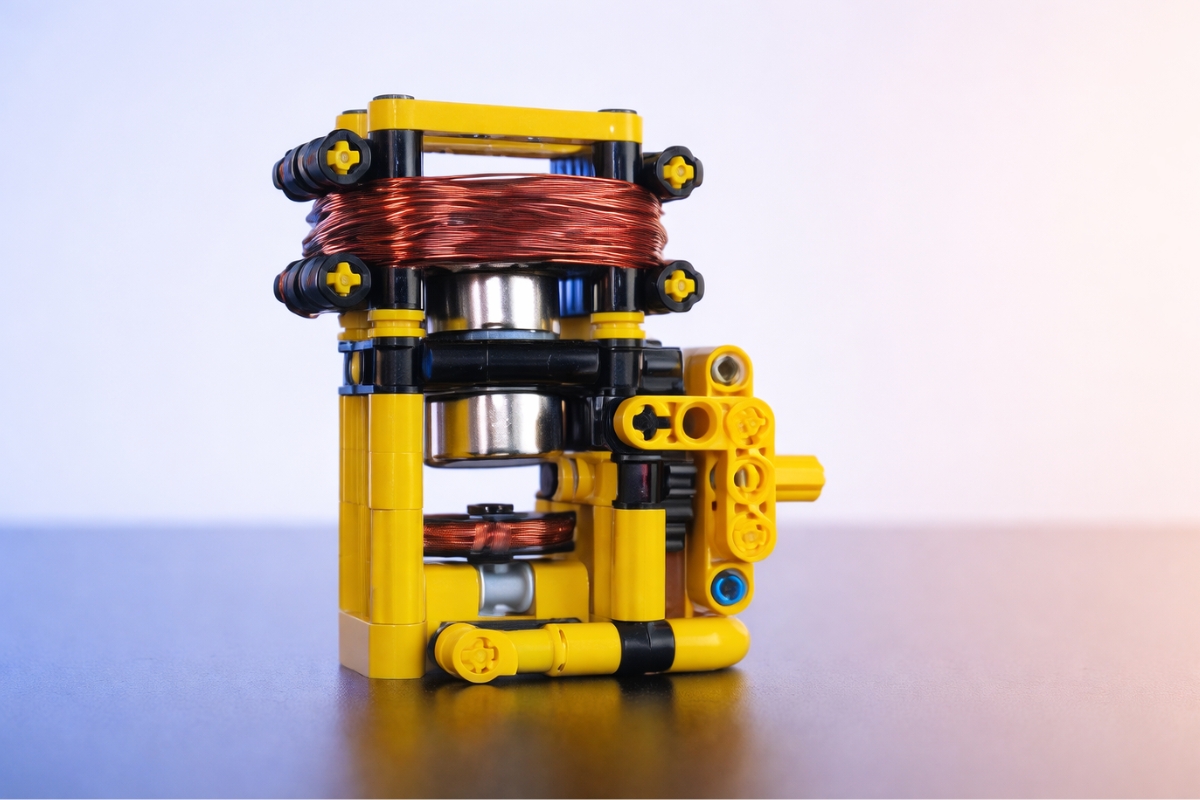
Without Software and Without Smart Boards, a Motor Made of LEGO, Copper, and Magnets Placed Physical Feedback at the Heart of Its Operation, Showing How “Simple” Systems Can Self-Synchronize with Just Basic Electronics
A creator decided to go against the trend of “ready-made” robotics kits, programmable boards, and closed solutions. Instead of hiding technology behind smart modules and firmware, he took the reverse route: simplified everything down to just the essentials. The result drew attention: Jamie, from the YouTube channel Jamie’s Brick Jams, built a functional electric motor mainly using LEGO pieces, common magnets, and basic electronic components — and even showcased everything “on the inside,” with mechanics and electromagnetism on display.
The proposal is straightforward: no microcontroller, no software. Just physics, trial and error, and a clear understanding of how a magnetic field behaves when current reaches it at the right moment. More than just spinning, the motor becomes a practical lesson in what drives a huge part of the modern world.
“Open” Electric Motor: You Can See the Physics Happening
Electric motors tend to seem complicated because they almost always hide their internal parts within metal casings. Here, the opposite happens: everything is exposed. The principle is known, but rarely presented in such an educational way: electric current passing through a coil generates a magnetic field which, when interacting with permanent magnets, produces motion.
-
Friends have been building a small “town” for 30 years to grow old together, with compact houses, a common area, nature surrounding it, and a collective life project designed for friendship, coexistence, and simplicity.

-
This small town in Germany created its own currency 24 years ago, today it circulates millions per year, is accepted in over 300 stores, and the German government allowed all of this to happen under one condition.

-
Curitiba is shrinking and is expected to lose 97,000 residents by 2050, while inland cities in Paraná such as Sarandi, Araucária, and Toledo are experiencing accelerated growth that is changing the entire state’s map.

-
Tourists were poisoned on Everest in a million-dollar fraud scheme involving helicopters that diverted over $19 million and shocked international authorities.


In the project, the rotor (the part that spins) is made with two neodymium magnets positioned on opposite sides of an axis. And one detail becomes the protagonist: balance. If the assembly vibrates, energy is lost. To hold the pieces during tests, a simple resource is used: a little temporary adhesive, just to stabilize.

In front of the rotor is the motor coil, mounted on a LEGO structure and manually wound with around 150 turns of copper wire. When the battery powers the coil, the magnetic field created there attracts or repels the rotor’s magnets, giving the initial push to start spinning.
The problem appears quickly: a single pulse does not sustain movement for long. Inertia fades away and the spin stops. This is where most simple motors fail: without synchronization, there is no continuity.
The “Trick” to Keep the Motor Running: a Coil that “Listens” to the Rotor
The solution chosen by Jamie is minimalist and clever. He adds a second coil, smaller, which does not serve to push — it serves to detection. This “sensor” coil detects the passage of the rotor’s magnets and generates a small electrical signal.
This signal goes to a very basic circuit, with a TIP31C transistor and, optionally, an LED. The transistor acts as an automatic switch: when the sensor coil detects that the magnet is at the right point, the transistor opens for an instant and allows the battery to send a pulse to the motor coil.
In other words: the motor stays on because the movement itself “commands” the next pulse. No programming, no digital control. It is physical feedback in practice — the kind of concept that underpins many industrial systems, even when it is today packaged as an “algorithm.”
And there’s a critical detail: the polarity of the coils. An inverted connection, and the system simply does not work. Adjusting, testing, swapping wires, and finding the right point is part of the learning process.
Speed, Torque, and the Effect of Magnets on Performance
In the simplest tests, with two magnets, the assembly reaches about 1,300 revolutions per minute (RPM) before receiving gears. When a 3:1 reduction is added, the speed decreases — but the torque increases. And then comes the practical test: the motor stops being just a curiosity and starts to move a LEGO car on a surface.
Later, the rotor is redesigned with eight magnets arranged in a disc. The behavior changes: the rotation drops to something close to 480 RPM, but the spin becomes more stable and the thrust becomes more constant. The pulses occur more frequently and are better distributed, reducing “jerks” and improving control.
In practice, it’s the same kind of trade-off present in real applications: in some cases, you want more speed; in others, more torque and consistency. There is no “perfect” configuration — there are design choices and clear consequences.
Why This Matters Beyond the Hobby
At first glance, it may seem like just a home experiment, but the value goes far beyond entertainment. Electric motors are at the center of the energy transition: heat pumps, wind turbines, trains, efficient appliances, and, of course, electric mobility. Without them, there is no electrification on a large scale — and much less decarbonization.
What this type of project delivers is something rare: understanding. Instead of abstract diagrams, you can see the operation “live”: magnetic field, synchronization, feedback, and the conversion of electrical energy into motion happening right before your eyes.
For students, teachers, and curious minds, the message is simple: understanding the basics is still one of the most powerful ways to gain technical knowledge — and that makes a difference when it comes to technology and energy.










Seja o primeiro a reagir!