





 Portuguese
  English
  Spanish
  4 min of reading
  1 comment





In January 2022, the black diamond called The Enigma, with 555.55 carats and 55 facets, was exhibited in Dubai before heading to Los Angeles and then to auction in London in February of the same year. The combination of rarity, Khamsa shape, and carbon isotopes supports suspicions of origin in space under hydrogen analysis.
The 555.55-carat black diamond that appeared in Dubai drew attention not only for its size but also for the technical narrative that came with it: the hypothesis that part of the history of this type of stone may be linked to space events. In the showcase, it looks like a luxury piece; in detail, it becomes a subject of debate.
The public image is simple, almost irresistible, but the topic is more complex. When a black diamond exceeds 555 carats, each number becomes an argument, from the shape to the facets, from the auction route in London to the scientific discourse trying to explain why certain carbonados deviate from the norm.
The Enigma of 555.55 Carats and the Obsession with the Number Five

The black diamond was named “The Enigma” and carries an unusual numeric sequence: 555.55 carats.
-
Friends have been building a small “town” for 30 years to grow old together, with compact houses, a common area, nature surrounding it, and a collective life project designed for friendship, coexistence, and simplicity.

-
This small town in Germany created its own currency 24 years ago, today it circulates millions per year, is accepted in over 300 stores, and the German government allowed all of this to happen under one condition.

-
Curitiba is shrinking and is expected to lose 97,000 residents by 2050, while inland cities in Paraná such as Sarandi, Araucária, and Toledo are experiencing accelerated growth that is changing the entire state’s map.

-
Tourists were poisoned on Everest in a million-dollar fraud scheme involving helicopters that diverted over $19 million and shocked international authorities.


The cut also follows the same pattern, with 55 facets, reinforcing a design that relies not only on weight but also on symbolism applied to the piece.
The shape has been associated with the Khamsa, a symbol linked to the idea of strength and protection, and the term itself refers to the number five.
In this context, the black diamond ceases to be just a stone and becomes an object with its own language, constructed to be interpreted both by buyers and by analysts.
Dubai as Showcase and London as Auction Destination

Dubai was chosen as the exhibition point before the auction, with a stop also in Los Angeles, in a route designed to put the black diamond in front of different audiences.
It is a typical circulation strategy for rare pieces, where the showcase location acts as part of the perceived value.
After the showcase in Dubai, the announced destination was London, with the auction held in February 2022.
The black diamond “The Enigma” was sold for £3.16 million, equivalent to approximately US$4.3 million at the time of sale.
What was at stake in London was not just the price; it’s the type of market that is willing to negotiate a black diamond at this level.
Why the Black Diamond is Called Carbonado
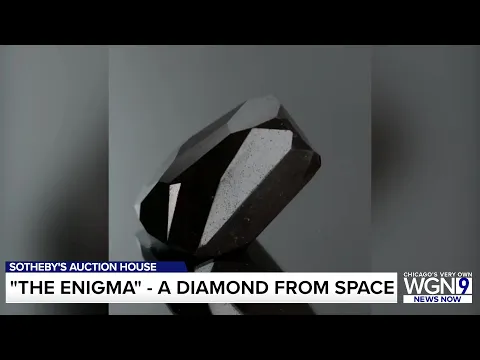

The mentioned black diamond is described as a carbonado, a category known for its extreme rarity and characteristics that differentiate these stones from the more common image of transparent diamonds.
The term is not aesthetic; it is a classification: it indicates composition and formation outside the more widely distributed commercial standard.
Another piece of information associated with carbonados is their geographical distribution: they are found naturally only in Brazil and Central Africa.
This reinforces the rarity and explains why a black diamond exhibited in Dubai with 555.55 carats becomes headline news for simply existing, even before any discussion about space.
Indications of Space and What Science Tries to Explain Without Simplifying
The hypothesis of origin in space is linked to indications such as carbon isotopes and high hydrogen content, elements used to support the idea that some carbonados may relate to high-energy events.
One line of explanation mentions meteorite collisions with Earth, with formation through processes like chemical vapor deposition, or even direct association with the meteorites themselves.
The technical care here is to separate hypothesis from certainty.
To say that the black diamond “may have come from space” does not mean treating the origin as an established fact, but rather recognizing that certain physical-chemical signals feed unconventional formation scenarios.
Instead of “mystery,” what exists is a set of clues that still require careful reading.
The 555.55-carat black diamond exhibited in Dubai and destined for London concentrates, in a single piece, three forces that rarely come together in the same object: material rarity, market narrative, and scientific discourse with the hypothesis of space.
The jewel makes news because its size impresses, but it remains a topic of debate because the indications raise difficult questions to settle.
If you had to choose one criterion to believe more in this space hypothesis, which would weigh more for you: carbon isotopes, hydrogen, the history of carbonados in Brazil, or the logic of meteorite collisions? And why, in your own words, without repeating what everyone else already says?










É estranho pensar em um diamante de mais de 555ct (110g, quase 40 ml) sobreviver à ablação em uma atmosfera rica em oxigênio… E sem deixar uma cratera imensa.
Só o contato da rocha super aquecida com a atmosfera, já destrói quase totalmente os diamantes de origem vulcânica.