





 Portuguese
  English
  Spanish
  7 min of reading
  2 comments


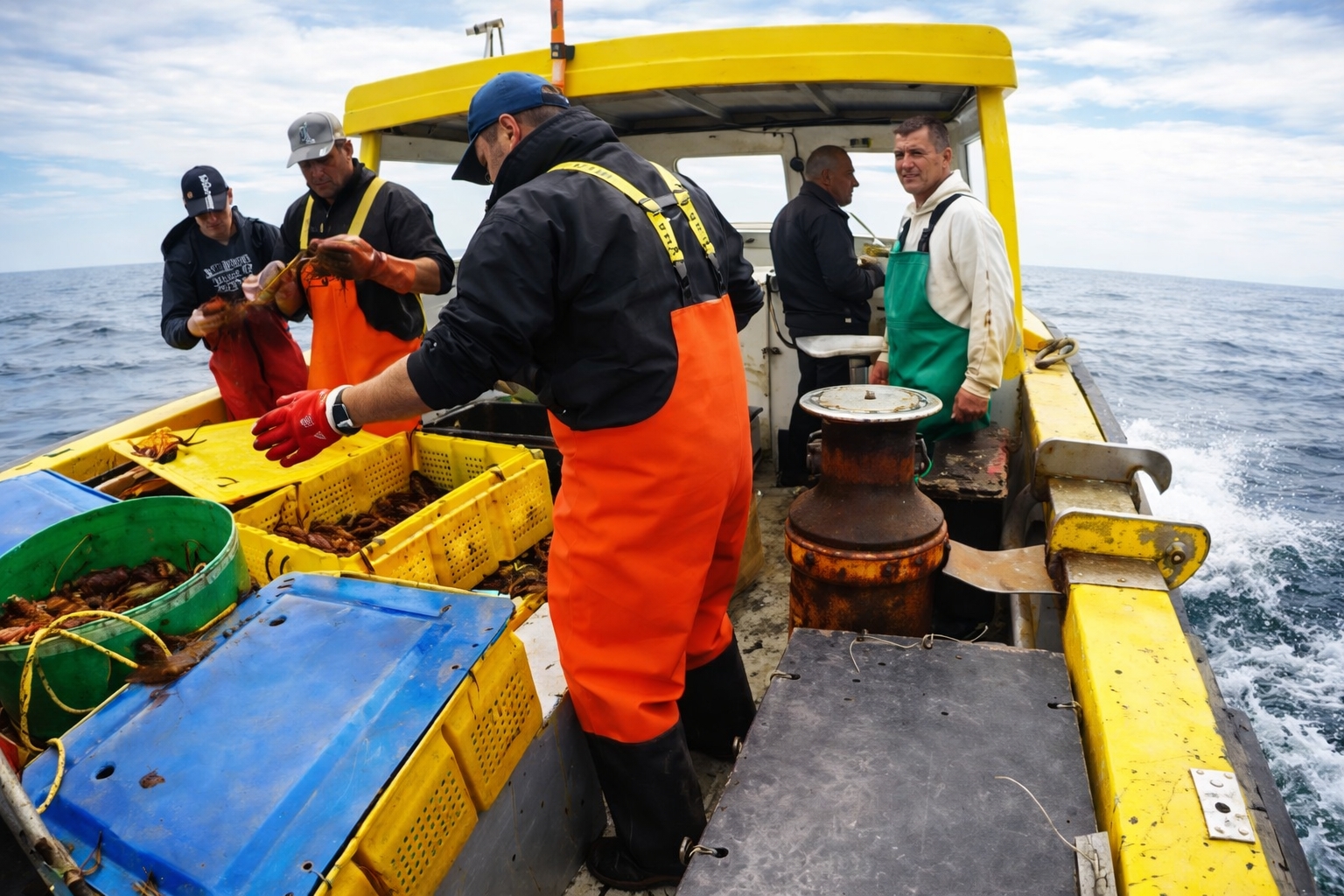


A Community of 229 Residents Created a Marine Protected Area of 687,000 km² to Sustain Lobster Fishing, Causing a Reduction in Maritime Traffic and Attracting Attention from UK Authorities and Monitoring Organizations.
The day begins before sunrise, with the metallic sound of a hammer striking an old oxygen cylinder. In Tristan da Cunha, in the South Atlantic, this gong has a direct meaning: it is fishing day.
Here, fishing is not just a tradition; it is survival. With just over 200 people living in the most remote inhabited place on Earth, almost everything depends on the ocean, especially the main local source of income: the São Paulo lobster.
The most striking detail is the contrast. Surrounded by millions of square kilometers of open sea and 2,414 km away from Saint Helena, the island has tried to do something that larger countries still struggle to implement: protect almost all of its sea while keeping the economy functioning.
-
Tourists were poisoned on Everest in a million-dollar fraud scheme involving helicopters that diverted over $19 million and shocked international authorities.

-
Hidden beneath the dense forest of the Sierra Nevada, Betoma emerges in a neighbor of Brazil as the greatest archaeological discovery of the century, revealing a colossal ancestral city covering over 18 km², with 8,334 stone structures and the potential to rewrite the history of South American civilizations.

-
Goodbye iron: new technology from Xiaomi promises to revolutionize the way we iron clothes with 500 kPa steam, continuous flow of 120 g/min, heating in 65 seconds, and six smart modes for different fabrics.

-
Rio Pardo, the most mysterious city in Rio Grande do Sul: untouched Pampas castle, the missing treasure of the Devil Boy, bride’s saint, invisible tunnels, and a 200-year curse today.

But the threats don’t stop. Climate change, invasive species, and even ships turning off tracking systems increase the pressure on an ecosystem considered one of the most untouched on the planet.
What Sustains the Island is a Rare Lobster, Sold Abroad for Up to US$ 39 per Tail, Equivalent to R$ 215

The star of Tristan da Cunha’s economy is the São Paulo lobster (Jasus paulensis), a crustacean found only near remote islands in the southern oceans of the planet.
The meat is described as sweet and delicate, and its value is impressive: a single tail can fetch up to US$ 39 in the North American market, around R$ 207. The product is also exported to Japan and the UK.
In the cold, temperate waters of the archipelago, these lobsters live near the coast, at depths of up to 200 meters. And they are not just an export item. They help maintain the balance of the marine environment, as they are part of the food chain, recycle nutrients, and serve as food for predators like octopuses.
A Short Season and a Ritual at 5 AM Show the Weight of Each Fishing Day
In Tristan da Cunha, fishermen have a narrow window for work. There are only 18 to 72 fishing days per season, making each opportunity a priority.
The boats leave from Calshot Harbor, known as The Beach, while dogs bark and rubber boots hit the ground. The pace is fast because there is no room for wasted time.
In January 2024, for example, a team set out on the Island Pride, an orange 8-meter boat, heading to a fishing spot on the southern side of the island. The location does not rely on sophisticated technology but on triangulation with land references and depth reading of the sea.
The work is hard. Large traps are set in deep waters and remain on the bottom for hours, long enough for the bait to attract the lobsters. In shallower areas, cylindrical nets are used in the underwater kelp forests and are pulled aboard once an hour.
The Island Nearly Lost Everything Due to Overfishing, and the Rules Only Became Strict After 1997
Today, the community advocates for taking only what is necessary from the ocean. But it hasn’t always been this way.
Decades ago, overfishing significantly reduced the number of crustaceans. Initially, the activity had little regulation. Small lobsters and females with eggs were taken before they could reproduce, which weakened the stock.
The first clearer measures appeared in 1983 when the Island Council created size limits. Quotas were introduced in 1991. However, according to the local Fisheries Department, these rules were only really enforced starting in 1997.
The memories of the elders show how abundant it once was and how everything changed. An 82-year-old resident recalls that when he started fishing at 15, he and a partner once caught 1,360 kg in a single day using just 10 nets.
A Company with Exclusive License Captures Most of the Production, with Daily Oversight and Shipping to Cape Town
The operational base of commercial fishing is managed by a South African company called Ovenstone Agencies, which holds the concession for a large quota of São Paulo lobster, about 800,000 per year, along with 110 tons of Antarctic jellyfish (Hyperoglyphe antarctica).
This contract has a direct impact on daily life. The company provides jobs, electricity, and passenger maritime transport, including medical evacuations to Cape Town, South Africa.
Between August 2023 and April 2024, the company’s main fishing vessel, the MFV Edinburgh, fished around Nightingale, Inaccessible, and Gough islands, bringing in about 316 tons to shore. This volume represents the bulk of the island’s annual production, which reached 441 tons.
The remainder of the quota, up to 125 tons, is allocated to local fishermen in smaller boats, always with strict rules. There are limits on nets and traps, constant use of measuring sticks, and observers from the Fisheries Department monitoring trips, measuring hundreds of lobsters every day.
The catch is processed, packaged, and frozen onboard before heading to Cape Town. Throughout the year, the Fisheries Department also tags lobsters, monitors movements, uses underwater cameras, and conducts random sampling and biomass data to assess stock health.
The Marine Protected Area Closed 91% of the Sea, Reduced Traffic by Over 20%, and Became a Real Test of Remote Monitoring
The boldest response to protect the main source of income was to create one of the largest marine protected areas on the planet.
The marine protected area of Tristan da Cunha covers 687,000 km². In 91% of the territorial waters, commercial fishing is prohibited. In the remaining 9%, there is control with strict quotas, size limits, and onboard monitoring.
The plan also established Areas to Be Avoided for navigation, trying to reduce the risk of accidents near sensitive habitats. The logic is straightforward: it is not enough to control fishing because much of the significant damage has come from transiting ships.
The most recent figures show that the change had an effect. In 2019, before the protected area was established, 14% of the ships transiting the local waters came within 46.3 km of one of the islands. By 2023, that percentage dropped to 2%. And overall traffic within the protected area has decreased by over 20% since 2020.
Monitoring relies on technology because the island has no airport and lacks its own patrol vessel to cover the entire territory. Satellite monitoring and AIS data, the Automatic Identification System, have become the island’s eyes in the middle of the ocean.
The UK’s Maritime Management Organization assists the protected area by interpreting data and identifying suspicious behaviors, such as speed reduction, drifting in prohibited zones, or turning off the AIS.
Climate Change, Invasive Species, and Historic Stranding Incidents Show That the Risk Does Not Come Only from Fishing
Even with the sea considered healthy, environmental pressure has not disappeared. There are signs that climate change may directly impact the system’s foundation.
There is still no conclusive evidence, largely due to the small number of studies. But there are indications that rising sea temperatures are already harming the growth of kelp in summer, a critical habitat for the lobsters. Warming may also push lobsters further south, beyond the reach of the residents.
And there is a factor that marked local history: incidents with vessels in transit.
In June 2006, a massive oil platform called PXXI ran aground at Trypot Point, having separated from its tug while being transported from Brazil to Singapore. There was no oil spill, but the impact came in another form: 62 invasive species were introduced.
Among them is the marimba (Diplodus argenteus), an omnivorous reef fish native to South America. It has spread to three islands of the archipelago, with only Gough Island remaining free. A young lobster has already been found in a marimba’s stomach, raising alarms for fishing. This advance has become the subject of study by the University of Exeter, with a student expected to spend four months on the island analyzing the spread and interactions with the lobsters.
Another incident occurred in March 2011 when the MS Oliva ran aground on Nightingale Island and spilled fuel and 65,000 tons of soybeans. Thousands of northern rockhopper penguins and other seabirds died, and fishing around Nightingale and Inaccessible was temporarily suspended.
Even so, scientific expeditions have found abundant marine life. Among them, the National Geographic Pristine Seas expedition, led by Paul Rose in 2017, conducted the first detailed survey with divers, underwater cameras, and satellite tagging. The survey reinforced that the local seas are among the most untouched on Earth, with important colonies of seabirds, shark nurseries, and vast kelp forests.
The big question now is how long this will last.
An Island Without a Coast Guard Uses Satellites but Admits Practical Limitations and Dreams of Its Own Vessel

The scenario seems positive on paper, but execution has a sensitive point: patrolling a vast area without the structure to physically intercept invaders.
Tristan da Cunha has only one patrol vessel, the Wave Dancer, with a range of 483 km. There is no coast guard. If there is a mechanical failure, there is no immediate local rescue.
The annual cost of a fully equipped vessel would be in the millions, beyond the reach of the island. Nevertheless, the desire for a vessel of its own appears as a strategic necessity.
For now, the official assessment is of high compliance with the rules, with no confirmed cases of illegal fishing. But more recent reports from July 2025 indicate that the waters remain under constant pressure.
Two vessels apparently entered areas to be avoided. One of them turned off the AIS less than 370 km from the protected area. And a fleet of five tuna fishing boats operated 46 km from the limits. Turning off the AIS does not necessarily mean illegal fishing, as it could be a technical failure or coverage limitation via satellite, but the behavior raises suspicions, especially near areas rich in fishing.
What seemed impossible has become routine in a small community. But the tension remains: protecting a vast ocean with limited tools while keeping alive the only activity that sustains the island.









Cadê a foto da lagosta?
1