





 Portuguese
  English
  Spanish
  4 min of reading
  0 comments


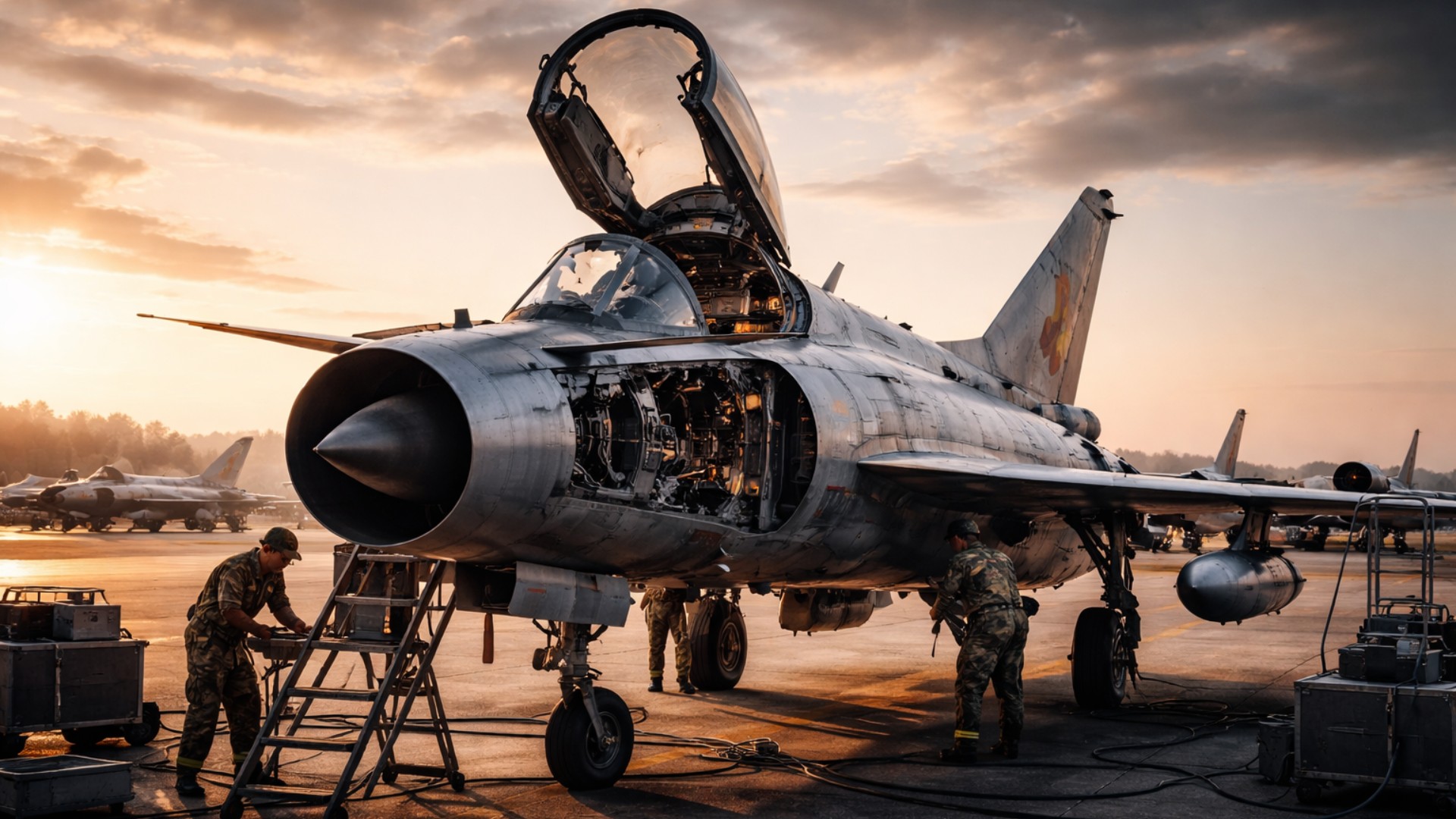
Movement marks end of historical cycle in Chinese military aviation and opens space for reuse of old aircraft in new strategic functions, including conversion to drones, export, and technological adaptation, reflecting military advancement and continuous modernization.
The withdrawal of the Chengdu J-7 fighter from active frontline service has been confirmed by China, covering both the People’s Liberation Army Air Force (PLAAF) and the People’s Liberation Army Naval Air Force (PLANAF), officially ending the trajectory of one of the country’s most emblematic aircraft.
With this, an operational cycle that spanned decades and accompanied different phases of Chinese military strategy comes to an end, consolidating the J-7 as a central piece of air defense during much of the second half of the 20th century.
Withdrawal of J-7 fighter marks end of an era in China
Even though it was anticipated by analysts, the confirmation of the deactivation symbolizes the closure of a significant chapter in the history of Chinese military aviation, especially as it concerns a model that was widely disseminated and adapted over time.
-
Six 400,000-year-old teeth found in China contained a protein that was believed to exist only in the mysterious Denisovans: the discovery reveals that Homo erectus interbred with this extinct relative and left a genetic trace that still lives in human populations today.

-
American donated US$ 5,000 to a Chinese farmer to plant trees in the desert, and decades later the money turned into a forest with more than 50,000 trees.

-
Almost no ship sails directly between South America and Australia, and the reason is a combination of the vast distance, winds that circle the planet nonstop, and the absence of ports along the way, leaving the South Pacific as a water desert.

-
More than 85 million homes in China heat water for free with vacuum glass tubes invented at a Chinese university, a cheap technology with no moving parts that faces certification rules and codes in the United States, making installation too expensive.




Inspired by the Soviet MiG-21, the J-7 began large-scale production in the 1960s and, over the years, underwent various modernizations that allowed it to remain active for a longer period.
During this time, the J-7 established itself as one of the main pillars of China’s air defense, being widely employed by both the air force and naval aviation in different strategic contexts.
Additionally, the production volume reached thousands of units, reinforcing its operational relevance and ensuring a constant presence in military bases spread across Chinese territory over several decades.
Fleet modernization accelerates replacement of J-7
In recent years, the withdrawal of the model occurred gradually, accompanying the technological advancement of the Chinese armed forces and the incorporation of more modern aircraft capable of meeting the demands of contemporary combat scenarios.
In this process, fourth and fifth generation fighters began to take on roles previously performed by the J-7, raising the sophistication level of the fleet and reducing dependence on platforms considered outdated.
Unlike an abrupt replacement, the transition was conducted in a planned manner, allowing for the progressive integration of new systems while older units were retired without compromising operational capacity.
What happens to retired fighters
With the definitive deactivation, a new stage arises regarding the fate of the aircraft that still remain in structurally adequate conditions, opening up different possibilities for reuse both domestically and internationally.
Among the alternatives analyzed are export to partner countries, use in secondary training roles, and adaptation for unmanned platforms, following a trend already observed in other air forces around the world.
In this context, the conversion to remotely piloted drones stands out as a strategic solution, allowing for an extension of the lifespan of these aircraft and reducing costs compared to the development of new equipment.
Furthermore, these platforms can be used in various missions, such as air defense training, combat simulation, and reconnaissance operations, broadening the range of military applications.
Military reuse follows international trend
The reuse of decommissioned aircraft is not limited to China, as other countries also adopt similar strategies aimed at maximizing resource utilization and reducing operational waste.
Within this scenario, the transformation of old fighters into drones represents an efficient alternative aligned with current demands, especially in light of the growing importance of unmanned systems in military operations.
This approach also allows for testing emerging technologies in real environments, while simultaneously expanding operational capacity without requiring high investments in new platforms.
New phase of Chinese military aviation
More than the retirement of a historic aircraft, the end of J-7 operations reflects a structural change in Chinese air defense strategy, which now prioritizes more advanced and integrated technologies.
Thus, the country’s air force advances towards a model centered on innovation, automation, and digital systems, keeping pace with the transformations of contemporary warfare scenarios and reinforcing its strategic positioning in the global landscape.
By concluding the trajectory of the J-7, China completes an important cycle in its military history and simultaneously consolidates the transition to a new generation of air capabilities.









Be the first to react!