





 Portuguese
  English
  Spanish
  4 min of reading
  0 comments


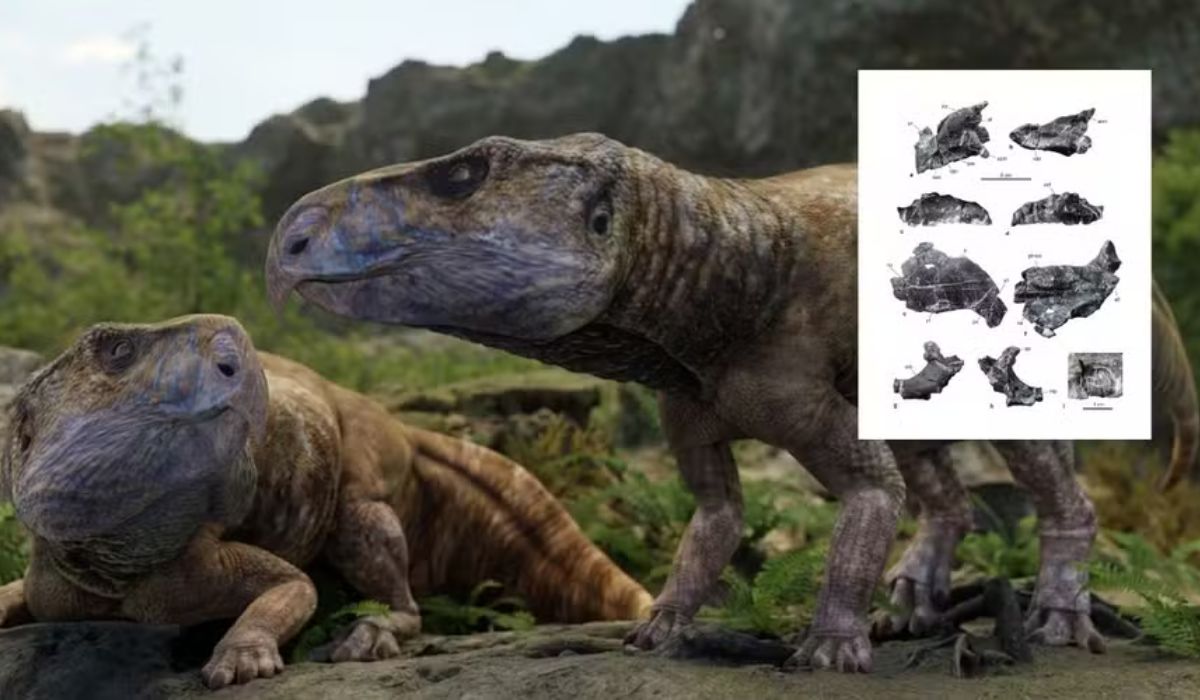
A fossil found in western Hungary reinforces the presence of horned dinosaurs in Cretaceous Europe and leads scientists to reassess classic models about the dispersion of these animals, as well as ancient classifications based on fragmentary records.
A skull set found in western Hungary reinforced the interpretation that ceratopsian dinosaurs were present in Europe at the end of the Cretaceous period.
The analysis of the material, attributed to the small herbivore Ajkaceratops kozmai, is part of a study published in the journal Nature and provides new elements for a debate that remained open since the initial description of the animal and leads researchers to reassess European fossils previously associated with other groups.
Based on this evidence, paleontologists began to revise classic models of dinosaur paleobiogeography.
-
With a cost per shot close to zero, the DragonFire laser could change naval warfare in 2027 and provide British ships with nearly unlimited defense against drones.

-
A British startup creates tires that generate electricity in electric vehicles when passing over potholes, speed bumps, and cracks.

-
Scientists have created robots made with living cells that have their own nervous system, swim on their own, explore the environment, and self-organize without any genetic engineering, and now they want to do the same with human cells.

-
Students create a solar-powered ambulance that operates without a plug, without fuel, and still keeps medical equipment running in remote areas.

Among them is the idea, widely accepted for decades, that ceratopsians—a group popularly known as “horned dinosaurs,” represented by forms like Triceratops—would have been distributed almost exclusively throughout Asia and North America throughout their evolutionary history.

Ceratopsian Dinosaur Fossil and Skull Analysis
The fossil analyzed in Hungary includes cranial parts considered more informative than those available in previous studies of Ajkaceratops.
In such research, the skull is often central to classification, as it concentrates anatomical characteristics used to differentiate closely related lineages, which may share similar traits in teeth or limbs but diverge in cranial structures.
According to the authors of the study, the material was examined using imaging techniques, including tomography and digital reconstructions, which allowed for the observation of internal details and areas that are hard to access in fragmented fossils.
This information was compared to data from ceratopsians already described in other regions, especially in Asia and North America, where the group is better documented.
Based on this comparison, the researchers point out that Ajkaceratops presents a set of characteristics compatible with ceratopsians, such as aspects of the beak and internal anatomy of the skull.
According to the team, this combination supports the attribution of the animal to the group, reducing uncertainties that persisted due to the fragmentation of previous finds.

Europe in the Cretaceous and Insular Environment
Estimates indicate that Ajkaceratops lived in the Late Cretaceous, about 84 million years ago.
At that time, Europe’s configuration was substantially different from today, with large parts of the continent formed by islands separated by arms of the sea associated with the ancient Tethys Ocean.
This geographical scenario helps contextualize the irregular distribution of fossils in the region.
Insular environments tend to generate more fragmented and localized fossil records, which makes it difficult to identify certain groups.
Still, the presence of a ceratopsian in this European context broadens the debate about how these dinosaurs dispersed among different landmasses during the Cretaceous.
In the specific case of Ajkaceratops, it is a small-sized animal, distinct from the more well-known images of large ceratopsians.
Experts emphasize, however, that this difference does not alter the relevance of the find, as the main point lies in confirming the group to which the animal belongs, rather than its body dimensions.
Reclassification of European Fossils
Until recently, the presence of ceratopsians in Europe was considered uncertain, supported only by fragmentary fossils and contested interpretations.
With the new cranial evidence, the debate gains a more consistent anatomical basis, according to the study’s authors.
This advancement has led researchers to consider reevaluating European fossils classified over the past century as belonging to other groups of herbivores, such as iguanodonts or rhabdodontids.
The overlap of characteristics among these dinosaurs may have influenced previous classifications, especially when the available material was limited.
According to the experts involved, part of this European material may represent a greater diversity of ceratopsians than previously recognized.
This possibility, however, depends on further analyses and careful review of specimens preserved in scientific collections, a process that tends to be gradual and subject to technical debates.
Dispersion of Ceratopsians Between Continents
The central discussion involves the history of ceratopsian dispersion.
The abundant fossil record in Asia and North America long supported the interpretation that the group developed and diversified mainly in these regions.
The confirmation of a ceratopsian in Europe adds a new element to this scenario, indicating that the group reached the continent at some point during the Cretaceous.
According to researchers, this does not alone define the routes or frequency of these dispersions but broadens the set of hypotheses that need to be considered in future studies.
Another point highlighted in the work is the role of modern imaging techniques.
Methods such as computed tomography allow for extracting anatomical information from incomplete fossils, increasing the potential of materials previously considered poorly diagnostic and contributing to more detailed taxonomic revisions.
Gaps in the European Fossil Record
Despite the advancement represented by the Hungarian fossil, the history of ceratopsians in Europe remains incomplete.
The scarcity of specimens attributed to the group limits estimates about diversity, geographical distribution, and possible regional lineages.
Additionally, taxonomic revisions often require extensive reanalyses of already described material, often involving divergent interpretations among specialists.
Some fossils may be confirmed as ceratopsians, while others may remain without definitive classification due to a lack of preserved diagnostic characteristics.
With the new material, Europe takes on a more active role in discussions about the evolution of ceratopsians.







-

-

-

-

-

-

39 pessoas reagiram a isso.