





 Portuguese
  English
  Spanish
  5 min of reading
  10 comments


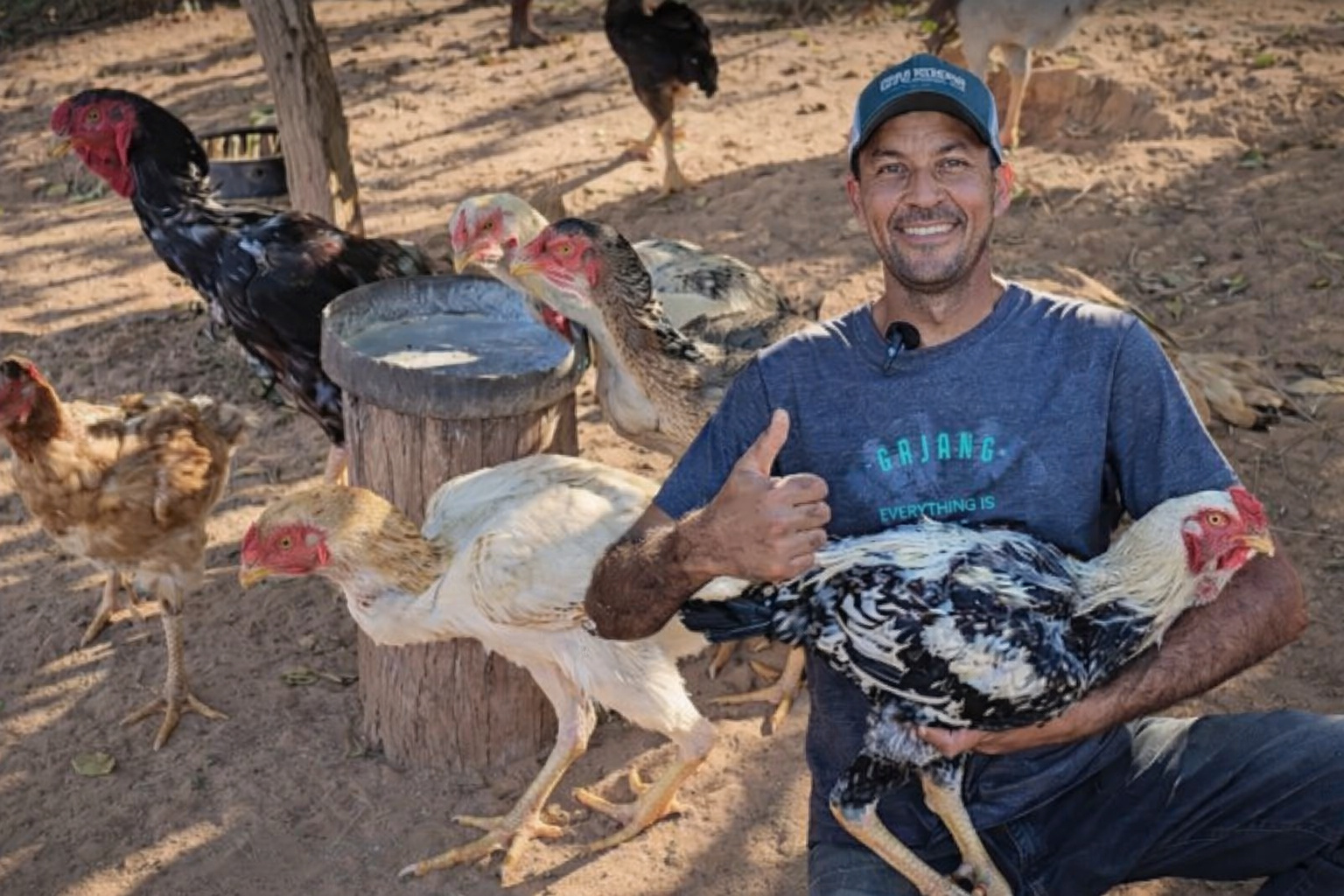


The Specialized Raising of Malaysian Indian and Giant Chickens Shows How Genetic Selection, Proper Management, and Direct Sales on the Farm Can Generate High Added Value, Reduce Losses, and Transform Small Rural Properties Into Lucrative Businesses
The raising of giant chickens has ceased to be merely a rural curiosity and has become a solid income-generating strategy in the countryside. In a farm in the countryside, a farmer found in the Malaysian Indian breed and crossings with giant roosters a highly profitable alternative, capable of surpassing the profitability of traditional free-range chicken farming. The secret lies in genetics, the strict selection of animals, and direct sales to the end consumer.
The information was disclosed in an audiovisual recording and field interview, where the producer details the entire process of raising, selecting, feeding, and marketing the birds, practically demonstrating how specific physical characteristics increase market value and ensure credibility with buyers.
Unlike conventional farming, the focus is not on quantity, but on quality. Each bird is observed from an early age, going through a rigorous screening that determines which roosters and hens truly meet the expected standard for reproduction or sale. This care avoids losses, reduces complaints, and strengthens the reputation of the breeder in the region.
-
Friends have been building a small “town” for 30 years to grow old together, with compact houses, a common area, nature surrounding it, and a collective life project designed for friendship, coexistence, and simplicity.

-
This small town in Germany created its own currency 24 years ago, today it circulates millions per year, is accepted in over 300 stores, and the German government allowed all of this to happen under one condition.

-
Curitiba is shrinking and is expected to lose 97,000 residents by 2050, while inland cities in Paraná such as Sarandi, Araucária, and Toledo are experiencing accelerated growth that is changing the entire state’s map.

-
Tourists were poisoned on Everest in a million-dollar fraud scheme involving helicopters that diverted over $19 million and shocked international authorities.


What Makes the Malaysian Indian Chicken and the Giant Rooster So Valued in the Market

The Malaysian Indian breed stands out due to a set of very specific physical characteristics. Among the most valued points are the thick wattles, popularly known as “beef wattles,” the short and robust beak, the wide head, the thick shank, and the ball crest, different from the high saw-like crest found in other breeds.
In addition, the size of the animal directly impacts its commercial value. A giant rooster, to be classified as such, must reach 1.15 meters or more, measured from the tip of the toe to the beak, with the body stretched over a surface. Roosters measuring 1.10 m or 1.12 m are already considered large, but only those above 1.15 m officially enter the giant category, which directly affects the price.
The Malaysian Indian, on the other hand, does not reach the same length as the giants, averaging between 90 and 95 centimeters, but compensates with robustness, musculature, and an imposing appearance. These attributes lead many breeders to use crossbreeding between the two lineages to obtain birds with accelerated growth and higher added value.
Another determining factor is the short tail. Roosters with long feathers that drag on the ground tend to lose market value. The less feather on the tail, the better the commercial acceptance, as this standard is associated with genetic purity and the tastes of specialized buyers.
Why the Producer Does Not Sell Eggs, Chicks, or Fertilized Eggs

Despite the high demand, the producer chose not to sell eggs, fertilized eggs, or chicks. The decision is strategic and directly related to the guarantee of the quality of the final product. According to him, by selling chicks, there is no way to ensure which birds will truly develop the desired characteristics, as from a batch of 50 chicks, only about 10 usually meet the ideal standard.
The same reasoning applies to fertilized eggs. It is not possible to visually guarantee if the egg is truly fertilized, which can lead to buyer frustration and harm the breeder’s image. Therefore, sales are made only from fully developed roosters and hens, allowing the customer to see the animal in person, observe its body size, physical conformation, and make the choice on-site.
This model eliminates conflicts, reduces returns, and strengthens trust. Many buyers arrive requesting photos or videos, but the producer prefers that the choice be made in person. Experience shows that upon arriving at the farm, the customer often changes their mind and selects another animal, something common when dealing with genetics and animal aesthetics.
Feeding, Management, and Supplementation: What Ensures the Growth and Health of the Birds

Feeding management is another pillar of raising chickens. The basis of the diet consists of a carefully prepared mixture. The producer uses 20 kg of layer feed, 40 kg of cracked corn, 15 kg of whole corn, in addition to 3 kg of calcitic limestone and supplementation with vitamins ADE.
This combination ensures not only accelerated growth but also nutritional balance. Calcitic limestone, for example, is essential to avoid problems of stress and aggressive behavior, such as the habit of pecking feathers off each other, something common in confined birds without proper calcium supplementation.
In the first few days of life, chicks receive preventive medication in water, such as the product known as Triufim, in addition to specific starter feed. After 30 days, the diet gradually shifts to a mixture with cornmeal and coarser grains, until the birds learn to feed themselves freely in the yard along with the free-range hens.
This system reduces costs, improves animal welfare, and contributes to a firmer and tastier meat, a factor highly valued by the end consumer.
Prices, Weight, and Quick Turnaround Make Raising Highly Profitable
The numbers help explain why raising giant chickens has become the main source of income for the farm. A chicken raised in this system reaches the point of sale in 90 to 100 days, with a low mortality rate when managed correctly.
When sold with feathers, these chickens are marketed for R$ 60 each. When processed and cleaned, they reach between 2.0 kg and 2.7 kg, being sold at prices ranging from R$ 70 to R$ 75, depending on the final weight. The traditional free-range chicken, which is more valued by the public, can be sold for between R$ 80 and R$ 100, depending on size and conformation.
The producer is also studying the sale by weight, with estimated prices of R$ 25/kg for cleaned giant chickens and R$ 35/kg for free-range chickens. This differentiation allows targeting different audiences and maximizing revenue without compromising quality.
Even the animals considered “culls” in genetic selection are utilized as free-range cut chickens, ensuring that practically nothing is wasted. The result is an efficient, sustainable system highly adapted to the reality of the small rural producer.
Would you invest in raising giant chickens as the main source of income on the farm, or do you believe that traditional free-range chicken is still the safest business in the countryside?









Realmente o autor não mencionou o lugar porque o artigo é meio inventado e os preços são de tempos passados
Como uma pessoa faz um vídeo desse e não informa contato?
Reportagem meia boca, não fala onde fica esse sítio.
Se esse pseudo repórter não sabe,dizer que fica no interior, não diz nada com coisa nenhuma