





 Portuguese
  English
  Spanish
  4 min of reading
  0 comments


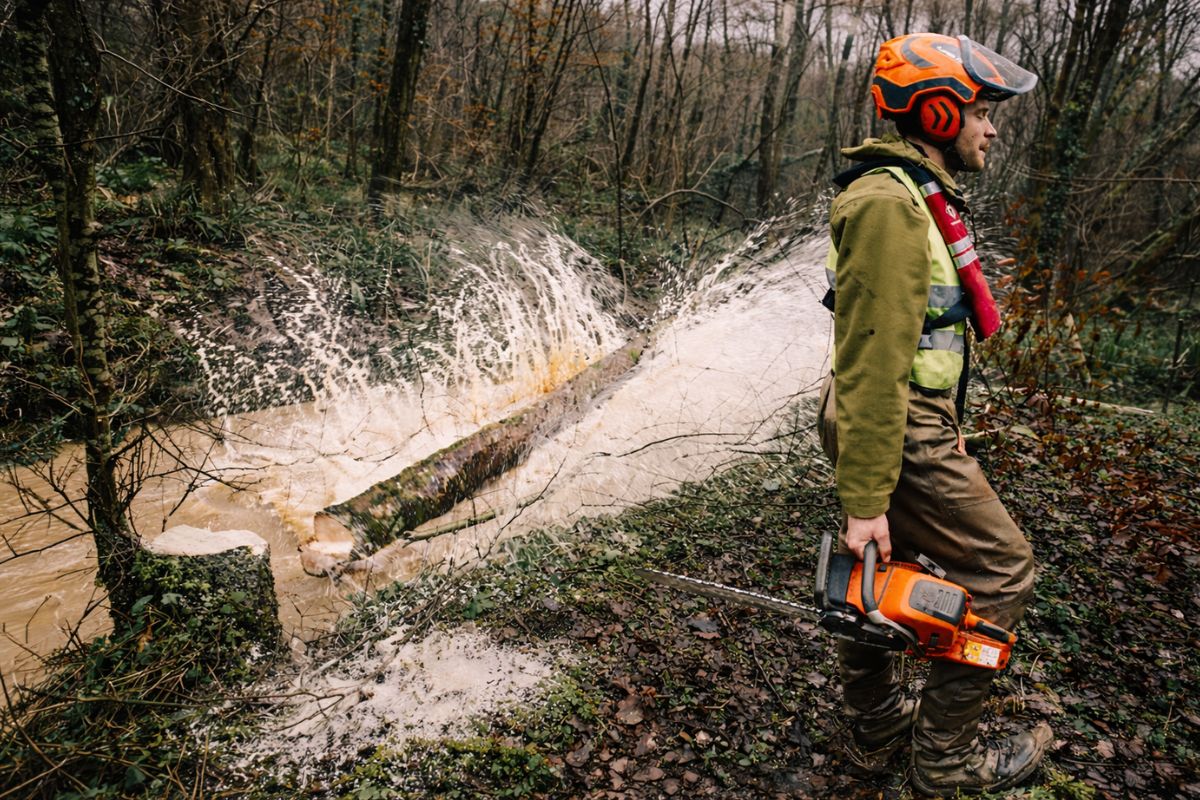
On The Chew, A British River Linked To The Bristol Avon Network, Teams Are Repositioning Wood, Driving Stakes And Cutting Trees With Chainsaws After Rains Made The Water Turbid And High. The Stated Goal Is To Create Hydraulic Roughness, Stabilize Vulnerable Sections And Redistribute Sediments Along The Points
On The Chew, A British Rural River, The Work Begins With An Action That Seems Contradictory: Chainsaws Are Felling Trees Considered Healthy And Pushing Wood Into The Channel. The Visual Shock Is Part Of The Communication Problem: Cutting And Management Seem The Same At First Glance.
The Intervention Was Presented As River Management In Partnership With The Bristol Avon Rivers Trust, With Support From Teams And Volunteers From The Bristol Area. The Logic Is Not Aesthetic, But Operational: To Use Wood, Stakes, And Positioning To Alter The Behavior Of Water In A British River That Has Become More Unstable After The Use Of The Surroundings And Rain Events.
Why Chainsaws Come Into Play In A British River

In The Field, The Justification Presented Is Straightforward: Trees And Branches Fall Naturally Over Time, But The Pace May Be Too Slow For A Stretch That Has Already Lost Margin Stability And Bed Regularity.
-
Motorola launched the Signature with a gold seal from DxOMark, tying with the iPhone 17 Pro in camera performance, Snapdragon 8 Gen 5 that surpassed 3 million in benchmarks, and a zoom that impresses even at night.

-
Satellites reveal beneath the Sahara a giant river buried for thousands of kilometers: study shows that the largest hot desert on the planet was once traversed by a river system comparable to the largest on Earth.

-
Scientists have captured something never seen in space: newly born stars are creating gigantic rings of light a thousand times larger than the distance between the Earth and the Sun, and this changes everything we knew about stellar birth.

-
Geologists find traces of a continent that disappeared 155 million years ago after separating from Australia and reveal that it did not sink, but broke into fragments scattered across Southeast Asia.

The Chainsaws Accelerate A Process That Would Occur Anyway, Concentrating In Days What Could Take Decades.
The Technical Point Is The Control Of Results.
In The Chew, Wood Is Not Treated As Debris, But As An Element Of Naturalistic Engineering, Placed In Specific Locations To Alter Flow Velocity, Break The Uniformity Of The Channel, And Reduce Energy At Critical Points.
For This, Chainsaws Define Size, Direction Of Fall, And Geometry Of The Material That Will Interact With The Current.
Wood As A Tool To Reorganize Flow And Sediments

When A Trunk Enters The Channel, It Increases Hydraulic Roughness And Changes The Flow Pattern. This Can Create Zones Of Lower Velocity, Favor Sediment Deposition At Some Points, And Force The Flow To Bypass Obstacles In Others, Opening Depth Variations.
In This Model, The Wood Works As A “Brake” Located To Redistribute Energy From The British River.
In The Chew, The Team Describes Three Formats For Inserting Wood: Larger Trunks Loosely Placed By Their Own Weight, Stacked Branches, And The Solution That Keeps Part Of The Tree Connected To The Soil.
The Intention Is To Achieve Stability With Minimal Permanent Infrastructure, Using Wood As A Basis For Fine Tuning And Choosing Locations Where The Channel Has Already Shown Vulnerability.
Stakes, Wire, And Fixation When The Rain Changes The Game

After A Night Of Heavy Rain, The Level Of The British River Rose And The Water Became Turbid, Described As “Chocolate”.
Previously Positioned Trunks Became Dislodged And Had To Be Brought Back, Not Out Of Caprice, But Because High-Energy Flow Easily Displaces Wood If There Is No Locking.
The Operational Response Was To Fix With Stakes And Wire: Stakes Driven Into The Sides, Wire Loops Tightening The Set, And Metal Pins Helping To Maintain Tension.
The Stakes Become The Link Between The Piece And The Ground, Reducing The Probability Of Displacement And Transforming A Loose Trunk Into A Hydraulic Control Structure In The Chew.
The “Articulated” Tree And The Controlled Opening Of Coverage
A Technique Mentioned Is The “Articulated Tree”: The Tree Is Felled, But Not Cut Close, Maintaining Connection So That The Material Is Not Easily Removed By High-Flow Events.
The Reasoning Is Mechanical: The Connection Increases Resistance To Drag And Reduces The Chance Of The Trunk Becoming A Errant Object In A British River During Intense Rain.
Additionally, There Is A Decision To Open Space In The Coverage To Allow Light To Enter Specific Pockets, Instead Of Altering The Whole Stretch.
This Choice Appears As Calibration, Not As Cleaning. Chainsaws, Wood, And Stakes Enter Here As Precision Tools: Cutting Less, Positioning Better, And Using Stakes Where The Force Of Water Tends To Prevail.
How To Assess Whether The Intervention Worked Without Relying On Perception
The Promise Of The Project Is To Observe Changes In A Few Months, But Validation Requires Simple And Repeatable Metrics.
In A British River Like The Chew, The Most Direct Indicators Are Physical: Depth Variation, Creation Of Low-Velocity Areas, Reconfiguration Of Sediment Bars, Reduced Erosion On Banks, And Diminished Fine Material In Suspension After Rain Events.
The Second Group Is Operational: Whether The Wood Remains Where It Was Placed, Whether The Stakes Hold Under High Flows, And Whether The Stretch No Longer Requires Continuous Repositioning.
When Stakes Fail, The Intervention Becomes Eternal Maintenance; When Stakes Work, It Becomes Stable Reconfiguration. The Difference, In This Case, Is Less Discourse And More Consistency Of The Bed Over Time.
The Image Of Chainsaws Felling Trees In A British River Is Uncomfortable Because It Challenges The Common Sense Of “Not Touching”.
In The Chew, The Intervention Was Presented As An Attempt To Reorganize Flow And Sediments With Wood And Stakes, Accepting The Appearance Of Destruction To Prioritize Stability And Hydraulic Control.
If You Saw Chainsaws Operating On The Banks Of A British River In Your Area, What Would Weigh More In Your Assessment: The Scene Of The Cut, A Report With Measurements Before And After, Or The Transparency About Where The Wood And Stakes Were Installed And Why?







-

-

-

-

-

-

12 pessoas reagiram a isso.