





 Portuguese
  English
  Spanish
  5 min of reading
  0 comments


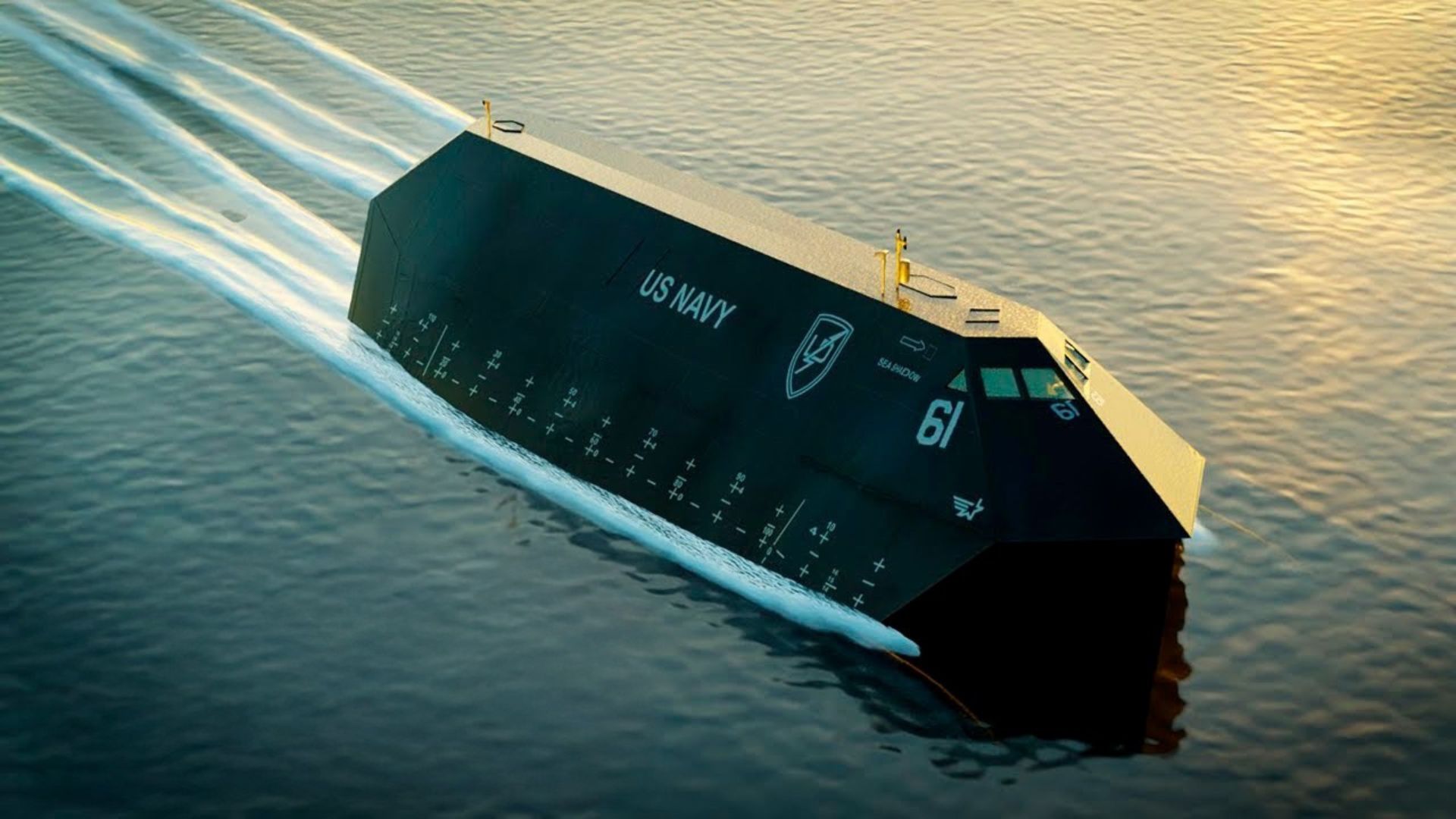
Ultra-Secret Project of the United States Navy Tested Naval Stealth with Innovative SWATH Hull, Night Operation, and Hidden Construction Inside a Submersible Barge, Becoming a Technological Symbol of the Cold War Before Being Dismantled by Official Requirement.
The Sea Shadow (IX-529), an experimental prototype of the United States Navy, was designed to reduce the radar signature of a surface ship and test an unusual hull, the SWATH, on a real vessel of 164 feet and a displacement of 563 tons, according to official records from the U.S. government.
Rather than being born as a “combat ship,” the project was described as a testing platform, aimed at validating shapes, materials, and stability solutions that could reduce the chance of detection and thereby shorten an adversary’s reaction time in the technological landscape of the Cold War.
The existence of the Sea Shadow remained classified until 1993, and confidentiality was treated as part of the program itself, with trials limited to nighttime while the prototype had not yet been publicly recognized, as recorded by the Maritime Administration.
-
Friends have been building a small “town” for 30 years to grow old together, with compact houses, a common area, nature surrounding it, and a collective life project designed for friendship, coexistence, and simplicity.

-
This small town in Germany created its own currency 24 years ago, today it circulates millions per year, is accepted in over 300 stores, and the German government allowed all of this to happen under one condition.

-
Curitiba is shrinking and is expected to lose 97,000 residents by 2050, while inland cities in Paraná such as Sarandi, Araucária, and Toledo are experiencing accelerated growth that is changing the entire state’s map.

-
Tourists were poisoned on Everest in a million-dollar fraud scheme involving helicopters that diverted over $19 million and shocked international authorities.


Naval Stealth Inspired by Military Aviation

The attempt at “stealth” in the naval environment aimed to adapt ideas that had already circulated in aviation but faced different obstacles at sea, where waves, foam, wakes, and constant contact with saltwater altered signals and degraded materials over time.
The most visible point of this bet was in the design of the ship’s top: flat surfaces and sharp angles replaced curves, in a logic associated with dispersing radar energy and reducing direct returns to the emitter, a similar approach to low observability aerospace designs.
Still, the program was not limited to the “shell” of the Sea Shadow, as the Maritime Administration also records the goal of evaluating the stability of a specific hull configuration, the Small Waterplane Area Twin Hull (SWATH), known for reducing the area at the waterline and increasing stability with submerged volumes.
HMB-1: The Barge That Hid the Prototype
To keep the prototype out of sight, construction and part of the operation occurred inside the Hughes Mining Barge 1 (HMB-1), a submersible barge used as a shelter and support, according to the defense agency linked to technological risk projects.

The option had a practical effect and a strategic one: in addition to allowing access control and hiding the shape of the ship, the structure acted as a covered “dry dock,” favoring maintenance, test preparation, and return to shelter during the day when public visibility increased.
Behind this backdrop, the HMB-1 itself already carried a rare reputation, linked to previous secret operations, because it was used in a logistical phase of Project Azorian, a CIA mission to recover part of a Soviet submarine from the ocean, as reported by the U.S. press.
In the case of the Sea Shadow, the barge played a less cinematic and more constant role: to hide a program that, according to official records, was conducted “under a high degree of secrecy” and, until public disclosure, had trials conducted only at night.
Technical Problems and Adjustments at Sea
Taking a “stealth” ship to the water exposed contradictions that do not appear in models, and the program’s documentation itself records that the initial tests were disappointing because the wake was “unexpectedly large” and detectable, including by sonar and from the air.
According to those responsible for the project, the problem was attributed to an installation error, with propellers mounted backward, and the program advanced after correction, highlighting how mechanical details can compromise the discretion intended by geometry designed to deceive radars.
Meanwhile, the operational routine described in visitation archives indicates that tests occurred in controlled windows, with the HMB-1 serving as cover for refueling and repairs during the day, which helped keep the prototype away from casual eyes for years.
Public Revelation and Final Destination in Scrap

The exposure of the Sea Shadow to the public occurred in 1993, when secrecy ceased to be a central part of the program, although the ship remained an experimental platform, without evolving into a commissioned vessel routinely employed in missions.
In official records, the prototype appears with measurements that size the project as something fully built to naval scale, including 164 feet in length, 68 feet in beam, and a displacement of 563 tons, along with the observation that the ship was not fully commissioned.
With the end of the usage cycle, the Sea Shadow was incorporated into the reserve fleet in Suisun Bay in September 2006 and, later, sold and removed from the area on July 13, 2012, which ended its administrative trajectory within the U.S. government structure.
When the alienation was defined, the rule was not to preserve, but to eliminate, as the official guidance determined that the vessel was to be “completely dismantled and scrapped within the U.S.A.,” with a prohibition on use as transport.
Regarding the same auction, the U.S. press highlighted the dismantling and scrapping requirement as a condition for winning the bid, which in practice made it unfeasible to turn the Sea Shadow into a navigable attraction or to keep it as a living piece in operation.
Thus, the ship that became a legend for existing “in the shadows” ended up as recyclable material, while its main legacy remained in the design lessons and the errors detected at sea, a reminder that the naval environment requires, sooner or later, the price of every engineering decision.
If a prototype like the Sea Shadow needed a submersible barge to operate away from daylight and only gained public name when it had already completed its testing phase, how many other naval experiments may have existed under secrecy before appearing in official records?









Seja o primeiro a reagir!