





 Portuguese
  English
  Spanish
  9 min of reading
  0 comments


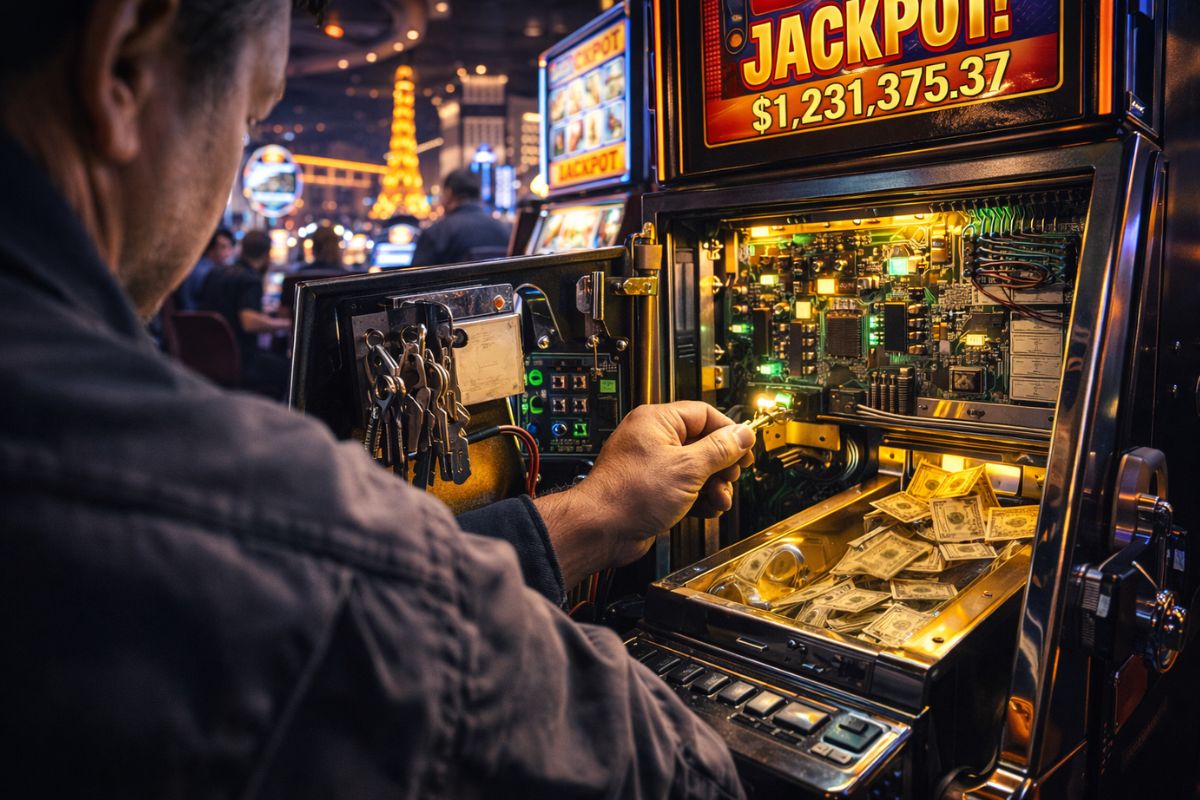
The Real Story Of The 57-Year-Old Locksmith Who Turned Slot Machines Into Programmable Zombies, Stole Millions Of Dollars In Las Vegas Without Triggering A Single Alarm, And Forced Casinos And Manufacturers To Redesign Their Entire Security Technology.
On June 10, 1998, at 10:14 PM, in Las Vegas, the slot machines were running in automatic mode. Drunken tourists shouted at the craps tables, cocktail waitresses balanced trays of drinks, and no one noticed the gray-haired man standing in front of a state-of-the-art slot machine. In less than 5 seconds, he would reach into the machine’s electronic brain, swap a single chip, and walk away a few minutes later with US$ 3.7 million guaranteed, without a single camera suspecting a thing.
Las Vegas is a neon ecosystem built for money to flow in and never come out. Just in slot machines, the city moves billions of dollars a year, with over 200,000 terminals spread across casinos and monitored by tens of thousands of high-definition cameras. This entire digital fortress was dismantled by someone who wasn’t a hacker or a mobster, but a locksmith obsessed with mechanisms, codes, and the idea of turning the logic of slot machines to his favor.
The Silent Empire Of Slot Machines

The modern casino looks nothing like the old mafia movies. There are no dark-suited thugs waiting in the basement with baseball bats. The enemy today is invisible: it’s a total surveillance system that combines cameras, software, and statistics.
-
Friends have been building a small “town” for 30 years to grow old together, with compact houses, a common area, nature surrounding it, and a collective life project designed for friendship, coexistence, and simplicity.

-
This small town in Germany created its own currency 24 years ago, today it circulates millions per year, is accepted in over 300 stores, and the German government allowed all of this to happen under one condition.

-
Curitiba is shrinking and is expected to lose 97,000 residents by 2050, while inland cities in Paraná such as Sarandi, Araucária, and Toledo are experiencing accelerated growth that is changing the entire state’s map.

-
Tourists were poisoned on Everest in a million-dollar fraud scheme involving helicopters that diverted over $19 million and shocked international authorities.


On the ceiling, the famous “eye in the sky” watches everything. Dark domes conceal cameras capable of zooming in enough to see the serial number of a bill in a player’s hand from dozens of meters away.
Facial recognition software cross-references each visitor’s face with real-time databases of authorities.
But the real heart of this control machine is the slot machine itself. The modern version is no longer a set of mechanical gears; it is a shielded computer. Inside, a special chip governs everything.
A random number generator runs billions of combinations per millisecond, determining whether each bet is a win or a loss.
The math is programmed to ensure that the house retains a fixed slice of the money in the long term. For those on the outside, consistently beating slot machines is a carefully planned statistical impossibility.
If someone tries to force the door, sensors trigger silent alarms. External magnets are blocked by internal shields. Attempts to access the software run into layers of encryption.
That’s why the locksmith’s feat was not just a high-value theft. It was a direct attack on the belief that slot machines were inviolable.
Who Was The Locksmith Who Challenged Las Vegas
Years before the heist in Las Vegas, far from the bright lights of the casinos, Denis lived in Chicago and drew no attention. Glasses, plain clothes, a low voice, the appearance of a retiree who enjoys fishing on weekends. Nothing about him resembled a cinematic “master criminal”.
His strength lay in something much more discreet: he was a locksmith. Not the common professional who opens a car when the key is left inside, but a master of precision mechanics. Since he was young, Denis had developed an obsession with understanding how things close and, more importantly, how they open.
He learned to read the tension of springs, the behavior of metal pins, and the minimum tolerances of industrial locks.
He looked at a high-security lock and saw not an obstacle, but a mechanical puzzle begging to be solved.
Over time, he realized that the world was migrating from steel to silicon. Locks were becoming electronic, keys were turning into codes.
Rather than ignore this change, he decided to keep up with it. He bought technical manuals, studied circuit diagrams, and learned the basics of microchips and digital electronics. Denis combined the steady hands of a surgeon with the technical curiosity of a software engineer.
He did not seem motivated by pure greed. What seduced him was the intellectual challenge. Looking at the hypnotic glow of the slot machines in Las Vegas, he did not see fun or entertainment; he saw a giant machine designed to take money from fools. And he decided he would not be one of them.
How He Turned Slot Machines Into Programmable Zombies


Denis’s plan had a simple starting point: if you can’t predict the outcome of a system, the only way to win is to dictate the outcome.
Instead of trying to guess the exact moment when the random number generator would deliver a jackpot, he decided to mess with the machine’s brain.
For months, Denis was able to legally acquire a slot machine identical to those used in large casinos. He took the equipment to his garage and began to dismantle each part.
He studied the motherboard, identified the chip responsible for the game’s logic, and delved into the code that made the machine decide between “you lost” and “you won.”
He discovered the “digital master key”: the component that, if altered, reset the rules of the game. With chip recording equipment, he started copying and rewriting the content of that electronic brain, understanding the proprietary pattern of the manufacturer.
Then came the step that the industry considered impossible. Denis created a fake chip, visually identical to the original but with a hidden instruction. It was what he himself referred to as a backdoor, a secret command.
When a specific sequence of buttons was pressed, or when coins were inserted in a certain way, the machine would ignore chance and directly deliver the maximum prize.
In practice, he turned slot machines designed to drain money into obedient devices that appeared normal to anyone but responded to a hidden code that only he knew.
The Perfect Choreography Of The Heist Inside The Casino

What remained was the more dangerous problem: how to open a locked machine in the middle of a crowded room, swap a delicate chip on the motherboard, and close everything without triggering a single alert, surrounded by cameras and security?
For that, Denis assembled a team. He recruited big men with no technical role, but with a simple, crucial mission: to create a human curtain. These blockers were to spread around the target machine, play on neighboring machines, hold large cups, read newspapers, talk loudly, laugh, and gesture.
From the cameras’ perspective on the ceiling, it would just look like a group of excited tourists squeezed around the slot machines. In practice, they formed a wall of flesh that blocked the most important lines of sight.
Meanwhile, Denis entered the casino like any regular customer. Jacket over his arm, tools hidden, modified chip in his pocket. He walked naturally, not staring at the cameras, like someone who had frequented the place for years.
When the setup was complete, he approached the chosen machine. In less than a minute, using a master key he had developed by studying the pattern of circular maintenance locks, he opened the side cabinet, located the original chip, removed the component with an extractor, and inserted the ghost chip in its place.
No cut wires, no brute force, no laptop plugged into the service door. Just quick hands, a perfectly copied key, and a pre-programmed chip. When he locked the machine again, it looked identical to all the others. But now it was an obedient zombie.
Denis didn’t play immediately. An accomplice would sit first, “warming up” the machine with a few bets, simulating normal play.
Then the executor would enter, following the secret sequence: inserting coins, pressing the buttons in the predetermined order, pulling the lever.
Roll after roll, the jackpot symbols aligned. The lights exploded, the siren sounded, the victory sound flooded the room. Security rushed to congratulate the “lucky one,” offered champagne, and smiled for the cameras.
The casino paid out the maximum prize believing it was facing a rare case of luck when in fact it was aiding the perfect heist created from within the slot machines themselves.
Years Of Invisible Heists And The Greed That Took Down The Operation

The operation was not an isolated heist. Over the years, the group repeated the process in different gaming houses, always carefully, always swapping chips, always activating the backdoor at the right moment. Millions of dollars were silently extracted.
Denis grew confident. Too confident. He began planning a big final heist, a “Big One” that, according to internal talks, could yield something like US$ 17 million in a single shot. The higher the value, the greater the risk.
The problem was no longer the slot machines, but the people. One of the team members started feeling cheated in the money division. The internal conflict ignited a spark that the security system could not detect on the electronic boards.
The Nevada Gaming Control Commission and the FBI received an anonymous tip. Instead of arresting the group immediately, they preferred to observe. Agents managed to install wiretaps, even in locations near Denis’s home.
As he proudly explained the technical details of the new chips to an associate, he was actually being listened to in real time by investigators taking notes on every sentence.
One of the tensest moments occurred when he, already under surveillance, discreetly tested a lock in the casino. Upon inserting the key, he noticed a different resistance due to recent maintenance.
A security guard noticed the movement and stared at Denis for a few seconds. With cold blood, the locksmith pretended to have dropped a coin, bent down, hid the tool, complained about “bad luck,” and left. The security guard lost interest.
This time, however, he wouldn’t escape for long. The net was closing in. Denis would be arrested at home, surrounded by agents who found keys, chips, manuals, and detailed notes on the inner workings of the slot machines and the algorithms used by manufacturers.
When The Industry Discovered The Enemy Was Inside The Machine
From the casinos’ perspective, arresting the culprit seemed like the end of the story. But when the manufacturer’s engineers and gaming security experts analyzed what Denis had done, the mood was not one of relief. It was panic.
They realized they hadn’t just captured a thief. They had found someone who had rendered the entire business model based on the inviolability of slot machines obsolete.
Denis did not exploit an isolated error. He created a systemic, repeatable flaw that could be taught, copied, and sold.
The estimated balance of the group exceeded US$ 16 million. Denis was convicted and ended up in prison. But the casinos’ reaction was immediate and costly.
The industry was forced to spend hundreds of millions of dollars to replace chips, reinforce encryption, and replace physical locks with much more complex electronic systems.
The locksmith himself tried to cooperate in exchange for a lesser sentence, showing step by step how he opened the machines, how he reprogrammed the brains of devices that were supposed to be impregnable.
Engineers watched in astonishment as he calmly disassembled equipment that was supposedly shielded against any human intervention.
Years later, official records indicate that Denis died in 2010 of natural causes. For the authorities, the case was closed. For the casinos, a trauma that still dictates how the new generations of machines are designed, tested, and monitored.
The Ghost Of The Locksmith And The Doubt Left In The Slot Machines
Despite the arrest and death, a significant portion of the money was never recovered. Millions simply vanished from the accounts, without a trace. This void fueled persistent rumors behind the scenes in Las Vegas.
Some theories suggest that Denis did not act solely for his own benefit. For certain investigators and people from the underworld, it is possible that he sold the concept of the “ghost chip” to criminal organizations on other continents before being captured.
There are talks of machines operating on international cruise ships, underground casinos, and gaming houses in distant regions, still carrying variations of the code he created.
The uncomfortable question is simple: is there someone, somewhere in the world, still sitting in front of an apparently ordinary machine, just waiting for the secret sequence to activate a legacy left behind by a locksmith from Chicago?
More than money, Denis left a disturbing lesson. We trust machines because we believe they are neutral, mathematical, and fair within their own game.
But every machine was designed by humans, and everything that one human builds, another can dismantle, reprogram, and turn against the system.
After learning this story, would you still have the courage to trust your money to slot machines, believing you are only playing against chance?









Seja o primeiro a reagir!