





 Portuguese
  English
  Spanish
  6 min of reading
  0 comments


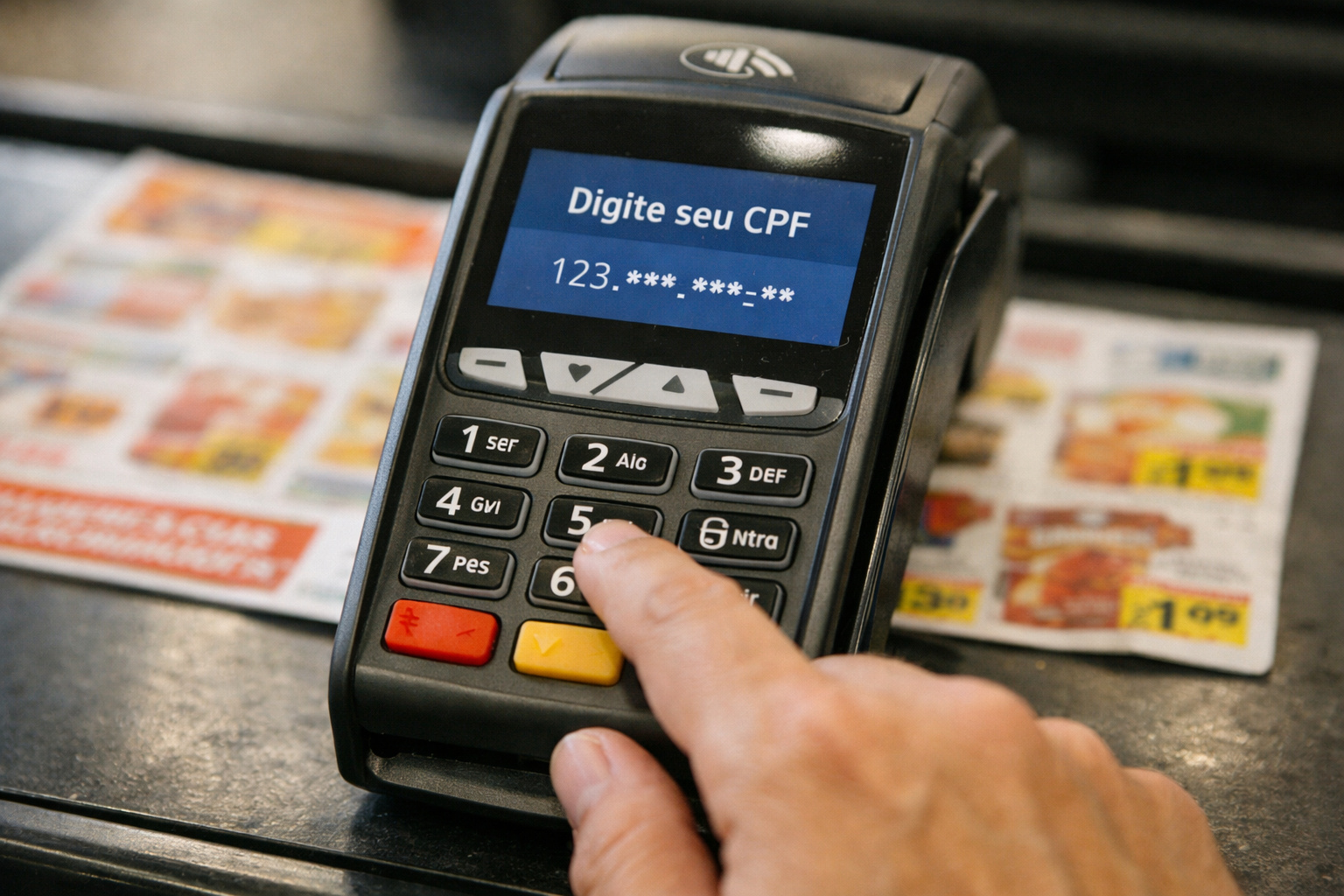
Understand Why Informing the CPF at the Checkout Is More Than a Habit for Discount and Begins to Influence Privacy, Economic Profile, and Commercial Strategies in Supermarkets as of 2026
When informing the CPF for purchases at the supermarket, many consumers still believe that the practice serves only to obtain immediate discounts, access exclusive offers, or participate in loyalty programs. However, this perception is changing rapidly. In 2026, with the accelerated advancement of data analysis systems, big data, and artificial intelligence, the use of CPF in purchases will play a much more strategic role for companies — and be much more sensitive from the consumer privacy perspective.
The information was disclosed by specialized portals in consumption and technology, according to recent articles that analyze the intersection between personal data, purchase history, and payment methods in retail. According to these analyses, the CPF has ceased to be merely an identifier for discounts and has begun to integrate robust databases capable of mapping habits, consumption frequency, and even the economic profile of customers.
In this context, the so-called notice for all who provide the CPF when shopping at supermarkets in 2026 arises as an alert. The objective is to clarify what is being done with this information, what the legal limits are, and what choices the consumer can exercise in light of this new digital scenario.
-
Artificial intelligence is skyrocketing energy consumption, raising emissions from tech giants and pushing Google, Microsoft, and Meta closer to natural gas.

-
Mercor paid $1.5 million per day for doctors, lawyers, and former Goldman Sachs bankers to teach artificial intelligence to do their jobs, and in 17 months, it went from zero to $500 million in annual revenue while its own contractors accelerated the replacement of their own work.

-
Casio Unveils Moflin, Robotic Pet With Artificial Intelligence Designed To Provide Emotional Comfort And Simulate A Permanent Affectionate Bond

-
Google Maps Revolutionizes GPS Navigation With Gemini Artificial Intelligence, Ask Maps Feature, and Advanced 3D Visualization for Route and Travel Planning

Notice About CPF in Supermarkets in 2026: What It’s About
When talking about a notice directed at those who provide the CPF at the checkout, the central point is the handling of personal data. Starting in 2026, the trend is that large supermarket chains will adopt even more sophisticated solutions in big data and artificial intelligence, cross-referencing CPF with purchase preferences, holidays, approximate location, and consumption behavior over time.

Every time the CPF is entered at the checkout or provided through prior registration, the system records that transaction. Thus, it becomes possible to identify which products are purchased most frequently, what the average monthly expenditure is, which promotions generate the most engagement, and even during which periods the consumer buys the most. This data is used for strategic decisions, such as pricing, inventory management, and targeted marketing campaigns.
On the other hand, this same set of information connects a sensitive personal identifier, the CPF, to consumption behavior. In 2026, this relationship requires even more attention to data protection regulations, avoiding abusive use, leaks, or unauthorized selling. Therefore, communications from companies and consumer protection agencies have emphasized the importance of transparency in privacy policies.
Why CPF Is Requested for Supermarket Purchases
The request for CPF at the checkout does not happen for just one reason. In most chains, the number is associated with loyalty programs that offer differentiated prices, accumulated points, cashback, or personalized coupons. In other cases, the CPF is used for issuing electronic invoices, participating in promotional campaigns, or controlling benefits per customer.
In general, supermarkets justify the collection of CPF for four main purposes:
Loyalty programs aimed at creating registrations that unlock exclusive offers and personalized discounts.
Electronic invoices, when the consumer chooses to link the CPF to the purchase.
Promotional campaigns and raffles that require identification to participate in prizes and marketing actions.
Consumption analysis, allowing tracking of purchase volume, most consumed categories, and visit frequency.
Although these justifications are presented as benefits to the consumer, the volume of data generated grows significantly with each purchase recorded with CPF, especially in an increasingly digitalized scenario.
CPF in Supermarkets in 2026 Enters the Radar of Artificial Intelligence
In practice, the more times the CPF is provided, the more complete the consumption history associated with that customer becomes. In 2026, with the integration between physical stores, apps, discount clubs, and delivery platforms, a single CPF can consolidate purchase information made in different cities and channels.
This cross-reference broadens the scope of stored data and allows for more detailed analyses. Artificial intelligence begins to identify behavior patterns, predict future preferences, and adjust campaigns almost in real time. Thus, the CPF ceases to be just a number and begins to function as a central key for consumer profiling.
At the same time, the concern about the responsible use of this information is growing. In 2026, guidance notices reinforce that data handling must follow clear rules, ensuring that the consumer knows why their data is collected, how it is used, and how long it remains stored.
What Precautions to Take When Informing the CPF in Supermarkets in 2026
With the increased use of data, precautions regarding the CPF gain even more relevance. The notice for all who provide the CPF when shopping at supermarkets in 2026 often highlights simple yet important measures to protect personal information.
Among the main points of attention are reading the privacy policies, evaluating the real necessity of providing the CPF for each purchase, and being cautious when providing additional data in registrations. In many cases, information such as income, detailed preferences, or extra personal data is not mandatory.
Furthermore, monitoring communications received via email, SMS, or apps helps understand how the consumption profile is being used. Current legislation also guarantees the right to request correction, revision, or even exclusion of data, as applicable.
Another frequent alert concerns the exposure of CPF in insecure environments. Providing the number aloud in busy lines, writing it down on unnecessary papers, or sharing images of invoices on social media can facilitate improper uses, especially in an intensely digitalized scenario starting in 2026.
How CPF Usage in Purchases Impacts the Consumer’s Daily Life
The recurring use of CPF in supermarkets generates direct impacts on daily life. On one side, advantages such as personalization of offers, targeted coupons, and more competitive prices on certain products arise. On the other side, there is an increase in the traceability of consumption behavior, bringing the shopping routine closer to a highly monitored environment.
This traceability influences campaigns displayed in apps, social media, and geo-localized ads. A consumer who frequently provides the CPF tends to receive communications aligned with the categories they consume most, such as specific foods, cleaning products, or children’s items. In 2026, with the cross-reference between different platforms, this segmentation becomes even more sophisticated.
In light of this, some consumers opt to keep their CPF registered across all chains, taking advantage of commercial benefits. Others prefer to limit sharing, informing the number only when strictly necessary. The central point of the notices is to reinforce that the decision must be conscious and informed, leaving it to the owner to evaluate when it is worthwhile to provide the CPF.
Many people still associate the CPF at the checkout solely with immediate discounts. However, 2026 marks an important turning point in this understanding, expanding the debate on data, privacy, and consumer choice.
What to Expect from Notices About CPF in Supermarkets in the Coming Years
The trend for the coming years is the increase in clearer and more direct notices regarding the use of CPF in purchases. Supermarket chains and consumer protection agencies should intensify guidance on transparency, right to choose, and security of personal information.
The notice for all who provide the CPF when shopping at supermarkets in 2026 is based on three main pillars: transparency in data handling, the consumer’s right to decide when to inform the CPF, and precautions regarding the exposure of personal information. With access to this information, the consumer gains more control over their relationship with retail in an increasingly digital environment.
Source: In Focus









Seja o primeiro a reagir!