





 Portuguese
  English
  Spanish
 4 min of reading
  58 comments


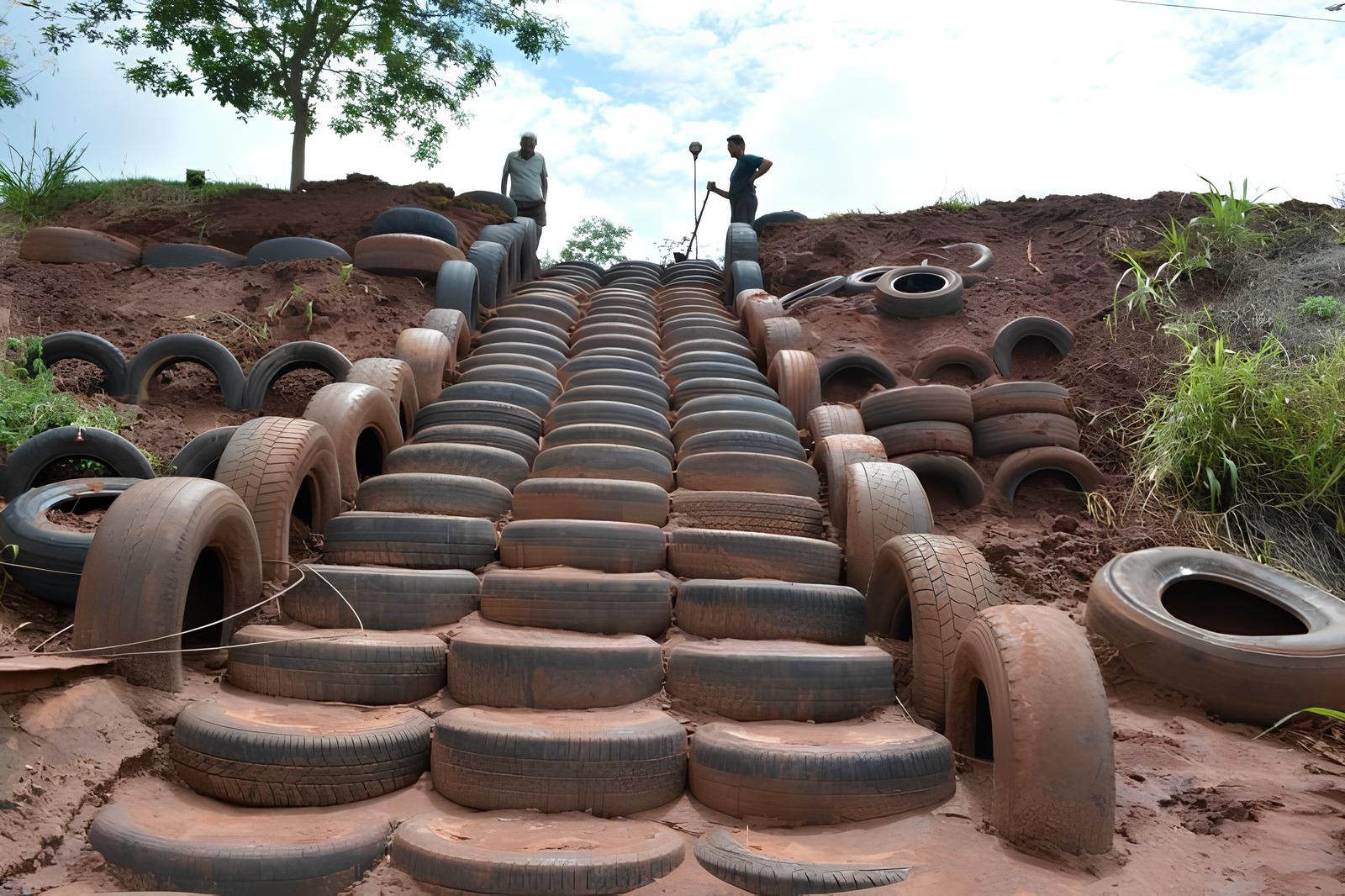


Without Public Support, A Resident of Camapuã Used Discarded Tires to Build a Staircase on a Steep Embankment, Improving Mobility and the Routine of the Neighborhood.
In 2016, during the holiday period, a resident of the city of Camapuã, in the interior of Mato Grosso do Sul, decided to solve an old mobility problem faced by the population of his neighborhood on his own. Without public works, machinery, or any official funding, Giovani Sanchez, then 38 years old, used discarded tires to build a staircase on a steep embankment that separated two streets and served as an improvised passage for the neighborhood. The initiative was reported by the Campo Grande News, which documented the work and its direct impact on the community’s routine.
The location, previously marked by erosion, mud, and constant risk of falls, now had a stable and safe path, built entirely from reused materials. In Ceará, there is also a colossal work of a wall with 5,000 tires, see
A Common Problem That Affected The Whole Neighborhood
Before the intervention, the stretch functioned as an informal shortcut used daily by residents who needed to shorten the distance between two points in the neighborhood. The embankment, however, had no type of containment or steps. During the rainy season, the passage became slippery and dangerous, making it difficult for the elderly, children, and workers to move around. A resident reused about 5,000 discarded tires, stacked and reinforced them with cement to build a retaining wall in Ceará, transforming urban waste into heavy engineering.
-
Friends have been building a small “town” for 30 years to grow old together, with compact houses, a common area, nature surrounding it, and a collective life project designed for friendship, coexistence, and simplicity.

-
This small town in Germany created its own currency 24 years ago, today it circulates millions per year, is accepted in over 300 stores, and the German government allowed all of this to happen under one condition.

-
Curitiba is shrinking and is expected to lose 97,000 residents by 2050, while inland cities in Paraná such as Sarandi, Araucária, and Toledo are experiencing accelerated growth that is changing the entire state’s map.

-
Tourists were poisoned on Everest in a million-dollar fraud scheme involving helicopters that diverted over $19 million and shocked international authorities.


The alternative would be to take a long detour through paved streets, considerably increasing travel time. The absence of an official solution led the resident to act independently, taking advantage of his free time during the holidays to carry out the work.
Reuse of Tires as a Simple Structural Solution
According to the report, Giovani collected approximately 140 used tires through donations from local merchants and tire shops. The material, which would normally be destined for illegal disposal or landfills, was transformed into the structural base of the staircase.

The technique employed involved stacking the tires in rows following the natural slope of the land. Each tire was filled with compacted earth, which ensured enough weight to prevent displacement and created a firm base for each step. The circular shape helped distribute the load and contain the soil, reducing erosion on the embankment.
Work Executed Without Machinery and at Minimal Cost
The entire construction was carried out manually, without the use of concrete mixers, excavators, or any heavy equipment. The work was done over several days during the resident’s holiday period, using simple tools and physical strength.
The financial cost was practically zero, limited to the transport of the tires and the effort of compacting the earth. The solution drew attention precisely because it demonstrated that a recurring urban problem could be solved with empirical engineering, reuse of waste, and individual initiative.
A Shortcut That Became Daily Used by the Community
After the completion of the staircase, the improvised path began to be continuously used by residents of the area. Access between the two streets became quicker, safer, and more stable, even on rainy days.

According to Campo Grande News, the work received spontaneous approval from the neighborhood, which began to take care of the area and use the shortcut as part of its daily routine. The embankment, previously associated with risk and difficulty, was transformed into a functional point of community circulation.
Environmental Benefits Beyond Mobility
In addition to the immediate gain in accessibility, the staircase built with tires brought indirect environmental benefits. The reuse of 140 tires prevented the material from being improperly discarded, a common practice in urban and rural areas, where tires often accumulate water and become breeding grounds for disease-carrying mosquitoes.
The structure also helped reduce soil erosion, as the tires acted as physical containment, decreasing soil runoff during heavy rains.
Technique Already Used in Other Urban and Rural Solutions
The report highlights that the use of tires as soil containment is not an isolated idea. In other regions of Mato Grosso do Sul, similar solutions had already been applied to contain soil in bike paths and passage areas, with records of projects that used hundreds of tires to stabilize terrains.
These initiatives show that the material, when correctly employed, can function as a simple structural element in small community works, especially where financial resources are limited.
An Example of Popular Engineering Applied to Daily Life
The case of Camapuã illustrates how practical solutions, based on observation and real need, can arise outside the academic or institutional environment. Without a formal technical project, but with basic structural logic, the staircase of tires has solidified as an effective response to a recurring urban problem.
More than an improvised work, the initiative has become an example of how popular engineering, reuse of waste, and individual action can generate lasting collective impact, transforming waste into infrastructure and difficulties into functional solutions.








Isso já é normal em muitos lugares é usado pneus velhos pra fazer sapatas quando o terreno é muito úmido e corre o risco de as sapatas afundar então é usado os pneus
Olá, tudo bem!? Bom dia!
Acredito que o mais importante nessa matéria é o fato de um cidadão comum, morador da localidade ter feito o trabalho (ainda que “artesanal”), que cabia ao poder público, pelo fato deste, ter negligenciado o local a vida inteira.
Ele doou seu tempo, sua força, empregou suas habilidades pelo bem comum, em favor da coletividade. Não cabia a ele, mas, ainda assim ele foi e fez. Ah… mas foi benefício p ele, alguem pode falar, sim. Como foi para uma comunidade toda, MAS, ele foi lá e fez. Cansou de esperar os m@l@ndros do poder.
Parabéns ao rapaz pela iniciativa.
Conhece o conto O Vestido Azul?
Uma história bem bonita, que fala sobre esse tipo de iniciativa. Vale a pena a leitura.
Boa semana e que Deus abençoe sempre sua vida! Um abraço fraternal.
Um grande tapa na cara dos politicos locais que só lembram da população com promessas na época das eleições.
Achei muito bom e incrível funciona muito bem lindo demais ótimo o trabalho dele parabéns