





 Portuguese
  English
  Spanish
  6 min of reading
  0 comments


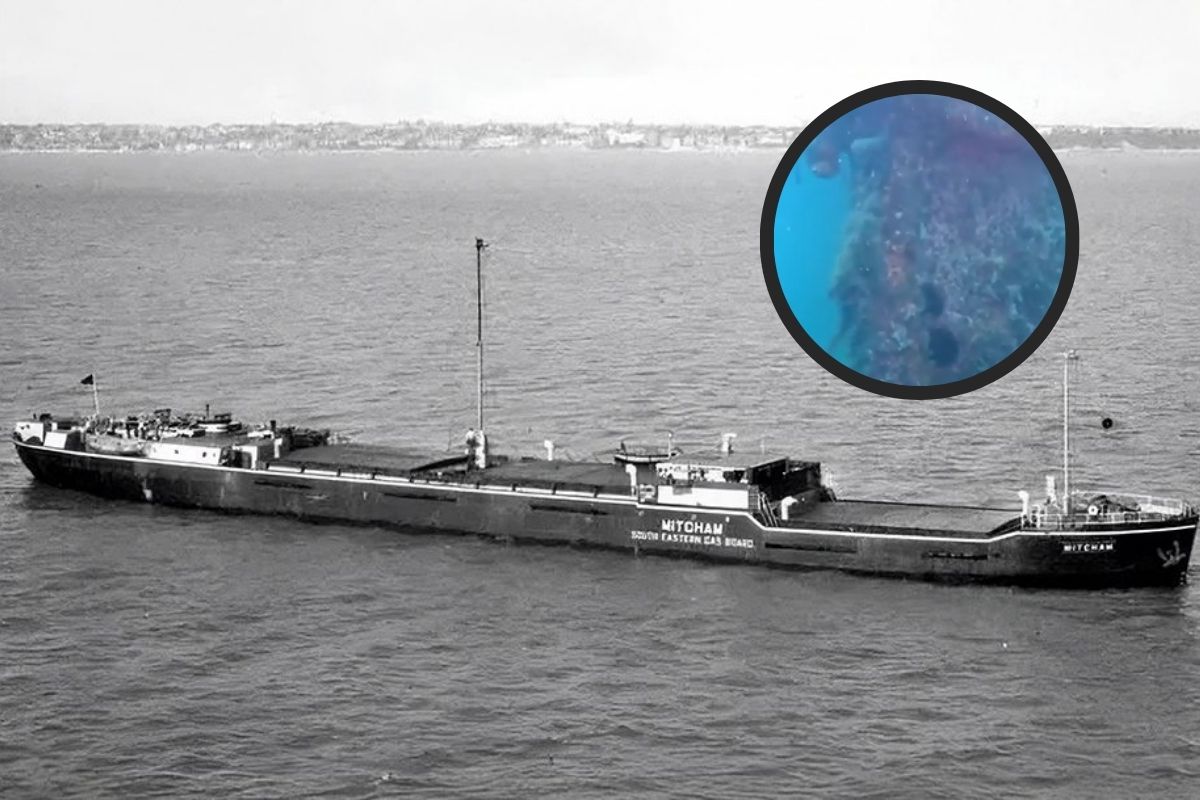
Divers Confirm That The Wrecked Ship Found Off The Coast Of São Paulo Is The Freighter Tutoya, Sunk In World War II After Attack By German Submarine.
A group of Brazilian divers has just confirmed the identity of a World War II wrecked ship off the coast of São Paulo, located between Peruíbe and Iguape. The vessel is the freighter Tutoya, torpedoed by a German submarine in 1943, and today rests a few meters deep, literally broken into two parts on the seabed.
More than just a diving spot, the wrecked ship Tutoya has become a time capsule, preserving in steel and rust a little-known chapter of Brazil’s naval history. The discovery, made with systematic research, sonar technology, and successive dives, confirms the accounts of survivors and reinforces the importance of the paulista coast as a strategic route during the war.
How The Wrecked Ship Tutoya Was Found
The recent history of the wrecked ship begins on solid ground, with documents and records. Passionate about shipwrecks and maritime history, diver and researcher Tatiana Mello and diver and researcher Maurício Carvalho initiated a systematic search for the Tutoya using data from the Shipwreck Information System, SINAU.
-
Friends have been building a small “town” for 30 years to grow old together, with compact houses, a common area, nature surrounding it, and a collective life project designed for friendship, coexistence, and simplicity.

-
This small town in Germany created its own currency 24 years ago, today it circulates millions per year, is accepted in over 300 stores, and the German government allowed all of this to happen under one condition.

-
Curitiba is shrinking and is expected to lose 97,000 residents by 2050, while inland cities in Paraná such as Sarandi, Araucária, and Toledo are experiencing accelerated growth that is changing the entire state’s map.

-
Tourists were poisoned on Everest in a million-dollar fraud scheme involving helicopters that diverted over $19 million and shocked international authorities.


They knew that the freighter had been attacked by a German submarine during World War II and that an unidentified wrecked ship had already been known in the region. Fishermen and local residents had been speaking for years about a structure on the seabed, used as a point for sport fishing.
That’s when sailor Clayton Aloise came into the picture, who provided the coordinates used by fishing vessels.
With this information, the group outlined a plan: map the seabed, check the depth, and identify if that wrecked ship could, in fact, be the Tutoya recorded in historical documents.
The Role Of Sonar And The First Dive
Before descending, the team used a sonar, equipment that emits sound waves to map the seabed relief.
During navigation, a different relief caught the divers’ attention, who approached until they launched a buoy over the suspicious point.
Only then did the most delicate phase begin. It was necessary to plan every detail of the dive, considering depth, bottom time, and oxygen consumption, so that the visit to the wrecked ship would be safe and productive.
On December 26, with favorable sea conditions, Tatiana Mello, Marco Bafi, and Luiz Flório finally managed to reach the site.
The first dive lasted about 35 minutes. To the team’s surprise, right as they descended along the line attached to the buoy, Tatiana fell practically into the engine room of the ship.
Still at the beginning of the exploration, the group was able to measure the stern, identify engines, cargo cranes, rudder, and other structural details.
Back on the boat, they cross-referenced these measurements with historical records. When the numbers matched, certainty came: that wrecked ship was indeed the Tutoya, sunk off the Brazilian coast during the war.
The Discovery That The Ship Was Split In Half

On the second dive, with the first measurements confirmed, the goal was to better understand the state of the wreckage.
During the inspection, the divers noticed that the ship seemed to “disappear” into the sand at a certain point. Visibility was not the best, which increased the doubt: did the wrecked ship end there or was there something beyond that curtain of sediment?
They decided to proceed, swimming parallel to the seabed. After about 15 to 20 meters, dark spots began to appear, pieces of metal, a “little iron here, another there,” until a new structure took shape: the bow of the ship.
It was at that moment that, as Tatiana reports, “the penny dropped”. The Tutoya, now identified as that World War II wrecked ship, was split in its central part.
The torpedo had hit the area near the command cabin, exactly as reported by survivors. The ship arched and sank in the middle, leaving the stern and bow separated on the seabed.
For the divers, it was not just a technical finding. There were the remains of the hull that housed seven Brazilians who lost their lives in the wreck, while another thirty managed to survive and tell what happened that night in 1943.
A Wrecked Ship That Preserves The Memory Of The War
The Tutoya was a steel steam freighter, built in 1913 in England under the name Mitcham. Later, it was sold to Lloyd Brasileiro, renamed Uno, and in 1929, it got the name Tutoya, in honor of a city in Maranhão.
Even amid World War II, this ship kept sailing the Brazilian coast, transporting medicines, food, and all kinds of cargo that connected states and supplied the population.
According to Tatiana Mello, Brazil directly depended on this type of freighter to maintain the flow of supplies during a critical period.
On the night when everything changed, the Tutoya was attacked by the German submarine U-513, which patrolled the country’s coast.
Even after turning on the lights and identifying itself, the freighter was hit. The torpedo struck the area of the command cabin, the ship arched and, shortly after, became another wrecked ship on the list of war targets in the South Atlantic.
Seven crew members died, thirty survived, and their accounts helped reconstruct the scene that today is confirmed by divers on the seabed.
For Maurício Carvalho, a wrecked ship is like a time capsule, preserving habits, engineering solutions, technology, and ways of life from an entire era.
Each valve, each machine, each twisted piece of steel tells part of a story that is not only in books but also in the wreckage scattered across the seabed.
Why The Wrecked Ship Cannot Be Removed
Despite the historical and emotional significance of the find, the Tutoya will not return to the surface. This wrecked ship is now considered an underwater archaeological site, protected by specific legislation that prevents the removal of pieces and any intervention that alters its structure.
According to Maurício, the ship has no commercial value and, from a legal standpoint, is a historical heritage preserved in the place where it sank.
The visit of divers is purely contemplative and scientific. They may dive, observe, study, photograph, and film, but they cannot touch or collect any objects. The information and accounts used in this content are based on an original report published by the Terra portal.
This approach reinforces a modern view of underwater archaeology: the wrecked ship is not scrap, it is material memory of a war episode experienced by Brazilians, a silent testimony of fear, courage, death, and survival. Leaving it where it is is a way to respect the history and the lives lost there.
On each new visit, divers and researchers “dive” again into that frozen moment of 1943, connecting the present to a past that, for a long time, remained hidden beneath the murky waters of the paulista coast.
And you, if you had the chance to visit the wrecked ship Tutoya on the seabed between Peruíbe and Iguape, would you dare to dive to see up close this forgotten part of Brazil’s history?









Seja o primeiro a reagir!