





 Portuguese
  English
  Spanish
  5 min of reading
  1 comment


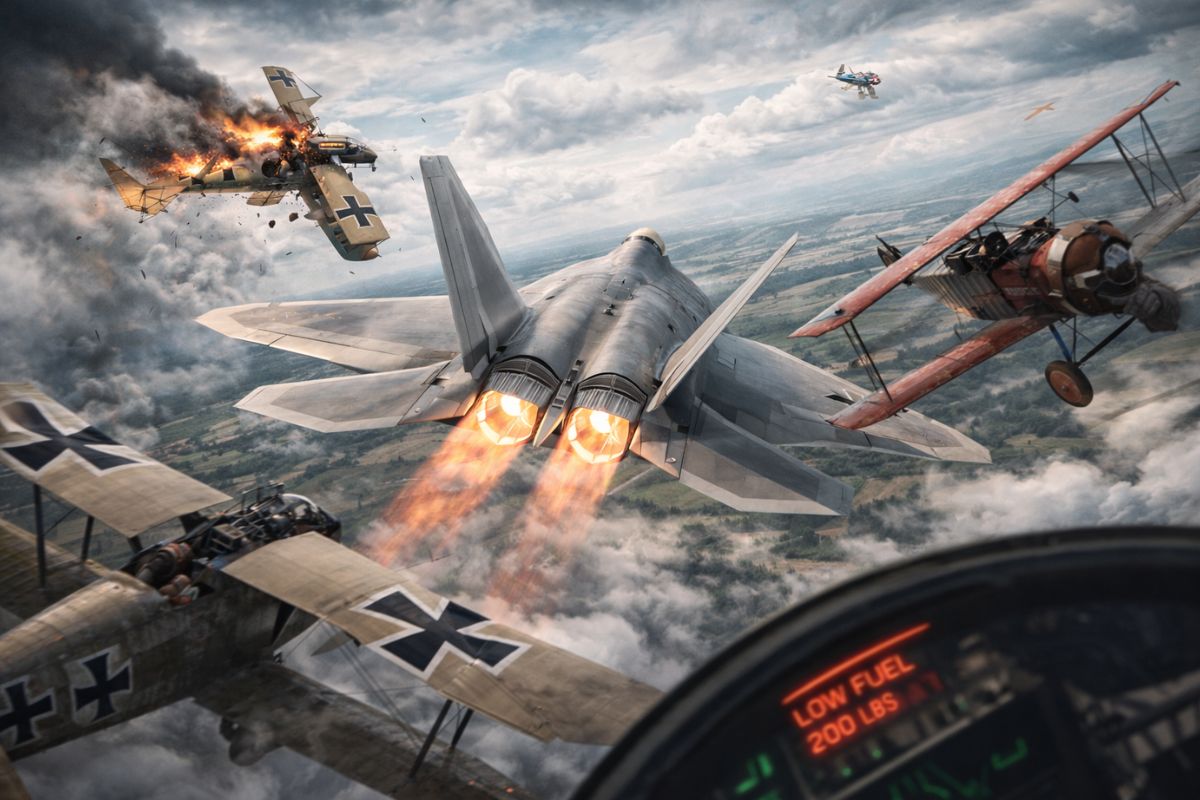


In The Western Front In April 1918, Biplanes At 185 Km/h Duel At Yards, And The Red Baron Dominates The Sky; Then An F-22 Appears With APG-77 Radar, Mach 2.25 And Eight Weapons, But Without GPS, Without IFF, Without JP8 And With 90 Minutes Of Combat At The Limit Of The Impossible
The F-22 would fall in 1918 as a kind of anachronism, an object too fast for the brain of someone living with propellers and fabric. An isolated American pilot a hundred years in the past would have total advantage in the first encounter, but would carry the curse of short range and lack of support.
The shock would not only be technical. The F-22 would change what men think is possible in the sky, and in war this change becomes fear, rumor, retreat, or a stroke of luck that brings the machine down in the wrong place.
April 21, 1918 And A Sky That Knows Nothing Of Radar

On the morning of April 21, 1918, the scene is one of mud on the ground and duels in the air.
-
Motorola launched the Signature with a gold seal from DxOMark, tying with the iPhone 17 Pro in camera performance, Snapdragon 8 Gen 5 that surpassed 3 million in benchmarks, and a zoom that impresses even at night.

-
Satellites reveal beneath the Sahara a giant river buried for thousands of kilometers: study shows that the largest hot desert on the planet was once traversed by a river system comparable to the largest on Earth.

-
Scientists have captured something never seen in space: newly born stars are creating gigantic rings of light a thousand times larger than the distance between the Earth and the Sun, and this changes everything we knew about stellar birth.

-
Geologists find traces of a continent that disappeared 155 million years ago after separating from Australia and reveal that it did not sink, but broke into fragments scattered across Southeast Asia.

Manfred von Richthofen, the Red Baron, flies his Fokker Dr.I triplane at about 185 km/h, and the combats follow the logic of short distances, using sun, clouds, and formation to gain position.
Then comes the rupture. The F-22 would arrive with an APG-77 radar capable of tracking targets at distances greater than 160 km, but in 1918 no one even has radar to perceive its presence.
Being stealthy in a world without radar is almost redundant, except that the real invisibility, there, would be psychological: no one would have the repertoire to explain what they didn’t see.
Speed, Altitude And Weapons That Break The Dogfight Rule

The best German fighters, like the triplane and the Albatros, revolve around 200 km/h in a dive and a ceiling of about 6,000 m on a perfect day.
The F-22 would reach Mach 2.25, about 2,400 km/h, and could operate at 65,000 feet, an altitude at which pilots from 1918 would faint before reaching halfway.
In armament, the difference becomes a chasm.
The F-22 would carry six AIM-120 AMRAAM missiles for beyond visual range combat, two heat-guided Sidewinders for short range, and an M61A2 20 mm cannon with 480 rounds.
A single half-second of cannon fire in 1918 isn’t a gunfight, it’s disintegration, because wood and fabric weren’t made to absorb 20 mm.
This contrast disrupts classic tactics.
The aces of 1918 are excellent marksmen and strategists of their own time, able to hit a radiator at 50 yards with a shaking plane, but their game assumes equality of speed and range.
The F-22 would arrive playing a different game, with distance, altitude, and time on its side.
The Brutal Problem Is Not The Enemy, It’s The Fuel Clock
The main limitation wouldn’t be a Fokker, nor an Albatros, nor an ace with 80 kills. It would be fuel.
The scenario describes a hard point: when the fuel runs out, cited as about 834 kg, the F-22 would perhaps have 90 minutes of combat time, even less if it uses afterburner the whole time.
And 90 minutes in 1918 have a hidden poison: where to land.
There are no long runways, no maintenance crews experienced in turbines, no JP8, there’s no system ready to receive a fighter that depends on an entire ecosystem to keep flying.
The F-22 would conquer the sky and lose the ground, because the post-combat would be an engineering of survival.
Add to this the absence of GPS, ground control, and IFF to differentiate friend from foe.
The pilot would have to identify German crosses with his eyes, choose targets manually, and still avoid being confused with allies. The operational risk, in such a scenario, becomes part of the combat.
The First Shock And The Panic That Spreads Before The Explanation
The initial impact would be disproportionate.
An observation balloon at 5,000 feet would become a perfect target, and a missile launched from miles away would make the balloon cease to exist while observers on the ground would only see a trail of smoke appearing from nowhere.
It is at this moment that the myth is born, the idea of an invisible enemy that kills without warning.
When fighters climb to investigate, they do so slowly, almost hanging on the propeller, and the F-22 can decide whether to shoot down, scare, or simply disappear.
A sonic boom in descent, something out of the repertoire of 1918, would suffice to provoke panic for miles.
In a classic dogfight, courage comes from understanding the risk.
Here, the risk would be incomprehensible. Aircraft would survive by scattering like fish fleeing a predator, unaware of where the attack came from or how to react.
The advantage of the F-22 would not just be killing, it would be making the other side stop taking off.
Three Possible Paths And A Fear Greater Than Steel
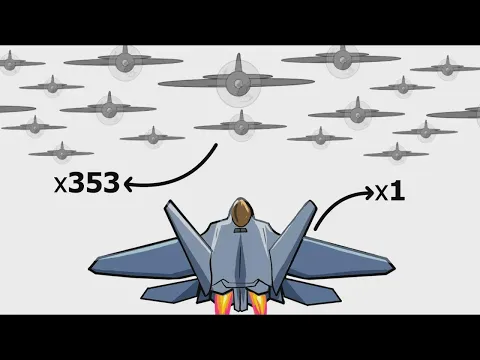

The first path is that of maximum impact: shooting down aircraft, attacking symbolic targets, and ultimately destroying the F-22 itself to avoid capture.
The second is that of psychological warfare: appearing randomly, destroying some planes and disappearing, creating an impossible-to-predict pattern and breaking the morale of pilots already operating at the limit.
The third is the most dangerous for the future: a stroke of luck or a fuel error forces a landing in enemy territory, and the F-22 falls relatively intact into the wrong hands.
The scenario describes engineers trying to learn concepts decades ahead, even without being able to replicate technology.
The victory of one day could become the dark shortcut of a generation, because military curiosity does not wait for peace.
Even in the best case, the machine does not erase the structural causes of war.
It would change the pace, reduce some missions, perhaps anticipate an end, but it would not resurrect the dead nor dismantle nationalism, imperialism, and alliances.
What it would do perfectly is kill the romance of the dawn of aviation in a morning of supersonic thunder.
The F-22 in 1918 would be a perfect predator for a short time. With no radar in the world, it would be invisible by definition, too fast for any pursuit and lethal enough to turn close combat into a sequence of wreckage.
However, fuel, the absence of JP8, lack of maintenance, and the unavailability of suitable runways would bring reality crashing down on the fuselage.
Now I want to hear from you with a personal response, without formula: if you were a pilot in 1918 and saw an entire squadron disappear without understanding where the attack came from, would you take off again the next day, or would you accept that the sky has become forbidden territory even without having seen the enemy properly?








Não entendi o sentido dessa matéria, em 1918 um f22? Um f-16 um f15, um a10 naquela época seria tecnologia alienígena