





 Portuguese
  English
  Spanish
  6 min of reading
  0 comments


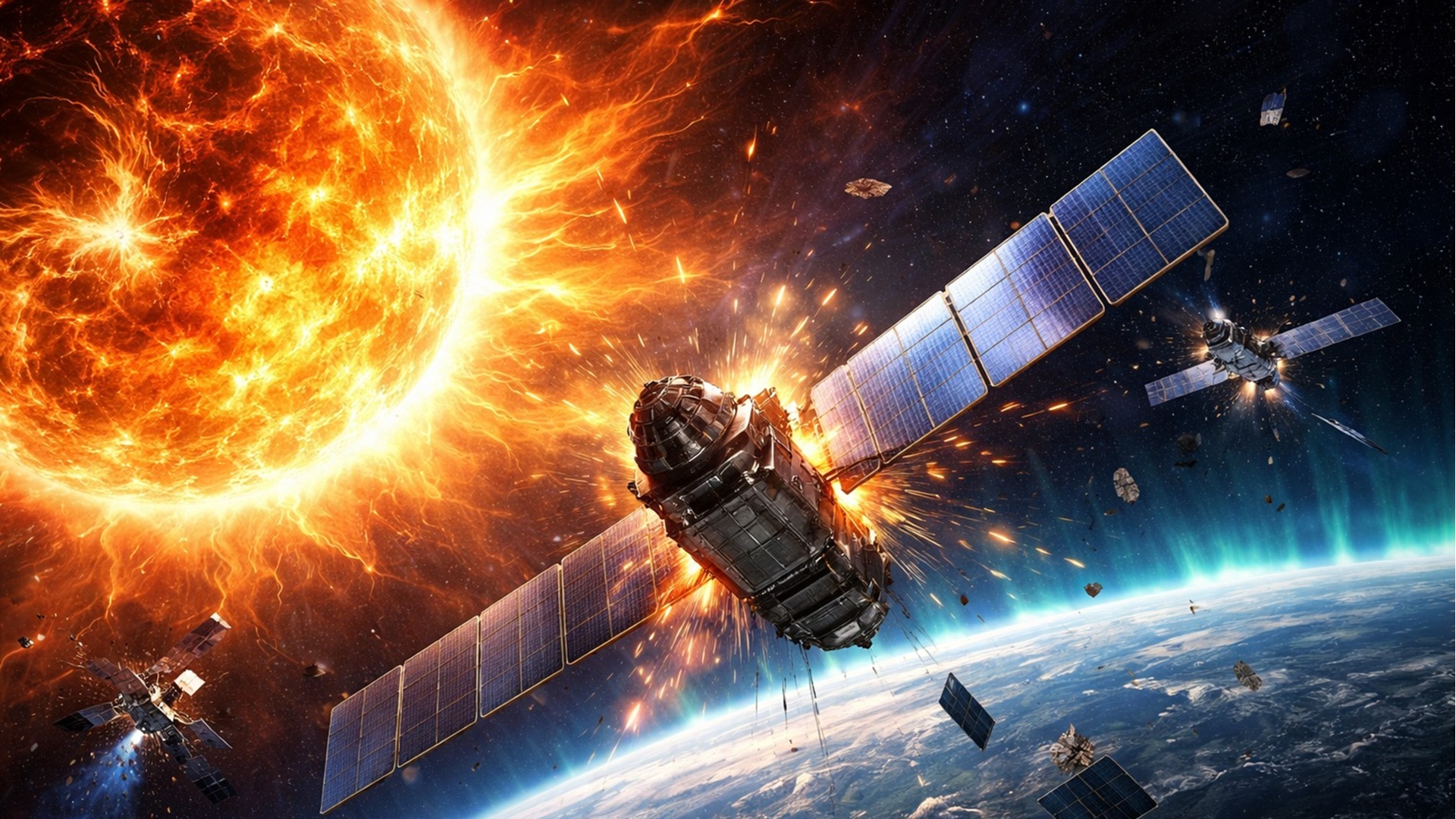
A scientific study published in 2025 warns that the current saturation of low Earth orbit has reduced the average time to a serious collision between satellites to just 2.8 days if extreme events, such as intense solar storms, interrupt control and maneuver systems
A scientific study led by a researcher from Princeton University warns that the current saturation of low Earth orbit could lead to a catastrophic collision in just 2.8 days if satellite control is interrupted by events such as extreme solar storms, with immediate global impact.
An Invisible But Increasingly Congested Space
In low Earth orbit, between 160 and 2,000 kilometers in altitude, an unprecedented number of artificial objects are currently in circulation. Operational satellites, rocket debris, and fragments from past collisions share a limited space where small variations in trajectory can result in widespread consequences.
This environment, largely imperceptible to those who only observe phenomena such as auroras or visible satellites, has become an essential component of global infrastructure. Communication, navigation, and observation systems directly depend on the stability of this saturated orbital space.
-
While Brazil wants to end the 6×1 work shift, the president of Argentina wants 12 hours for his workers, increasing political tension in the country.

-
The village where two rivers run side by side without mixing in Santarém and Alter do Chão reveals some of the most beautiful freshwater beaches on the planet.
-
Mars is accelerating, and scientists have discovered that the planet’s day is getting shorter, revealing surprising signs of internal activity.
-
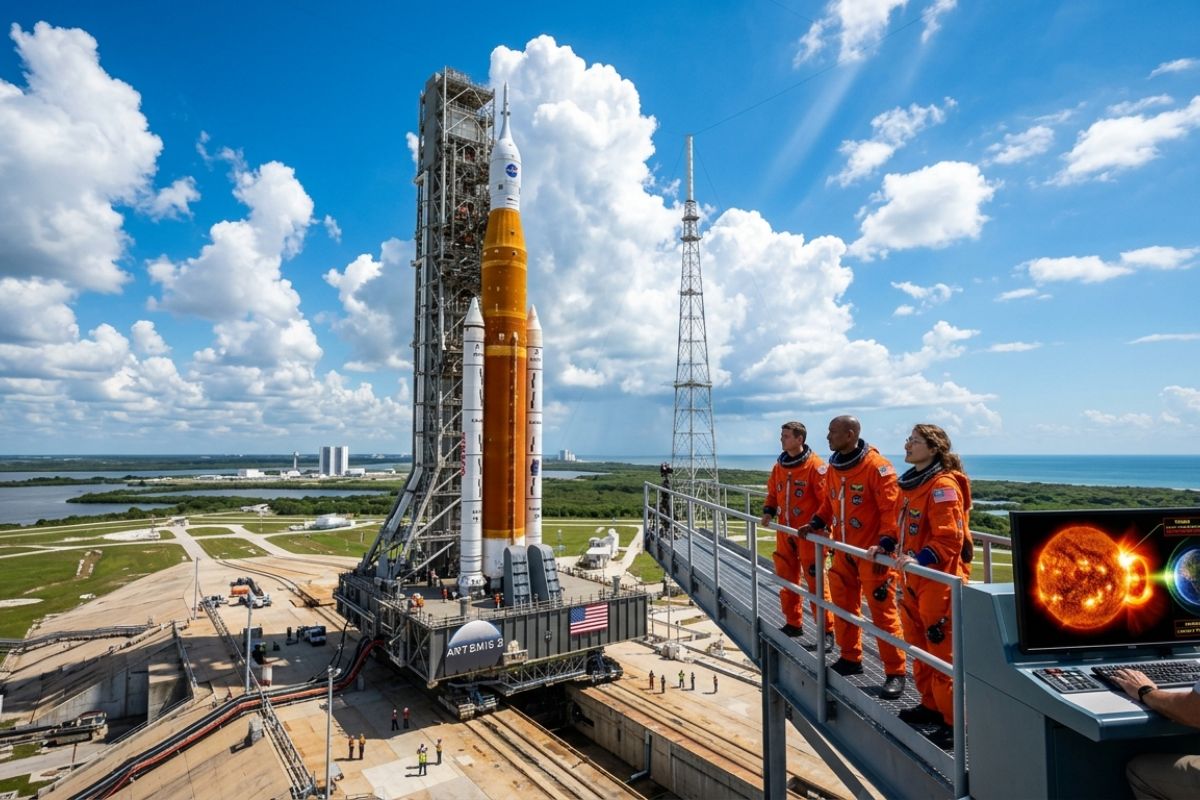
Artemis 2 is set to launch on April 1 at 7:24 PM to orbit the Moon with four astronauts, but a class X solar flare and coronal mass ejection could interfere with communications and threaten the launch.

The recent study conducted by Sarah Thiele describes this scenario as structurally fragile. The authors argue that orbital safety is no longer passive and now relies on constant, precise, and coordinated interventions among thousands of objects in continuous motion.
The Expansion of Megaconstellations and the Increased Risk
The proliferation of so-called megaconstellations has radically altered the dynamics of low Earth orbit. Projects such as Starlink, operated by SpaceX, have multiplied the number of active satellites by thousands in just a few years.
According to the data presented in the article, approaches between objects less than 1 kilometer apart occur, on average, every 20 seconds. When considering only the satellites in the Starlink constellation, this interval drops to 27 seconds, indicating high density in specific regions of orbit.
The report cited in the study states that over a six-month period, the constellation performed more than 144,000 avoidance maneuvers. This corresponds to about 41 maneuvers per satellite over the course of a year, a number that highlights the dependence on continuous adjustments to avoid collisions.
The authors note that the absence of major recent accidents does not indicate structural safety, but rather the repeated success of these maneuvers. Any systemic failure would disrupt this precarious balance almost immediately.
The CRASH Clock and the Orbital Countdown
The main methodological innovation of the study is the creation of the CRASH Clock, or Collision and Significant Damage Clock. It is an indicator that estimates how long it would take for a serious collision to occur if satellites lost the capacity for active maneuvering.
Calculated based on data from June 2025, the current value of the CRASH Clock is just 2.8 days. This represents a drastic reduction compared to 2018, when the same indicator marked 121 days, prior to the consolidation of megaconstellations.
The study points out that if operational control were interrupted, there would be a 30% probability of a serious collision between cataloged objects within the first 24 hours. This data highlights how quickly the system can collapse.
The change reflected by the CRASH Clock is not merely quantitative. It indicates a transition to a model of safety based on constant automated coordination, in which short interruptions can trigger cascading effects.
Solar Storms as a Destabilizing Factor
In addition to the mechanical risk among objects, satellites are subject to the direct influence of solar activity. Intense geomagnetic storms can heat the Earth’s atmosphere, increasing drag and altering orbital trajectories with high precision.
The study cites the solar storm of May 2024, known as the Gannon event, as an example. During this episode, more than half of the satellites in low orbit had to execute evasive maneuvers, many performed on an improvised basis due to urgency.
A single maneuver of this type can generate positioning errors of up to 40 kilometers for several days. This level of inaccuracy compromises conjunction calculations and substantially increases the risk of subsequent collisions.
The most critical scenario considered by the authors is the repetition of a solar event with the magnitude of the Carrington Event of 1859. In that case, satellite control systems could become inoperable for more than three days, surpassing the critical limit indicated by the CRASH Clock.
Collisions and the Risk of Chain Reaction
At speeds exceeding 28,000 kilometers per hour, orbital collisions do not only result in the loss of two objects. Each impact generates thousands of fragments capable of hitting other satellites and debris, rapidly increasing the number of threats.
This process is described as the Kessler Syndrome, a chain reaction that can render entire regions of orbit unusable for long periods. Although traditionally associated with time scales of decades, the study warns of the possibility of almost immediate collapse.
The authors highlight that a single large-scale collision could create conditions for an operational block of space traffic. In the article, this type of event is compared to the Exxon Valdez oil spill in 1989, as an environmental disaster with persistent effects.
Current numbers already indicate a high frequency of critical events. According to the study, an approach within less than 100 meters occurs, on average, every 33 minutes. In one simulation, a satellite and a fragment got as close as 30 meters apart within three hours.
Lack of Coordination in Space Traffic
Another structural risk factor identified is the absence of a global space traffic management system. Each operator uses their own criteria, data, and protocols to decide when and how to perform avoidance maneuvers.
This fragmentation reduces transparency and increases margin for error in an already extremely congested environment. The study recalls recent incidents, such as the one in 2019 when a European satellite had to manually avoid a Starlink satellite due to a failure in the alert system.
The authors also cite the 2009 collision between an Iridium satellite and a Russian satellite, attributed in part to a lack of communication among operators. Today, with many more objects and maneuvers, this type of failure becomes even more dangerous.
Although there are voluntary guidelines proposed by the United Nations, the study assesses that these initiatives do not keep pace with the rapid growth of private operations in space.
An Alert Before the Critical Limit
The article does not present detailed technical solutions but emphasizes the need for immediate recognition of the seriousness of the problem by governments, companies, and space agencies. Metrics such as the CRASH Clock can serve as objective decision-making tools.
The authors emphasize that the indicator does not represent a rigid limit but a measure of continuous risk. Values below three days should be interpreted as urgent warning signs for orbital sustainability.
If no coordinated action is taken, the study points out that the CRASH Clock could reach zero after the next extreme solar event. This scenario would imply rapid loss of operational capacity on a large scale.
The work concludes that low Earth orbit must be treated as a shared and finite ecosystem. Each satellite, in addition to fulfilling a specific function, consumes common space, and inappropriate use of this resource could compromise the entire global technological infrastructure, according to data published on arXiv.
The information presented is based on the scientific article “An Orbital House of Cards: Fragile Conjunctions of Megaconstellations”, led by Sarah Thiele, a researcher at Princeton University, published in 2025 on the arXiv platform, which gathers the data, simulations, and metrics used to calculate the CRASH Clock and assess the current risks of low Earth orbit.








Seja o primeiro a reagir!