





 Portuguese
  English
  Spanish
  5 min of reading
  0 comments


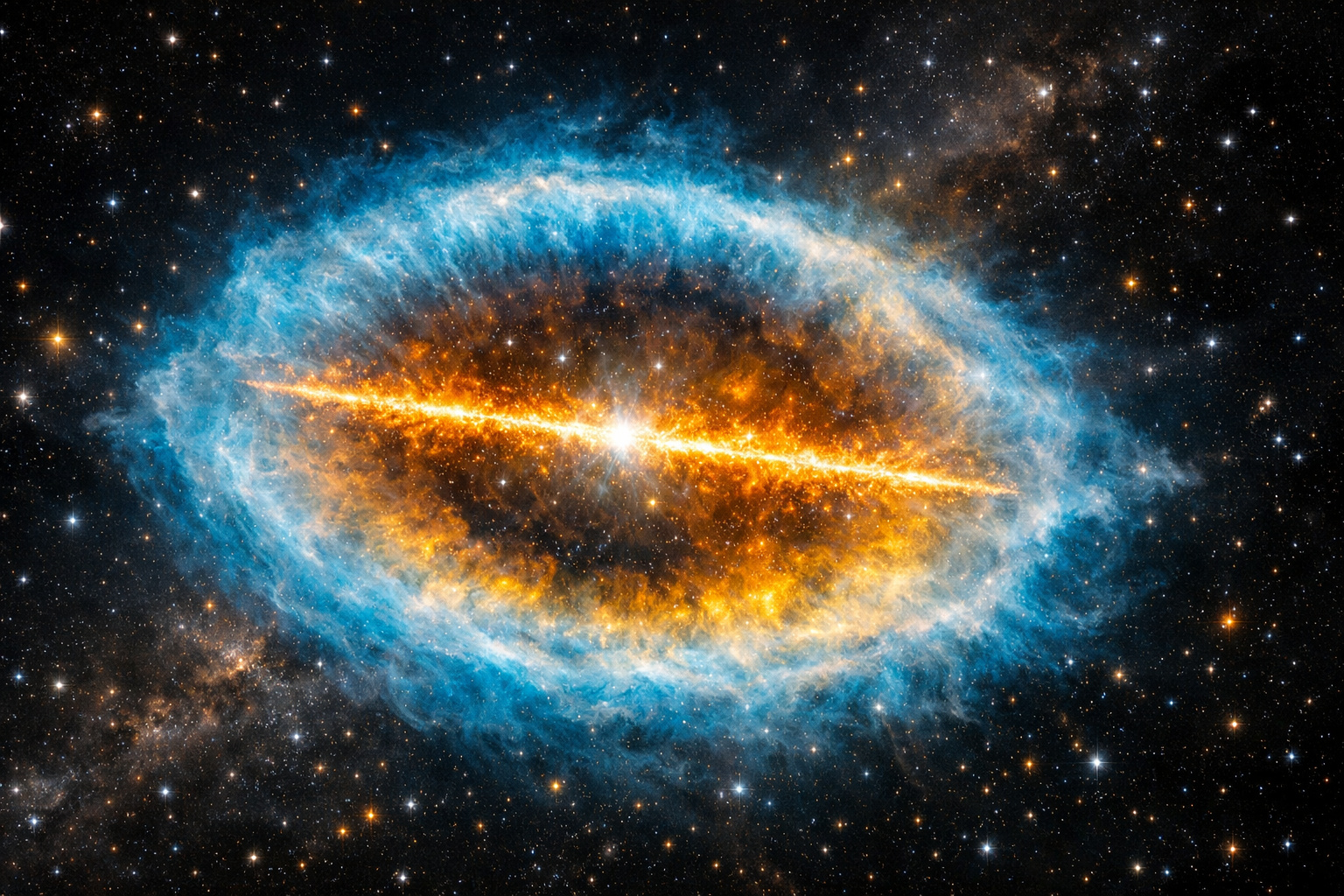
An Unexpected Phenomenon in the Heart of One of the Most Studied Nebulae in the Milky Way Raises Deep Questions About the Death of Sun-Like Stars and Defies Decades of Consolidated Astronomical Observations
For almost 250 years, the Ring Nebula has been regarded as one of the most classic and well-understood examples of a planetary nebula. However, recently, astronomers encountered an unprecedented mystery right at the center of this iconic cosmic structure. A linear bar composed of ionized iron atoms, shining brightly, crosses the nucleus of the nebula — something that has never been observed before in such objects.
This information was released by ScienceAlert, based on a scientific study published in the journal Monthly Notices of the Royal Astronomical Society (MNRAS), led by researchers from Cardiff University in the United Kingdom. Since then, the finding has intrigued the international scientific community, particularly because it contradicts everything known about the composition and dynamics of planetary nebulae.
Located about 2,570 light-years from Earth, in the constellation of Lyra, the Ring Nebula was discovered in 1779 by French astronomer Charles Messier. Despite its name, this type of nebula is not related to planets but represents the gaseous remnants of sun-like stars that have reached the end of their lives.
-
With a cost per shot close to zero, the DragonFire laser could change naval warfare in 2027 and provide British ships with nearly unlimited defense against drones.

-
A British startup creates tires that generate electricity in electric vehicles when passing over potholes, speed bumps, and cracks.

-
Scientists have created robots made with living cells that have their own nervous system, swim on their own, explore the environment, and self-organize without any genetic engineering, and now they want to do the same with human cells.

-
Students create a solar-powered ambulance that operates without a plug, without fuel, and still keeps medical equipment running in remote areas.


What Is the Ring Nebula and Why Has It Always Been Considered Predictable?

When moderately massive stars exhaust their nuclear fuel, they do not explode in violent supernovae. Instead, they go through a relatively calm process: their outer layers are slowly expelled into space while the core collapses and transforms into a white dwarf that is extremely dense.
Precisely because this process is gentle, the ejected material often forms almost symmetrical structures, often spherical or ring-like, as seen in the Ring Nebula. Over the years, thousands of planetary nebulae have been cataloged in the Milky Way, allowing astronomers to develop very clear expectations about their chemical composition, dynamics, and appearance.
For this reason, no one expected to find anything so strange in such a well-known nebula. Still, the new observations revealed a detail completely out of the ordinary: a linear structure, rigid and composed almost exclusively of ionized iron, crossing the center of the nebula as if it were a solid bar suspended in space.
How Technology Revealed a Detail Invisible for Decades
The discovery was only possible thanks to a significant instrumental advance. The observations were made with the WEAVE (WHT Enhanced Area Velocity Explorer), installed on the William Herschel Telescope, which is 4.2 meters long, located in the Canary Islands. The equipment operated in Large Integral Field Unit (LIFU) mode, which allows capturing spectroscopic data from the entire nebula at once.
According to astronomer Roger Wesson, leader of the study, this method represented a radical shift from previous observations. Until then, the Ring Nebula had mostly been analyzed using slit spectroscopy, a technique that only observes narrow slices of the object. This means that the iron bar would only have been detected if the instrument was perfectly aligned with it — something extremely unlikely.
“When we processed the data and went through the images, one thing jumped out immediately: this unknown bar of ionized iron atoms right at the center of the ring,” Wesson stated. This detail explains why the phenomenon remained hidden for so long, even in one of the most observed objects in the sky.
Why the Iron Bar Challenges All Known Explanations

At first glance, the structure resembles a jet of matter, common in young stars or black holes. However, a more detailed analysis quickly ruled out this hypothesis. The central white dwarf of the nebula is not aligned with the bar, indicating that it is not the source of the material.
Moreover, the movement of the structure does not correspond to that of a jet. The emission lines show that the entire bar is moving away from Earth in the same direction, rather than exhibiting a symmetrical pattern, as would be expected in double jets.
The most puzzling aspect, however, is its composition and mass. Estimates indicate that the bar contains around 14% of Earth’s mass, composed almost entirely of naked and ionized iron — which represents more mass than the planet Mars concentrated in exposed metallic atoms.
In nebulae, iron typically remains trapped in dust grains, and not floating freely in an ionized state. To release this iron, extremely energetic shocks or very high temperatures would be required, conditions that simply do not exist in the calm environment of the center of the Ring Nebula.
Observations from the James Webb Space Telescope (JWST) show dust accumulated on both sides of the bar, but curiously not above it, reinforcing the idea that something very specific occurred in that region. Still, there is no clear physical evidence of how this process could have happened.
Bolder hypotheses, such as the destruction of a planet, have also been considered, but they present serious problems. Planetary fragments would not form such a straight and organized structure, and would also contain other elements, like silicon and magnesium, which were not detected.
In light of this, the researchers themselves admit that the bar may have a more complex three-dimensional structure, perhaps extending beyond what we can see, like a plank viewed from the side. Nonetheless, no satisfactory explanation has been found so far.
“It would be very surprising if this iron bar were unique,” concludes Wesson. “As we observe more nebulae formed in the same way, we expect to find other examples that help us understand where this iron comes from.”
In light of the hypotheses raised so far — such as the destruction of dust, still unknown extreme interactions, or even the possibility of a hidden three-dimensional structure — what do you think could explain the emergence of this iron bar in the center of the Ring Nebula, even without a definitive answer from science?
Source: ScienceAlert







-

-

-

-

-

-

35 pessoas reagiram a isso.