





 Portuguese
  English
  Spanish
 7 min of reading
  0 comments


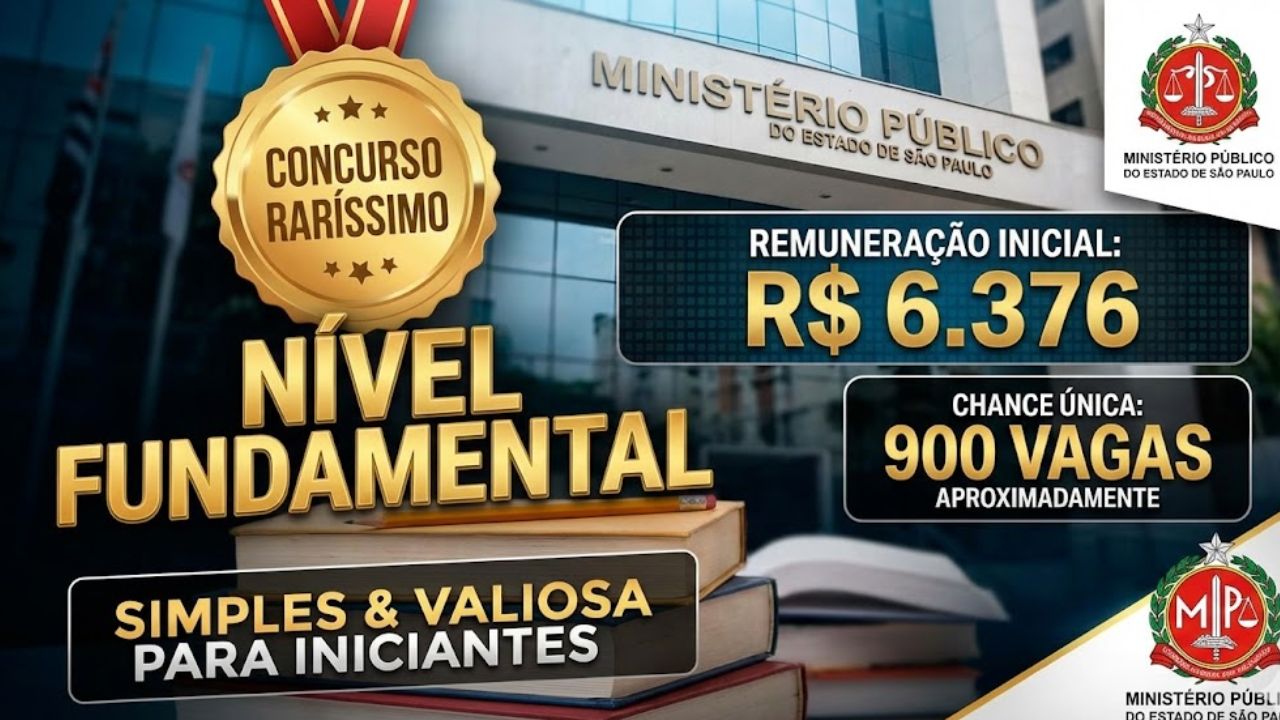
Rare Contest for Court Assistant Gathers Vunesp Board, Simple Exam, and History of About 900 Appointed, Turning a Discreet Notice into a Valuable Opportunity for Beginners
A rare contest has just been opened for elementary level to work at the Public Prosecutor’s Office of São Paulo, with an initial salary of around R$ 6,376 and a stable career that, in practice, surpasses many positions requiring medium and even higher education. In a scenario where most notices increasingly demand higher education, a rare contest like this becomes a concrete entry opportunity into public service for those who are just starting.
More than the starting salary, the position of court assistant offers the structure of a large, organized body used to calling many approved candidates throughout the validity of the exam. For those looking to start on the simplest possible path, this rare contest combines an accessible exam, good remuneration, and great potential for appointments.
Why This Rare Contest Deserves So Much Attention
We are faced with a rare contest for two main reasons. First, because notices for elementary level are becoming increasingly rare, especially in significant bodies like the Public Prosecutor’s Office of São Paulo.
-
Work at Vale! The company is recruiting individuals with high school, technical, and higher education in areas such as maintenance, operations, and technology, with 400 immediate openings in 6 states, salaries of up to R$ 10,000, and 100% online applications.

-
Australia accelerates the search for foreign workers in 2026 with an official list of in-demand professions that includes drivers, programmers, and nurses, salaries starting from AUD 76,515 per year, and visas that can lead to permanent residency.

-
The Macaé City Hall starts the week with job openings that promise to boost hiring and open doors for qualified professionals and newcomers to the market, with a focus on offshore positions.

-
Future profession with immediate earnings: Specialist reveals how a solar energy technician earns R$ 8,000 per month by taking advantage of the explosion in demand across the entire country.


Second, because the total package of remuneration and benefits is much higher than what is normally associated with this level of education.
The initial remuneration consists of the basic salary with bonuses, plus benefits such as meal allowance, daily transportation allowance, and health allowance around R$ 750, reaching approximately R$ 6,376 total remuneration right at the beginning of the career.
In practice, this is an amount that easily surpasses many medium-level contests scattered across the country.
Additionally, the exam is scheduled for March 29, giving a reasonable preparation period for those deciding to start now, from scratch.
As this is a rare contest with objective and direct content, a disciplined candidate can create a compact and competitive study plan even in a few months.
How Much Does a Court Assistant Earn and What Do They Do at the Public Prosecutor’s Office of São Paulo


The position is of court assistant at the Public Prosecutor’s Office of São Paulo, with initial remuneration around R$ 6,376 already including salary and main benefits.
The notice details a basic salary with bonuses exceeding R$ 3,700, plus fixed and variable allowances that complete the final amount.
In practice, the court assistant supports the administrative and routine activities of the prosecutor’s offices: basic attendance, document organization, support for the internal functioning of the unit, and operational tasks assisting the team.
It is the type of role that allows one to learn from the inside how one of the most important bodies of state justice works.
Another relevant point: in large bodies like the Public Prosecutor’s Office of São Paulo, there is a history of career advancement, salary progressions, and real gains over time.
Those starting with just over R$ 6,000 tend to see this amount increase over the years, and many court assistants today receive well over R$ 10,000 gross, as reported in the body’s own transparency.
Vunesp Board and Exam: What Really Appears in the Rare Contest
The exam will be organized by the Vunesp board, a well-known entity among exam candidates in São Paulo. This is a huge advantage, as there is a known standard for assessment and an abundance of previous exams for training. Those who understand the Vunesp style have an edge in this rare contest.
The content is straightforward and designed for elementary level, without exaggeration:
- Portuguese Language
- Mathematics
- Computer Science
- Specific Legislation (few articles, around nine or ten, easy to memorize)
- Recent History of Brazil, focusing from 1930 onwards
- Geography of Brazil
There is no essay. This greatly simplifies the preparation strategy, especially for those who have never taken an exam before.
Instead of getting lost in dozens of subjects, the candidate can concentrate energy on getting almost everything right within a compact content.
A key point emphasized by those who follow this type of exam: to be competitive in a rare and simple contest like this, the goal is not to “pass by a hair’s breadth,” but to aim for 90% correctness or more.
As the level of difficulty of the exam is relatively low, the competition occurs point by point at the top of the list.
Reserve List, Number of Appointed, and Real Chance of Being Called
One of the most common fears of those starting out is seeing the term “reserve list” in the notice and getting discouraged. But in this case, focusing only on this term is a strategic mistake.
Based on data gathered from the previous contest, there were around 900 appointed, across all regions, and about 420 appointments just in the capital, including quotas.
For an elementary-level contest, this volume of appointments is significant. It makes perfect sense for the administration to maintain a large pool of approved candidates, as the Public Prosecutor’s Office of São Paulo is a huge organization, operating in various regions and constantly needing to replenish personnel.
In other words, although the notice mentions a reserve list, history shows that the probability of appointment is real and significant, especially for those who are well-positioned.
In contests like this, what separates being just “another approved candidate” from becoming an “appointed approved candidate” is precisely the attitude of approaching the exam aiming high, without settling for mediocre scores.
Why This Rare Contest is Perfect for Beginners
For those starting from scratch, it’s hard to imagine a more favorable scenario than a rare elementary-level contest with a known board, objective content, and no essay requirement.
Some factors that make this contest an ideal entry point:
- Requires only elementary level, but pays like good medium-level positions.
- Compact content allows in-depth study in a few months.
- The Vunesp board facilitates the use of previous exams as the main training tool.
- A history of around 900 appointed shows that this is not a symbolic notice.
Instead of spending months or years preparing directly for much denser contests, like federal tribunals, many candidates can use this rare contest as the first step.
After approval and appointment, it is possible to continue studying, now in another reality: with a stable salary, routine in a public body, and less financial pressure.
Study Strategy to Make the Most of the Opportunity
In a contest with this profile, the most common mistake is studying in a dispersed manner, as if it were a large notice. Here, those who study less and better tend to have an advantage.
Some Strategic Lines Aligned with What the Video Teacher Himself Suggests:
Focus on the essentials. Instead of trying to “cover a course”, prioritize mastering Portuguese, basic mathematics, computer science, and specific legislation. These areas concentrate many points and tend to be predictable in the Vunesp board.
Use previous exams as the core of your study. In contests like this, solving Vunesp exams of similar level is almost as important as reading theory. Each question resolved with careful correction teaches more about the board than pages and pages of loose theory.
Aim to get 90%. Don’t settle for “passing with 70%.” In a rare, simple, and highly sought-after contest, the real cutoff is high. Study from the beginning with the mindset of getting practically everything right in Portuguese, much of the mathematical content, and not missing questions on legislation.
Keep the ego out of the decision. Many people look at the elementary-level position and turn their noses up, even earning less in the private sector.
Letting the ego decide can cost years of stability and growth within a robust body like the Public Prosecutor’s Office of São Paulo.
Is It Worth Facing This Rare Contest or Waiting for Another?
When you combine rare contest, elementary level, initial remuneration around R$ 6,376, objective content, and an organization of the size of the Public Prosecutor’s Office of São Paulo, the combination is too strong to be ignored by those wishing to enter public service.
Of course, each reality is different. Some may be focused solely on higher-level positions, others may not find it easy to balance work and study, and some may prefer to wait for a specific notice.
But looking coldly at the facts, it’s hard to find another rare contest with such a relationship between required effort and potential return.
If you are just starting, this notice could be your “first stamp” on your public resume. If you are already studying for medium level, it may be a parallel opportunity to secure stability sooner, while continuing to aim for greater heights.
In the end, the decision is yours. What you cannot do is let a rare contest like this pass without at least seriously evaluating whether it could be your shortcut to approval.
And you, are you going to tackle this rare elementary-level contest from the Public Prosecutor’s Office of São Paulo or do you intend to wait for another notice to appear?









Seja o primeiro a reagir!