





 Portuguese
  English
  Spanish
  3 min of reading
  0 comments


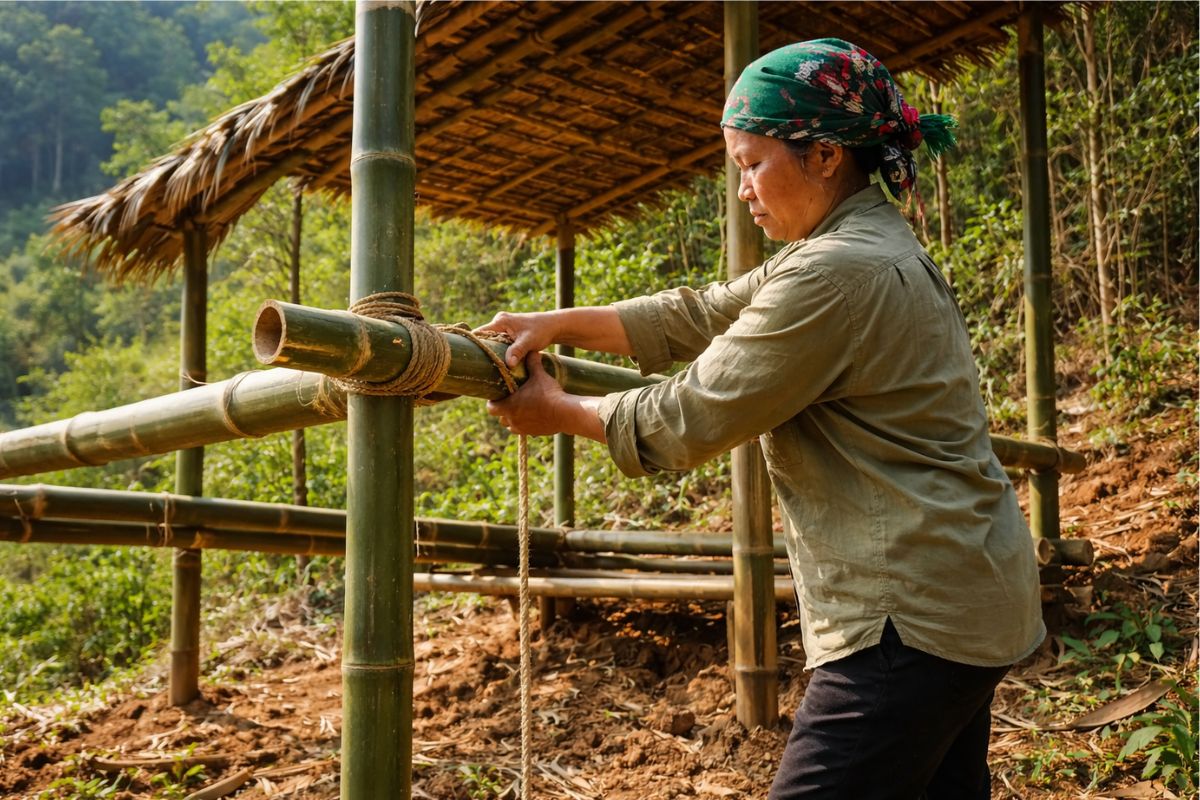
What Was an Open Area Becomes a Complete Construction When a Woman Digs the Base in the Arm, Fixes Thick Stems Vertically, Reinforces with Cross Braces and Shows How Repetition and Order Replace Industrial Solutions
In an Asian community, a mother decided to build a bamboo shelter using only simple tools and materials available in the region. What was an uneven piece of land began to take shape with cutting, digging, and organized assembly.
The contrast is evident. Before, the area was open and exposed to the sun. After, it became a structure with vertical pillars, tied beams, and a slanted roof made of wide leaves. The visual impact is immediate.
This type of construction attracts attention because it shows a concrete change using technique, planning, and repetition of movements. Without machines or industrial structures, just organization and practical application of natural resources.
-
Friends have been building a small “town” for 30 years to grow old together, with compact houses, a common area, nature surrounding it, and a collective life project designed for friendship, coexistence, and simplicity.

-
This small town in Germany created its own currency 24 years ago, today it circulates millions per year, is accepted in over 300 stores, and the German government allowed all of this to happen under one condition.

-
Curitiba is shrinking and is expected to lose 97,000 residents by 2050, while inland cities in Paraná such as Sarandi, Araucária, and Toledo are experiencing accelerated growth that is changing the entire state’s map.

-
Tourists were poisoned on Everest in a million-dollar fraud scheme involving helicopters that diverted over $19 million and shocked international authorities.


The detail that impresses the most is the clear sequence of steps. Nothing seems improvised. Each action prepares the next one.
Cutting Stems Marks the Start of Construction
It all begins with cutting the bamboo stems close to the ground. The segmented cylindrical shape appears after each stroke of the manual blade. The pieces are transported to the construction site.
She adjusts the length, removes excess from the ends, and separates the thicker stems from the thinner rods. This division facilitates assembly.
With the material standardized on the ground, the work progresses more efficiently. Each piece already has a defined function even before being installed.


Manual Digging Creates a Sturdy Base with Well-Aligned Pillars
After cutting comes digging. Circular holes are opened in the ground with simple tools. The movement is repeated until reaching sufficient depth to support the pillars.
The thicker stems are positioned vertically. The excavated soil is returned to the hole and compacted with feet. The alignment of the pillars defines the height and perimeter of the structure.
This step establishes the necessary base for the next phases of construction.
Horizontal Beams and Cross Braces Form the Main Structure
With the pillars fixed, the horizontal beams are added. Thinner stems are placed on top and tied with rope or vegetable fiber.
Cross braces reinforce the structure and distribute weight evenly. The overlap between vertical and horizontal stems creates sufficient rigidity to support the roof.
What were just isolated pillars transforms into a complete skeleton.
Slanted Roof Improves Protection Against Sun and Rain
After the framework is ready, the roof begins to take shape. Wide leaves are positioned over the upper beams and layered in successive overlaps.
The slant facilitates water drainage. Each leaf is secured to the braces with direct tying.
The interior now has constant shade, and the structure gains protection against the elements.
Side Panels Close the Space and Define the Internal Environment
With the roof completed, thin rods and leaves form side panels. They are fixed to the main structure and help reduce wind and direct light entry.
The floor receives additional leveling, and the interior is organized.
The final result is a complete bamboo shelter, with vertical pillars, tied beams, and overlapping vegetal coverage. The transformation of the land shows how method, organization, and repetition can result in a functionally constructed structure by hand.










-

-

-

13 pessoas reagiram a isso.