





 Portuguese
  English
  Spanish
  4 min of reading
  0 comments


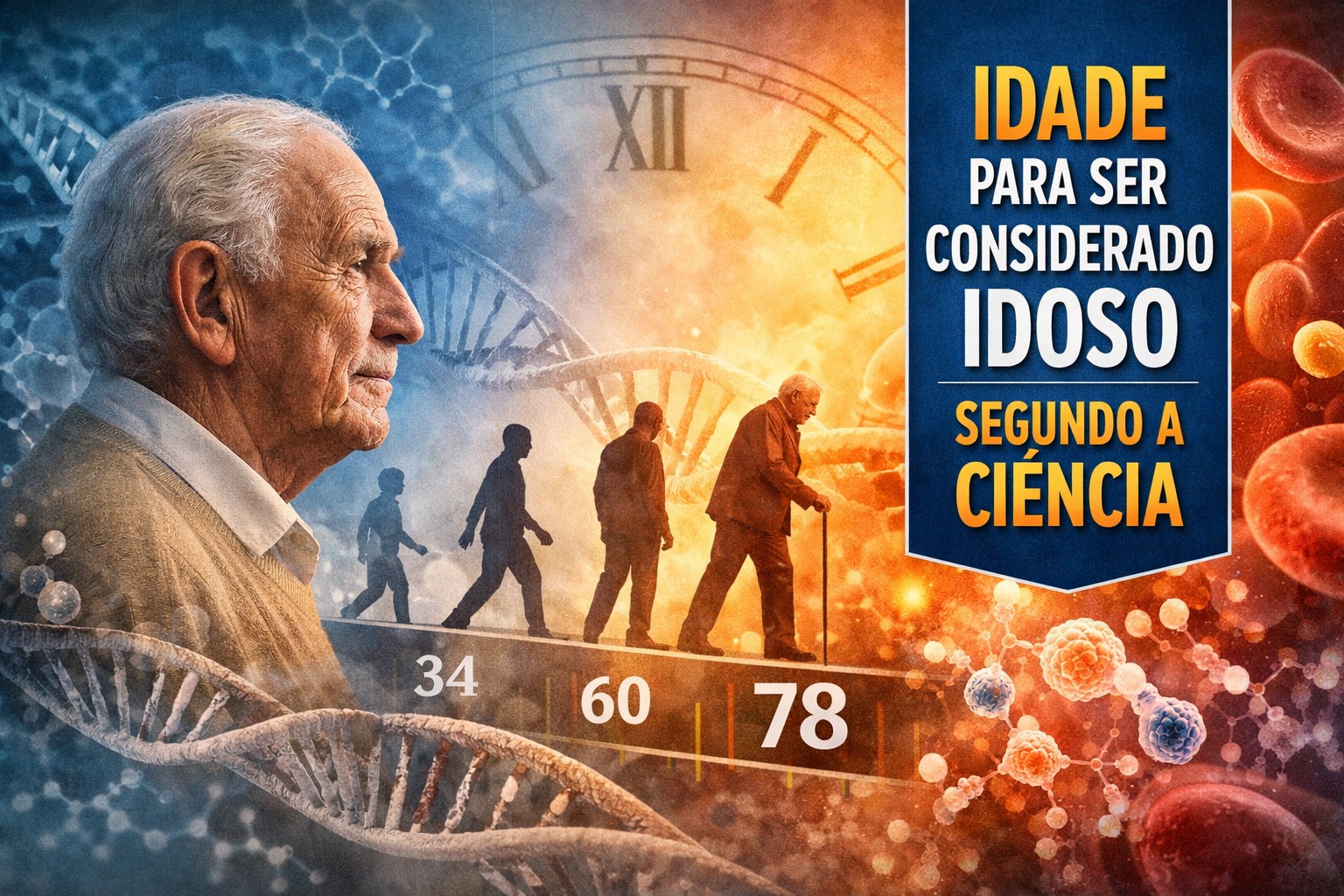
Biomedical Research Analyzed Thousands of Samples and Identified Three Stages of Human Aging, Pointing to Measurable Biological Breakdowns That Shift the Definition of Old Age From Legal Criteria to Objective Molecular Parameters
For decades, the definition of who is considered elderly has been linked to legal and social criteria, but a recent scientific study proposes a precise biological milestone, indicating that aging begins at 78 years old, based on measurable changes in the human body.
Aging Beyond the Calendar
Modern science has shown that aging does not merely mean accumulating years but undergoing profound biological transformations that do not always follow the rhythm of chronological time lived.
Recent research has begun to question when the human body actually enters a phase of advanced aging from a strictly scientific perspective.
-
The gigantic steel shell built to contain Chernobyl for a century has been pierced by a drone, exposing a critical system and creating a hole that could cost over 500 million euros to repair.

-
Brazilian Navy reaches a new level by taking over an airport with a 1,600-meter runway used by 1,800 military personnel and autonomous attack drone testing.

-
The Himalayas continue to grow to this day, with tectonic plates advancing 5 cm per year, mountains rising up to 10 mm annually, and the 2015 earthquake that killed 9,000 people may have increased the risk of an even larger seismic mega-event.

-
At an altitude of 400 km by astronauts from the International Space Station, Paris transforms at night into a golden mesh so precise that it reveals the outline of the Seine River, avenues, and entire neighborhoods like a luminous map drawn over the Earth.


This approach shifts the debate from legal age to biological indicators capable of revealing real internal changes in the functioning of the human body.
Study Identifies Breakdowns in the Aging Process
A study conducted by Stanford University and published in the journal Nature Medicine analyzed biological samples from thousands of individuals.
The researchers observed that aging does not occur linearly but rather through phases marked by more abrupt biological changes.
These changes were primarily detected through the analysis of proteins present in the blood, considered reliable markers of the overall state of cellular aging.
Proteins Reveal Critical Moments of Life
According to the study, plasma proteins reflect the integrated functioning of organs, tissues, and systems, serving as a mirror of biological aging.
The analysis showed periods of relative stability, interspersed with moments of acceleration, when the body undergoes more intense transformations.
These jumps indicate that the organism responds differently as time progresses, contradicting the idea of continuous and uniform wear.
Three Major Biological Cycles of the Human Body
Scientists divided human life into three major biological phases, defined based on the patterns observed in blood proteins.
The initial phase of adulthood spans from 34 to 60 years and marks the end of biological youth, with the first internal signs of wear.
During this period, the body still regenerates well, although this capacity is no longer as efficient as in earlier stages of life.
Late Maturity and Relative Stability
The second phase, called late maturity, encompasses the interval between 60 and 78 years, when physical changes become more noticeable.
Despite this, many systems in the body continue to function relatively stably, allowing for the maintenance of autonomy and daily activity.
This stage represents a transition, where aging progresses, but without the more intense molecular changes yet.
Biological Old Age Begins at 78 Years
According to the researchers, it is from 78 years old that biological old age officially begins, according to observable scientific criteria.
At this point, a significant change occurs in the patterns of plasma proteins, which begin to vary more acutely.
This change indicates a new stage of aging, marked by reduced capacity for adaptation and repair of the organism.
Decline Starts Much Earlier Than Old Age
Although old age is situated at 78 years, the study points out that the first significant physical decline occurs around 34 years.
This milestone marks the end of biological youth, even though the signs may be subtle and often imperceptible in daily routines.
This data reinforces that aging is a long, cumulative process that begins well before the traditionally recognized old age.
Physical Changes of Advanced Aging
In the final phase of aging, the researchers identified physical transformations such as loss of muscle mass and reduction in DNA repair capacity.
Bone weakening, decreased mobility, and alterations in sleep patterns and sensory perception were also observed.
These changes are associated with a decline in the production of essential proteins and alterations in the molecular environment of cells.
Impacts of Age on Brain Functioning
The study highlights that advanced aging also affects the brain, with greater difficulty in processing information and forming new memories.
This does not necessarily imply total loss of autonomy but reflects a natural adaptation of the nervous system to the new biological stage.
These effects vary among individuals, depending on their overall health conditions and the biological history of each person.
Proteins as Global Indicators of Aging
For scientists, plasma proteins serve as global indicators, allowing for precise identification of the biological phase of human life.
The changes in these levels represent a systemic transformation rather than the isolated wear of a single organ.
These findings enhance the understanding of aging and help contextualize debates about health, longevity, and quality of life over time.
With information from Tribuna de Minas.







-

-

-

-

-

-

41 pessoas reagiram a isso.