





 Portuguese
  English
  Spanish
  5 min of reading
  1 comment


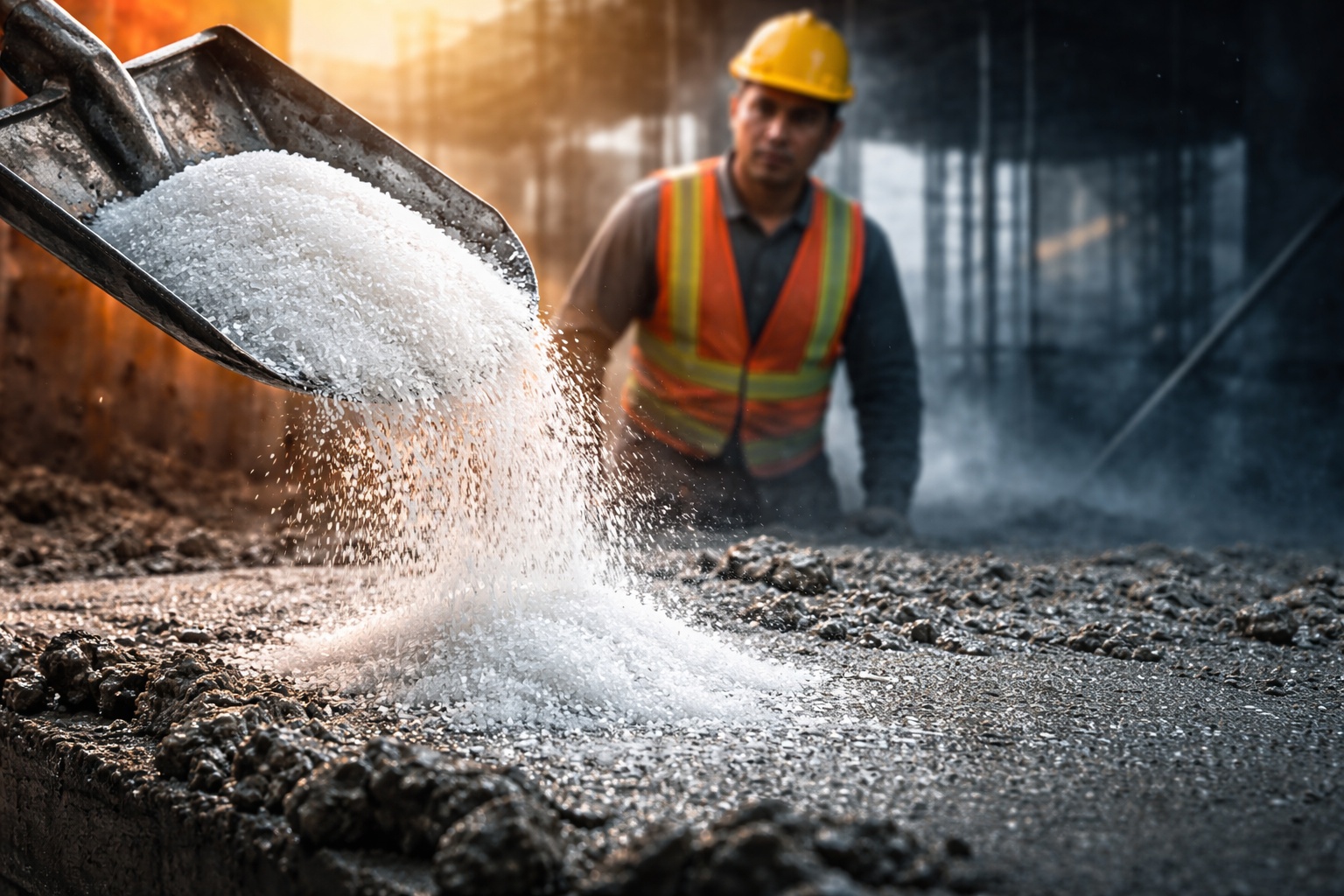


Understand How Sugar Acts as a Retarder of Portland Cement Hydration, Its Technical Limits, and the Structural Risks of Incorrect Use.
On construction sites in Brazil and other countries, one can hear reports about the addition of sugar to concrete mixes to “delay the setting.” This ancient practice, passed down empirically, is based on a real chemical phenomenon: small amounts of sucrose can interfere with the hydration of Portland cement. However, the same mechanism that allows for time gain in concreting may, if improperly dosed, completely compromise structural strength.
The discussion requires an understanding of the chemistry of cement, the role of compounds such as tricalcium silicate (C3S), and the delicate balance between time control and mechanical performance.
What Happens in Cement Hydration with Sugar
Portland cement is mainly composed of calcium silicates and aluminates. When mixed with water, a set of exothermic reactions known as hydration begins. Tricalcium silicate (C3S) reacts to form calcium silicate hydrate (C-S-H) gel, responsible for the concrete’s strength, along with calcium hydroxide.
-
The lack of welders, electricians, and operators becomes a structural threat in 2025, with the construction industry and manufacturing already suffering from delays, cost pressures, and labor shortages in Brazil.

-
Brazil and Paraguay are just 46 meters away from a historic union on the bioceanic bridge that promises to revolutionize trade between the Atlantic and the Pacific.

-
With 55 km over the sea, a cost of US$ 20 billion, and enough steel to build 60 Eiffel Towers, China’s largest project has connected Hong Kong, Zhuhai, and Macau in a colossal bridge that defies the logic of engineering.

-
A trick with joint compound transforms a Styrofoam ceiling into a plaster-like ceiling: leveled panels, wires and mesh at the joints, sand, paint, and change the environment while spending little today.



The hydration process occurs in stages. Initially, there is a rapid reaction period followed by an induction phase, during which the reaction temporarily slows down.
Next, hydration accelerates again, initiating the so-called “setting”, when the concrete loses plasticity and begins to harden.
Controlling the setting time is crucial in large concrete pours, hot climates, or operations requiring prolonged transportation of the material.
How Sugar Interferes with the Chemical Reaction
Common sugar (sucrose) acts as a retarder of hydration by interacting with calcium ions released during the initial stages of the reaction.
Studies show that sucrose can form complexes with calcium, delaying the formation of hydration products.
At very low concentrations, typically below 0.05% of the cement mass, sugar can significantly prolong the setting time without compromising final strength. Within this range, the main effect is the delay in the formation of the C-S-H gel.
However, when the concentration exceeds certain limits, the behavior changes drastically. At higher dosages, sugar can almost completely inhibit hydration, preventing the proper formation of the crystalline structure responsible for mechanical strength.
When the Technique Can “Save” a Pour
In high-temperature conditions, concrete can harden quickly, making it difficult to compact and finish. The use of industrial retarders is common in these situations. Sugar, by acting as a chemical retarder, can theoretically serve a similar function in small controlled dosages.
Historically, this practice has been used in emergencies at sites where industrial additives were unavailable. In small interventions, the time gained can prevent cold joints and improve the quality of the pour.
However, the construction industry already has specific retarders formulated for predictable control of setting time, with standardized testing and compliance with technical regulations.
The Structural Risks of Inadequate Use
The main risk of empirically using sugar is inaccurate dosing. The line between controlled retardation and loss of strength is extremely thin.
Excess sucrose can result in concrete that remains plastic for hours or even days, with insufficient initial strength development. In extreme cases, the structure may not reach adequate strength even after prolonged curing.
Additionally, the interference in hydration can alter the microstructure of the concrete, affecting durability, compressive strength, and behavior under structural loads.
Technical standards such as those from ABNT and international specifications do not recommend common sugar as a substitute for certified additives. The industrial control of additives involves laboratory tests that ensure predictability of performance.
Difference Between Industrial Retarders and Household Sugar
Commercial retarders are formulated with specific compounds that control hydration in a stable and predictable manner. They undergo tests for compressive strength, setting time, shrinkage, and durability.
Household sugar, on the other hand, lacks standardization for structural use. Its purity can vary, and its dissolution and dispersion in the mix depend on site conditions.
The difference lies not only in chemical function but also in technical reliability and performance traceability.
Percentage Limits and Concrete Behavior
Academic research indicates that concentrations of about 0.02% to 0.05% of the cement mass can act as moderate retarders. Above this, especially over 0.1%, the risk of severe inhibition of hydration increases.
Considering that one cubic meter of concrete can contain about 300 kg to 400 kg of cement, small variations in the amount of sugar added can represent a critical difference in final performance.
On construction sites, where improvised measurements are common, the margin of error is high.
Does the Technique Really Work Without Compromising Strength?
The answer is technical and conditional. Yes, sugar can control the setting time when used in extremely low and controlled doses. However, the risk associated with imprecise use outweighs the benefits when suitable industrial alternatives exist.
This practice does not increase the strength of concrete and does not replace adequate control of temperature, water/cement ratio, and the use of certified additives.
In structural applications — beams, columns, slabs — the use of common sugar represents unnecessary risk. In experimental or small-scale situations, it can show a real retarding effect, but always with uncertainty.
Adding sugar to concrete is not a myth. It is a documented chemical phenomenon: sucrose interferes with the hydration of Portland cement by complexing calcium ions and delaying the formation of structural products.
However, the same property that allows time gain can completely compromise mechanical performance if improperly dosed. The difference between control and structural collapse can be fractions of a gram per kilo of cement.
In a sector where structural safety depends on predictability and technical standards, the empirical use of sugar remains a risky practice. Modern engineering offers safer and more controllable solutions to delay setting.
Sugar can save an emergency pour. But it can also compromise the entire structure when it replaces technique with improvisation.










Esse assunto já foi objeto de estudo do Engº Eládio G. Petrucci e relatado no livro “Concreto de Cimento Portland – Ed. Globo – Porto Alegre – 1971 – 2ª Ed. – P. 89/90. Resumo : “A adição de açucar na água de amassamento até 0,3% retarda a pega; acima desse valor há uma aceleração, havendo redução de resistência mecânica. Além de 0,5% a redução da resistência é muito grande.” Conclui dizendo : “O açucar se combina com a cal do cimento e forma sacarato de cálcio, solúvel e expansivo, que torna o concreto facilmente desagregável, mormente em presença da queda de resistência.” Vale uma reflexão.