





 Portuguese
  English
  Spanish
  3 min of reading
  0 comments


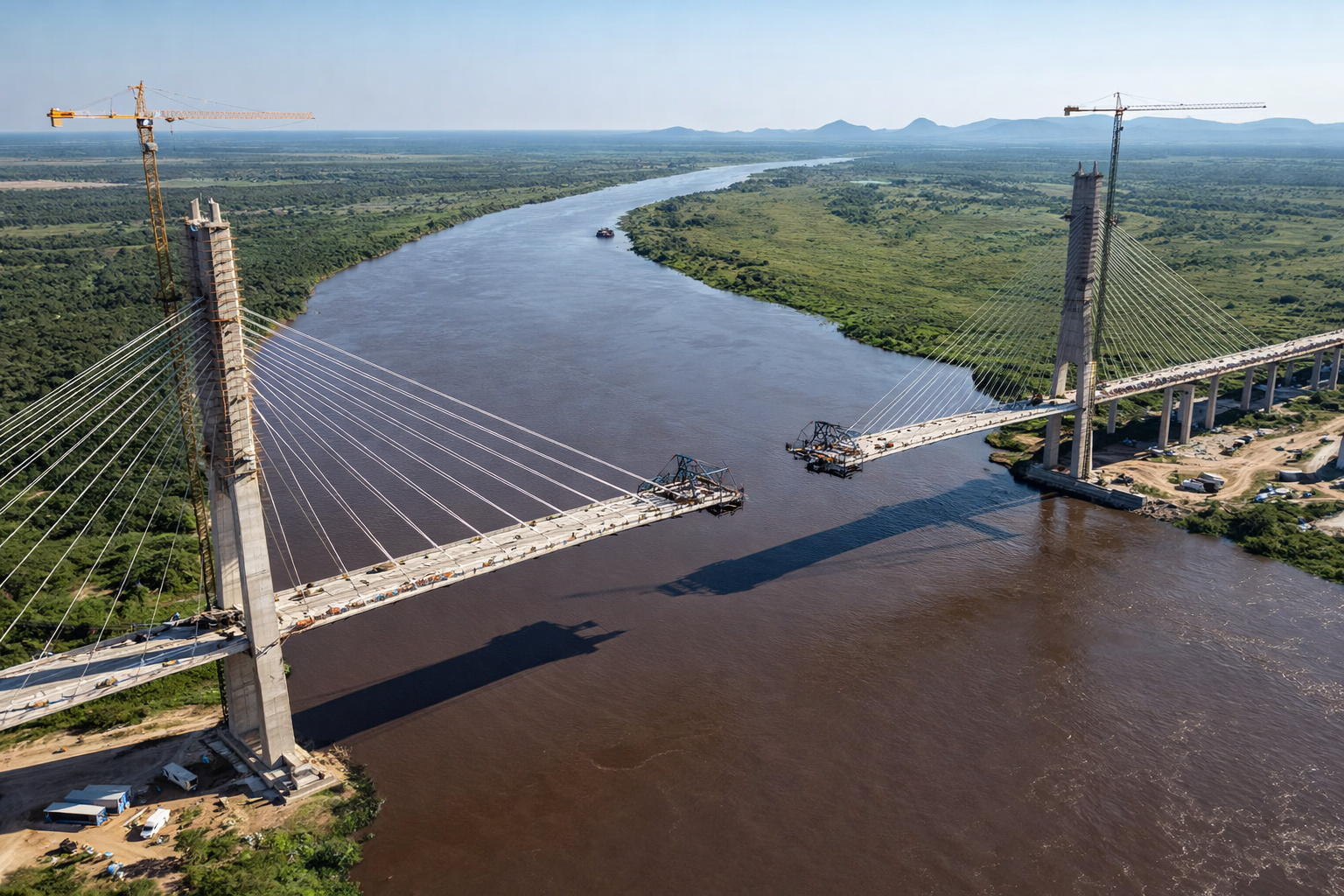
Strategic work advances to final phase and promises to transform South American logistics by shortening distances and reducing costs in international transport
Less than 50 meters away, Brazil and Paraguay are about to realize one of the most strategic works in South America. The international bridge over the Paraguay River, a key piece of the so-called Bioceanic Route, is already in the final phase and is expected to definitively connect its two ends in early May, marking a historic advance in the continent’s logistical integration.
Currently, there are only 46 meters left for the central structure to be completely connected — a distance that can be covered in about a minute of a leisurely walk. This figure alone symbolizes the proximity of a transformation that promises to directly impact international trade, the regional economy, and cargo transport between South American countries.
The information was disclosed by “Campo Grande News”, based on records made on land and aerial images captured this Thursday (2), confirming the advanced stage of construction and the expectation of imminent completion of this historic connection.
-
15 cargo planes per month will depart from China directly to Ceará loaded with equipment, and the most brilliant stroke of this plan is what the Ceará government wants to put inside these planes on the return trip so as not to waste any flight.

-
A R$400 million bridge that reduces a 30-minute crossing to just 1 minute was inaugurated between SC and Paraná, ending decades of ferry boat queues.
-
Paraguay wants to transform Itaipu water into a $665 million green fertilizer, create a factory without natural gas, and reduce Latin America’s food dependence on a threatened route in the Strait of Hormuz.

-
Houses in China use water-bonding bricks that can reduce the use of traditional mortar, promising faster, cleaner, and more economical construction, but they require correct design, certified material, and technical installation to ensure safety.



Bioceanic Route promises to reduce costs and transform international trade
As the work approaches completion, expectations around the impact of the Bioceanic Route also grow. After all, the project is not limited to the construction of a bridge, but rather the creation of an international logistics corridor that will connect Brazil, Paraguay, Argentina, and Chile by land.
In this sense, the new route will allow the flow of goods directly to ports in northern Chile, on the Pacific Ocean. As a result, there will be a significant reduction in distances traveled compared to traditional routes that use the Atlantic Ocean, which should decrease logistics costs and increase the competitiveness of South American products in the global market.
Furthermore, the bridge connects Porto Murtinho (MS) to Carmelo Peralta (Paraguay), establishing itself as one of the main physical connections between the two countries within this ambitious continental integration project.
Meanwhile, the works continue at a rapid pace, even with a temporary pause due to the Easter holiday. Activities are expected to resume on Monday (6), focusing on the concreting and advancement of the central structure over the river.
Construction involves investments, international engineering, and forecast until 2026
Behind this grand work is a joint effort between Brazil and Paraguay. The construction of the bridge is being carried out by the PYBRA Consortium, under the coordination of Paraguayan civil engineer Renê Gomez. On the Paraguayan side, the supervision is conducted by teams linked to the Ministry of Public Works and Communications (MOPC).
On the other hand, in Brazil, access works continue to progress with the assembly of viaducts, pillars, and concrete beams, under the responsibility of the PDC Fronteira Consortium, supervised by DNIT.
Simultaneously, in Paraguayan territory, works on hydraulic fill are underway, essential for the construction of approximately 4 kilometers of access to Ruta PY-15, the highway that integrates the bioceanic corridor in the Chaco.
The forecast is that the main structure of the bridge will be completed throughout 2026, between the first and second semesters, with total delivery of the work expected for August 2026.
Thus, with each meter advanced, the bridge ceases to be just an ambitious project and becomes a concrete reality — capable of redefining South American logistics and positioning Brazil as a central piece in trade between two oceans.
Work that a month ago was still far from completion is now a few meters away from connecting Brazil and Paraguay via the Bioceanic Route





Be the first to react!