





 Portuguese
  English
  Spanish
  6 min of reading
  0 comments


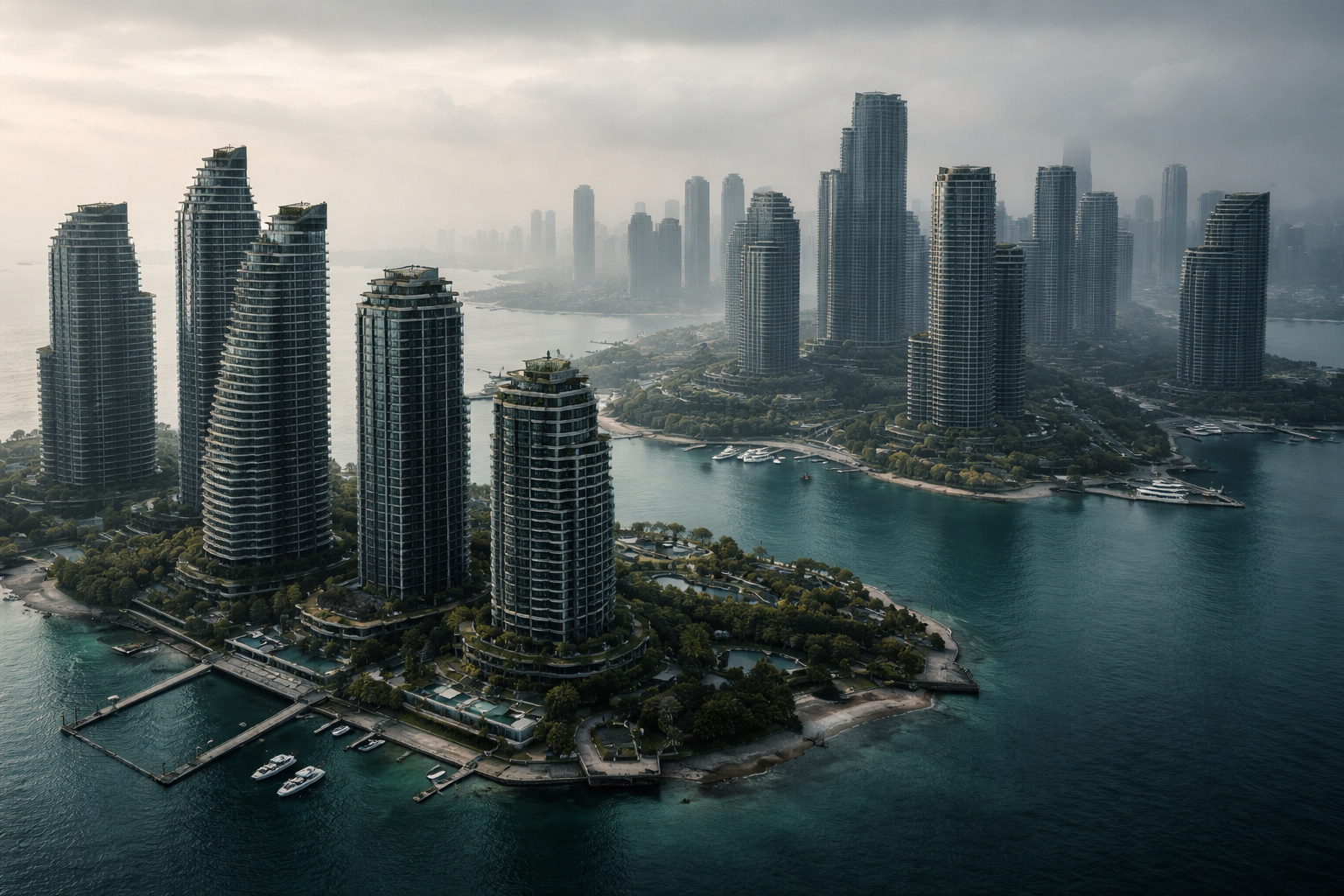
Forest City Megacity in Malaysia Consumed Over US$ 100 Billion, Became Empty After Real Estate Crisis, and Now Tries to Reinvent Itself as a Special Financial Zone Next to Singapore.
In Iskandar Puteri, in Johor state, southernmost Malaysia, just a few kilometers from the border with Singapore, one of the most ambitious urban projects of the 21st century was born. The so-called Forest City officially began construction in 2016, envisioned by the Chinese real estate group Country Garden, in partnership with the Malaysian state-owned company Esplanade Danga 88. The plan called for the creation of an entire city on four artificial islands, reclaimed in the Johor Strait, with a capacity to accommodate up to 700,000 residents, dozens of hotels, financial centers, marinas, universities, hospitals, and technology parks.
The total announced investment throughout the project exceeded US$ 50 billion, potentially reaching US$ 100 billion over decades, according to institutional materials released at the time of the launch. The Forest City was presented as a showcase of future urbanism: buildings covered in greenery, intelligent energy systems, electric mobility, car-free streets, and total integration between housing, work, and leisure. The project gained initial political support and was primarily marketed to foreign investors, especially Chinese buyers interested in properties outside mainland China.
However, less than ten years after the construction began, the reality on the ground proved to be very different from the model.
-
Friends have been building a small “town” for 30 years to grow old together, with compact houses, a common area, nature surrounding it, and a collective life project designed for friendship, coexistence, and simplicity.

-
This small town in Germany created its own currency 24 years ago, today it circulates millions per year, is accepted in over 300 stores, and the German government allowed all of this to happen under one condition.

-
Curitiba is shrinking and is expected to lose 97,000 residents by 2050, while inland cities in Paraná such as Sarandi, Araucária, and Toledo are experiencing accelerated growth that is changing the entire state’s map.

-
Tourists were poisoned on Everest in a million-dollar fraud scheme involving helicopters that diverted over $19 million and shocked international authorities.


Where It All Started: Artificial Islands in Southern Malaysia


Forest City was implanted in a strategic area of Southeast Asia. Johor is the Malaysian state closest to Singapore, one of the world’s major financial centers.
The geographical proximity was one of the main arguments of the project: to live in a futuristic city, with prices lower than those in Singapore, but with quick access to the financial market and opportunities in the city-state.
For this, a colossal engineering effort was required. Millions of cubic meters of sand were dredged to form artificial islands, a process similar to that used in projects like Palm Jumeirah in Dubai. The land reclamation altered the coastline, required extensive maritime containment, and demanded entirely new port, road, and electrical infrastructure.
The islands were designed to house vertical residential districts, shopping centers, luxury hotels, and elevated green spaces. In theory, Forest City would function as an autonomous city, connected to the mainland by bridges and expressways.
The Business Model Behind Forest City
The financial heart of the project lay in the early sales of apartments to foreign investors. The strategy followed a pattern already used by large Chinese developers: raise capital through off-plan sales to finance the continuous expansion of the works.
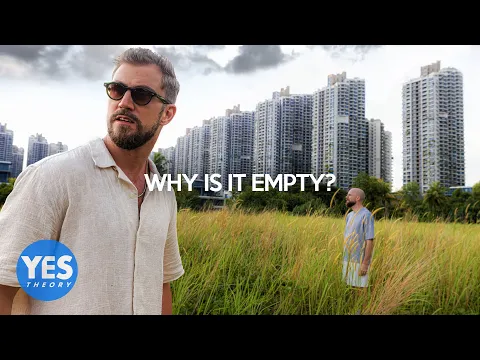
A significant portion of the units was sold to middle and upper-class Chinese citizens, attracted by the promise of property value appreciation, international legal security, and indirect access to global markets. At times, over 80% of buyers were foreigners, according to data reported by the Malaysian press.
However, this model made the project highly dependent on external factors, such as China’s capital control policies, regulatory changes in Malaysia, and the global economic cycle itself.
Political Changes and the Beginning of Difficulties
In 2018, the situation started to change significantly. The new Malaysian government began to review large-scale real estate projects aimed at foreigners, citing concerns about speculation, housing affordability, and territorial sovereignty. Additional restrictions were imposed on property purchases by non-residents, directly affecting demand for Forest City.
At the same time, the Chinese real estate market began to show signs of exhaustion. Large developers faced financial difficulties, and the flow of Chinese buyers to overseas projects drastically decreased.
The COVID-19 pandemic, starting in 2020, further aggravated the situation. Borders were closed, international travel practically ceased, and interest in properties in cities still under construction plummeted. Construction slowed down, and many completed buildings remained practically empty.
An Empty City Ready but Without Residents
By 2023, estimates indicated that fewer than 10,000 people effectively lived in Forest City, an insignificant number given the projected capacity of 700,000 inhabitants.
Complete residential towers, each with hundreds of apartments, were experiencing minimal occupancy rates. Commercial areas operated partially, and many planned services never came to fruition.

Aerial images of the region began to circulate in international media, showing wide avenues, modern buildings, and new infrastructure, but with very little human activity. The term “ghost city” began to be frequently associated with the project, although local authorities officially reject this classification.
From an economic standpoint, the impact was profound. The main developer, Country Garden, entered into a severe financial crisis starting in 2021, reflecting the broader collapse of the Chinese real estate sector. The pace of investments fell, new phases of the project were delayed, and part of the workforce was demobilized.
Environmental Impacts and Criticism of Coastal Engineering
In addition to financial and demographic problems, Forest City also faced environmental criticisms. The land reclamation and dredging process affected coastal ecosystems, artisanal fishing areas, and mangroves in the Johor region. Local communities reported declines in fishery productivity and changes in marine current dynamics.
These impacts generated debates about the environmental cost of mega-urban projects built over the sea, especially in ecologically sensitive regions.
The Attempt at Reinvention: Special Financial Zone
In light of the stagnation scenario, the Malaysian government announced, in 2023 and 2024, a new strategy for Forest City. The project was officially designated as Special Financial Zone, featuring tax incentives, differentiated regulatory regimes, and facilities for foreign companies to set up in the area.

The goal became to transform the city into a hub for financial services, technology, data centers, and digital activities, leveraging the existing infrastructure and proximity to Singapore. Among the announced incentives are tax exemptions, special visas for foreign professionals, and incentives for the establishment of regional headquarters by multinationals.
This shift marks a clear inflection in the original purpose of the project. Forest City is no longer marketed as a massive residential city but is instead presented as a strategic economic platform, focused more on capital and services than on large-scale housing.
What Forest City Reveals About 21st Century Megaprojects
The case of Forest City has become an emblematic example of the risks associated with urban megaprojects conceived from optimistic projections of continuous growth.
The combination of large-scale engineering, international capital, and long-term planning has proven to be extremely sensitive to political changes, economic crises, and unexpected global shocks.
At the same time, the project exposes the limits of urbanism based almost exclusively on real estate investment and asset speculation. Without a solid local economic base and organic resident population, even the most modern infrastructure can become underutilized.
For Malaysia, Forest City represents a strategic challenge: how to leverage an already made investment, minimize financial losses, and transform a symbol of excess into a tool for real economic development. For the world, the project serves as a warning about the hidden costs of cities designed for a future that doesn’t always materialize.










Seja o primeiro a reagir!