





 Portuguese
  English
  Spanish
  5 min of reading
  0 comments


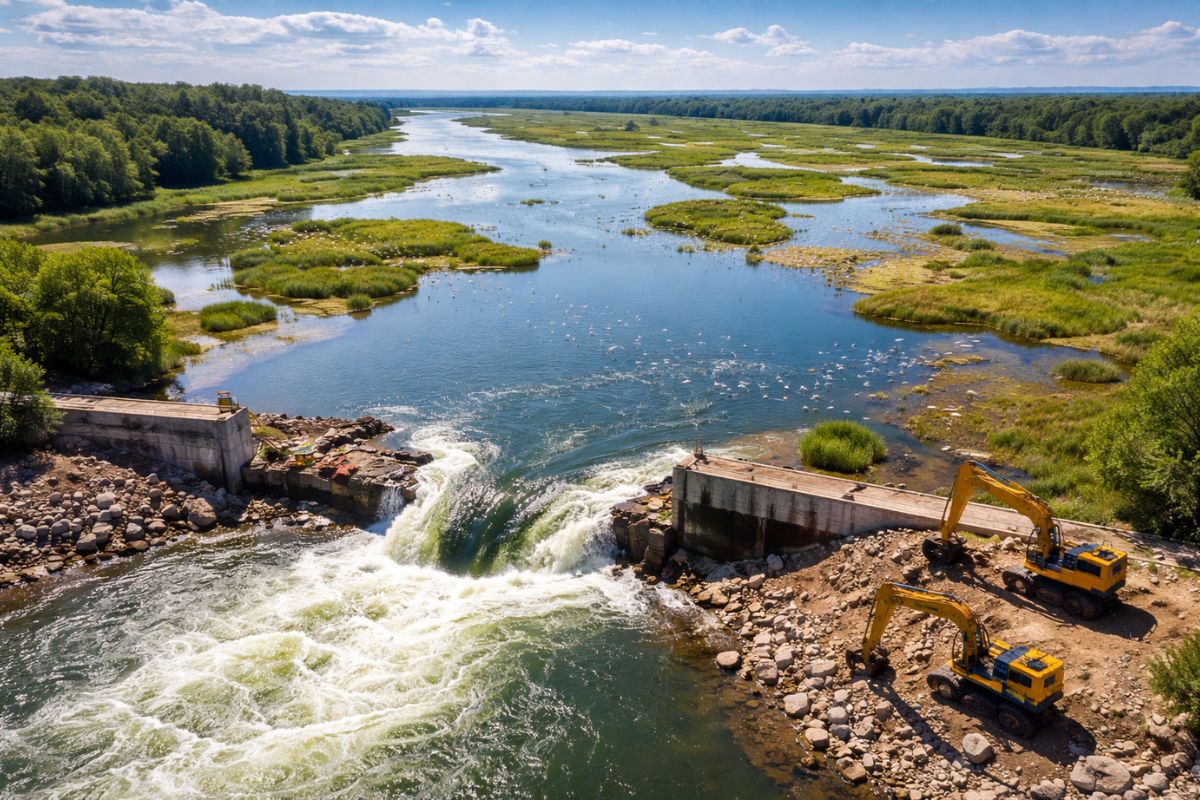
At The Cranial End Of The Danube Delta, A Lake That Had Been Separated From The River For Decades Is Regaining Its Natural Pulse. The Removal Of Dams, The Clearing Of Channels, And New Gates Increased Water Inflow By 40%, Revitalizing Habitats And Essential Services For The Region’s Residents Today
The Kartal Lake, on the Ukrainian side of the Danube Delta, spent decades “breathing short” after dikes, dams, and irrigation systems altered the water’s path and reduced the natural renewal of the system.
Now, with barriers removed and channels reopened, the lake is reconnecting more dynamically with the Danube, and the first signs are hard to ignore: more water circulating, more life returning, more territory recovering functions that seemed lost.
When A Lake Is Isolated, The Problem Is Not Just “Lack Of Water”
A floodplain lake does not only depend on volume; it depends on exchange. When the flow is interrupted, the water becomes more stagnant, quality may decline, and the system loses the ability to “clean itself” with continuous renewal. Gradually, this affects the entire chain: aquatic plants, invertebrates, fish, and ultimately, the birds that feed and nest in the area.
-
Friends have been building a small “town” for 30 years to grow old together, with compact houses, a common area, nature surrounding it, and a collective life project designed for friendship, coexistence, and simplicity.

-
This small town in Germany created its own currency 24 years ago, today it circulates millions per year, is accepted in over 300 stores, and the German government allowed all of this to happen under one condition.

-
Curitiba is shrinking and is expected to lose 97,000 residents by 2050, while inland cities in Paraná such as Sarandi, Araucária, and Toledo are experiencing accelerated growth that is changing the entire state’s map.

-
Tourists were poisoned on Everest in a million-dollar fraud scheme involving helicopters that diverted over $19 million and shocked international authorities.


It was this type of cascading effect that accumulated over time in the delta. The artificial disconnection of large areas of the floodplain from the main channels of the Danube reduced water levels and quality and favored problems like algae proliferation and declining fish stocks typical symptoms of a lake that ceases to function as a dynamic ecosystem.
What Was Done At Kartal Lake To “Reconnect” The Delta

The restoration of Kartal Lake and its surroundings progressed over six years and combined three fronts that, together, change the hydraulic behavior of the system: removal of dams and other barriers, clearing of silted channels, and installation of gates to control and maintain the connection operating in a more natural way.

The central result is the recovery of circulation between lake, channels, and reed beds. Instead of water being trapped in compartments, the system behaves like an interconnected network again something essential in wetlands, which naturally alternate levels and paths according to the river’s pulse.

Image: Oleksandr Kurakin / Renaturalizing Europe
The 40% Jump In Flow And Why That Number Matters

In the final, more extensive phase, the Luzarza canal at the western end of the lake had more than five kilometers reopened with the help of heavy machinery. This reopening increased water flow from the Danube to the lake by 40%, bringing the water regime closer to what would be a more natural state.

In practice, this increase means not just “more water.” It means more renewal and more ecological stability, because continuous exchange tends to improve quality, reduce stagnation, and support different micro-habitats. The intervention was also designed to revitalize about 450 hectares of floodplain, expanding areas suitable for fish, birds, mammals, and invertebrates.
The 11 Km Circuit And The Logic Of A System That Needs To Circle
Besides pulling water from the Danube into the lake, the engineering sought to strengthen the link between Kartal and Lake Kahul through a dynamic water circuit extending 11 kilometers. This detail is crucial because the resilience of wetlands grows when there are more circulation paths and more gradients (shallow areas, vegetated edges, channels, stretches with current).
In such systems, recovery can be surprisingly quick when the “right ingredient” comes back into existence: enough clean water. That’s why field reports indicate almost immediate recovery in some areas after the first interventions not as a miracle, but as a response to minimum conditions restored.
Fish, Birds, And Plants Returning Is Not “Luck”: It Is An Indicator Of Ecological Function
The signs observed after the reconnection the return of typical wetland plants, recovery of fish populations, and increasing arrivals of aquatic birds serve as a thermometer for the ecosystem. Fish need feeding, shelter, and spawning areas; birds rely on both fish and shallow zones and vegetation for resting and nesting.
When water flows again between lake, channels, and reed beds, the landscape ceases to be a collection of isolated puddles and regains the diversity of environments that sustain life. It’s the system regaining “strength and vitality”, with visible effects on the food chain and the use of space by different species.
Why Wetland Restoration Affects People, Not Just Nature

Healthy wetlands have direct value for communities: they help with water security, reduce flood risk, support tourism and job creation, and store large amounts of carbon. And this backdrop matters because, in the last 300 years, half of the wetlands in Europe have been lost to drainage for housing, industry, and agriculture.
In the delta, the reconnection of the lake also restores practical utility: water for irrigation and better conditions for fishing, two livelihoods in riparian regions. When the lake improves, the local economy often feels the effects first in daily life, whether in the availability of water or the predictability of traditional activities.
A Beacon In The Midst Of Uncertainty: What This Lake Reveals About Rapid Recovery
The revitalization of Kartal Lake gains extra weight as it occurs under the shadow of war and regional instability, when pressure on people and nature increases and nature tourism may halt. Still, the case suggests an objective lesson: with the right actions remove barriers, reopen channels, allow water exchange recovery can be faster than expected.
The point is not to promise identical results anywhere, because each lake and each floodplain have their own history and limitations. What Kartal demonstrates is the principle: reconnecting water with freedom and quality creates conditions for nature to be part of the process again, supporting biodiversity while reinforcing benefits that keep communities afloat.
The rebirth of Kartal Lake shows how wetland restoration can reverse decades of human intervention with concrete measures: removing barriers, restoring circulation, and accepting that a delta needs dynamics, not confinement. With 40% more water inflow, 18,000 hectares revitalized, and clear signs of fish and bird return, the lake is once again an ecosystem and resource in a landscape that depends on it to survive.
If you could choose a place in Brazil to “reconnect” the water and restore a lake or wetland, where would it be and why? In your view, would the greatest benefit be in fishing, irrigation, flood reduction, or nature tourism?










-

-

-

-

-

-

91 pessoas reagiram a isso.