





 Portuguese
  English
  Spanish
  4 min of reading
  1 comment


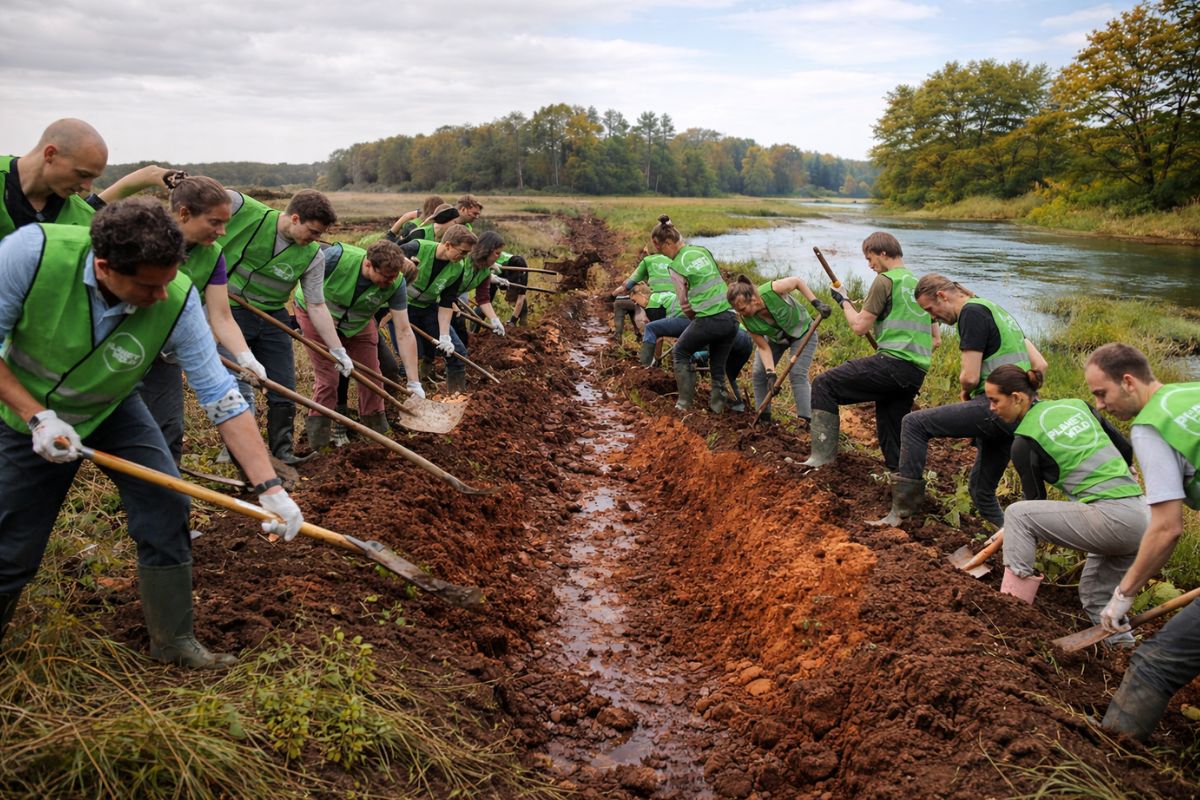


In Europe, Millennium Peats Turned into Farmland After Decades of Drainage Ditches, and the Climate Cost Appeared When the Peat Dried and Released CO2. In a Belgian Valley, Teams Close Channels, Remove Trees Out of Place, and Recreate Wetlands, with a Five-Year Plan to Secure Water and Carbon
Europe has spent a century redesigning its landscapes with engineering straight lines, and the result now comes with a climate and water bill. By transforming wetlands into agricultural fields, previously stable peatlands dried up, the peat came into contact with oxygen, and the release of CO2 ceased to be a technical detail and turned into a liability for public policies.
In Belgium, a restoration mission became a symbol of this turnaround: instead of opening new drainage ditches, teams are closing channels, removing trees out of context, and returning water to the soil to reactivate millennium peatlands. The goal is not to “turn back time,” but to stop losses that are still happening today.
Why Europe Is Returning to Soak What It Drained

In much of rural Europe, drainage ditches have been treated as basic infrastructure: they conduct excess water to streams and rivers, make the soil cultivable, and reduce flooded areas.
-
Motorola launched the Signature with a gold seal from DxOMark, tying with the iPhone 17 Pro in camera performance, Snapdragon 8 Gen 5 that surpassed 3 million in benchmarks, and a zoom that impresses even at night.

-
Satellites reveal beneath the Sahara a giant river buried for thousands of kilometers: study shows that the largest hot desert on the planet was once traversed by a river system comparable to the largest on Earth.

-
Scientists have captured something never seen in space: newly born stars are creating gigantic rings of light a thousand times larger than the distance between the Earth and the Sun, and this changes everything we knew about stellar birth.

-
Geologists find traces of a continent that disappeared 155 million years ago after separating from Australia and reveal that it did not sink, but broke into fragments scattered across Southeast Asia.

The side effect is that, without constant water, peatlands enter drying mode and begin to behave like an exposed carbon stock.
The environmental calculation behind the reversal is straightforward.
Although peatlands cover about 3% of the global land surface, they store more carbon than all the world’s forests combined, precisely because peat accumulates when decomposition is stalled.
When the water goes away, carbon starts to circulate again.
Peat, Oxygen, and the Natural “Brake” of Wetlands

Peatlands are not “common mud.” They form in wetlands where water does not drain, the soil remains flooded, and oxygen hardly reaches the inner layers.
In this condition, decomposing microorganisms lose efficiency, and the plant matter piles up in layers, turning into peat over centuries.
This dynamic creates a powerful biochemical brake.
The plant captures carbon during its life; when it dies and sinks in an oxygen-free environment, that carbon is retained.
What appears to be stagnation is, in practice, storage. Therefore, maintaining a high water table is more decisive than planting more trees in the wrong place.
Drainage Ditches, Agriculture, and the Invisible Cost of Carbon
The shock of reality appears when observing the historical scale.
Estimates cited in the mission indicate that up to 20% of Europe was covered by wetlands about 100 years ago, and that approximately 80% of those areas have disappeared.
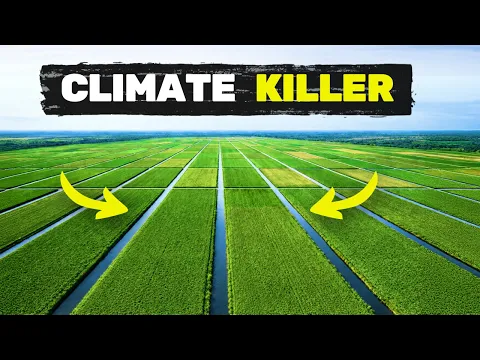
In some valleys, drainage became a mesh: around a thousand kilometers of drainage ditches were dug to dry out the terrain.
The technical consequence is a domino effect.
The dry peat, oxygen penetrates, decomposers “return” to the system, and the release of CO2 accelerates layer by layer.
The mission describes the drainage of peatlands as responsible for 5% of CO2 emissions related to peatlands globally.
It is not a point leak; it is a continuous process as long as the water remains low.
The Operation in Belgium: Close Channels, Cut Down Trees, and Measure Results

The intervention observed in Belgium takes place in the Black Creek Valley, involving EcoTree and a local partner, Natuurpunt.
The cited funding involves the community of the project itself, which brought volunteers to the field and funded the restoration of 7.5 hectares of peatland, with a five-year horizon for the complete reconstruction of the site.
The method combines four fronts, all with an ecological engineering logic.
First, cut down trees that do not belong to the peatland system, because their roots suck up moisture and prevent the peat from becoming saturated again.
Second, manually remove unwanted vegetation for years until the water level stabilizes.
Third, repeatedly mow to reduce the effect of decades of agricultural fertilization.
Fourth, close drainage ditches with barriers and fill, “putting the lid back on the bathtub” to keep water in the valley and raise the water table.
The success indicator starts underground.
With the water table rising, the decomposition of deeper peat slows down, including layers estimated to be up to 14,000 years old.
The formation of new peat on top is slow and can take generations, but biological signs may appear sooner: the mission cites the return of a pair of common cranes for breeding in Belgium, as well as sightings of wolves, presence of beavers, and other species associated with more functional wetlands.
The strategic reading for Europe is that restoration is not just “landscaping.”
Closing drainage ditches and accepting flooded areas changes the productive arrangement, pressures land use decisions, and demands governance to prevent the system from drying out again.
In exchange, peatlands return to acting as climate and water infrastructure, and not as a hidden liability.
Have you ever seen wetlands recovery efforts succeed, or drainage ditches create new problems where there was previously balance? Share what the turning point was that changed your opinion, and under what conditions you would accept “returning water” to the territory.








Não vi zonas úmidas recuperadas: tenho visto a destruição de zonas úmidas na ilha de Santa Catarina, Florianópolis. Lá (Jurerê e Trindade), a especulação imobiliária drenou extensas áreas de mangue para construir mansões e prédios de luxo. Nos últimos anos que estive lá na estação chuvosa, o excesso de água, aliado à drenagem excessiva do solo e o depósito dessa água em canais de drenagem ligados ao mangue fez, na última vez que estive lá (há 3 anos), os canais transbordarem e deixarem o bairro debaixo d’água.