





 Portuguese
  English
  Spanish
 5 min of reading
  0 comments


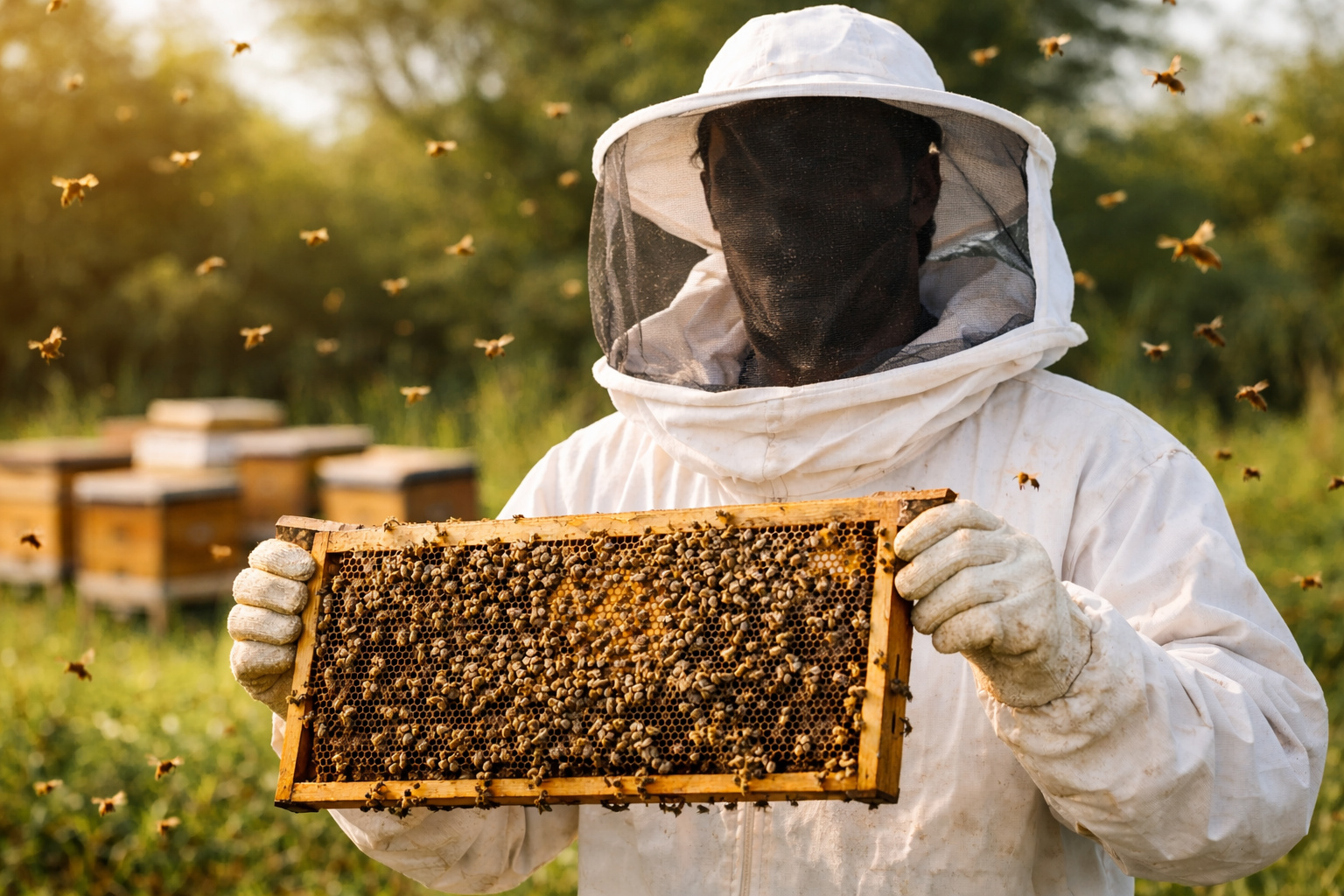
In Campo Erê (SC), Beekeeping Class Becomes Certified Rural Business; Adilso Cúnico Transforms Technical Education Into Income, Honey Production, and Local Impact.
What started as a practical lesson in the classroom has evolved into a structured, certified rural enterprise with a direct impact on the local economy and food production. In Campo Erê, in the West of Santa Catarina, beekeeper Adilso Cúnico is an example of how technical education can transcend the limits of school and become a sustainable life project.
Adilso’s first contact with beekeeping occurred while he was a student at the Professional Education Center of Campo Erê (Cedup), during classes taught by professor Nelson da Silva, who was responsible for the beekeeping course. At that time, the knowledge seemed just another subject in the technical course. After graduating, Adilso took a different path: he worked with heavy machinery and served as a mechanic for years.
The turning point came in 2020, when those lessons from his youth transitioned from a distant memory to his main activity. Beekeeping became central to his productive routine.
-
The sugar-energy sector advances with agricultural technology, but agricultural productivity still raises concerns.

-
The eggshell that almost everyone throws away is made up of about 95% calcium carbonate and can help enrich the soil when crushed, slowly releasing nutrients and being reused in home gardens and vegetable patches.

-
This farm in the United States does not use sunlight, does not use soil, and produces 500 times more food per square meter than traditional agriculture: the secret lies in 42,000 LEDs, hydroponics, and a system that recycles even the heat from the lamps.

-
The water that almost everyone throws away after cooking potatoes carries nutrients released during the preparation and can be reused to help in the development of plants when used correctly at the base of gardens and pots, at no additional cost and without changing the routine.

450 Hives and Migratory Beekeeping as a Productive Strategy
Today, Adilso maintains about 450 hives of Apis mellifera, the European honeybee, primarily working with migratory beekeeping. In this system, the hives are relocated throughout the year to different municipalities, following the available blooms at each period.
The bees migrate to cities such as Irani, Ponte Serrada, and Água Doce, regions with a higher incidence of certain plant species. The result is a diverse production of monofloral honey, such as Eucalyptus and Japan Grape, in addition to the valued Bracatinga Honeydew, a typical product from Southern Brazil, known for its more intense flavor and lower levels of simple sugars.
Even while working on a commercial scale, Adilso keeps two hives of stingless bees — from the species Jataí and Mirim Emerina — with a clear goal: environmental education. The hives are used to raise his son’s awareness of the importance of bees for the balance of ecosystems.
Production Beyond Honey and Certification That Opened Markets
The activity is not limited to honey. On his own property, Adilso produces combed beeswax and propolis extract, packing them locally. Sales occur through various channels: supermarkets, bakeries, and direct-to-consumer sales.

A decisive milestone came in 2024, with the achievement of the Artisan Seal, a certification that allows the national marketing of animal origin products produced in an artisanal manner, respecting regional, cultural, and traditional characteristics.
So far, Adilso is the only beekeeper in the municipality of Xaxim to obtain this certification, a differentiator that expanded markets and consolidated the activity as his main source of income.
Technical Support and Public Policies Made a Difference
According to the beekeeper, institutional support was crucial. He highlights the work of rural extension agent Ires Cristina Ribeiro Oliari from Epagri. The support included technical guidance, access to public policies, and programs such as the Beekeeping Kit.
“Without Epagri’s support for producers in Santa Catarina, it would be very difficult to reach this level of structure and regulation,” Adilso states, emphasizing that technical monitoring was essential to meet all sanitary and legal requirements.
Constant Management, Genetics, and Zero Risk for Error
The routine in migratory beekeeping is intense. Adilso performs periodic queen replacement, creates new swarms, and implements genetic control to maintain productivity at high levels without compromising hive health. Work only stops when weather conditions make management unfeasible.
During blooms, the demands increase even further. Each relocation needs to be planned precisely. A timing or location error can jeopardize the entire production of a specific harvest. “In migratory beekeeping, there is no room for error,” he sums up.
Among the challenges faced, Adilso points out three critical factors: climate change, excessive use of pesticides, and expansion of cellular phone towers. According to him, climate imbalance alters bloom patterns, reducing predictability and productivity.
The use of agricultural pesticides causes direct mortality of bees, while the electromagnetic waves emitted by cell towers can disorient the insects. “Many leave for the fields and cannot return to their hives,” he explains.
Bees, Pollination, and Direct Impact on Food Production
For Adilso, increasing the number of hives goes beyond income. Beekeeping strengthens agricultural pollination, benefiting crops such as soybean, canola, fruits, and vegetables. “The more bees, the more food we have on the table,” he argues.
He also sees conversations with the public as an essential tool. Explaining how hives work and the role of bees in agriculture helps combat prejudice and reinforces the importance of preserving these insects.
Young People, Technical Education, and the Future of Beekeeping
Just as he was impacted by classes at Cedup, Adilso believes that other young people can discover beekeeping through technical courses, internships, and training offered by Professional Education Centers (Cedups) and Rural Family Houses. For him, the activity combines technical knowledge, environmental responsibility, and economic viability — a rare combination in today’s rural landscape.
Santa Catarina on the National Honey Map
Adilso’s case fits into a broader context. Santa Catarina ranks third in honey exports in Brazil, behind only Piauí and Minas Gerais, and is the eighth largest national producer. The state has over 13,000 beekeepers registered with Cidasc.
The highest concentrations of producers are in the Extreme West (32%), West (18%), and Midwest (16%). Meanwhile, the Southern Plateau stands out for having the largest number of hives and obtaining, in 2021, the Geographical Indication (GI) for Bracatinga Honeydew.
The municipality of Xaxim, in West Santa Catarina, ranks seventh in the state honey production ranking. There are more than 35 beekeepers associated with the Bee Farmers Association of Xaxim and Region (ACAXR).
According to extension agent Ires Cristina Ribeiro Oliari, most producers operate in family settings, with beekeeping as a secondary source of income. The diversity of native and cultivated plants provides abundant nectar and pollen, resulting in honey recognized for its quality. Migratory beekeeping, a common practice in the region, contributes to distinct colors, aromas, and flavors.
When School Becomes a Starting Point
Adilso Cúnico’s journey exemplifies how technical education, institutional support, and careful management can transform school knowledge into a solid business.
What began as a class at Cedup now supports a family, strengthens agricultural pollination, and helps keep alive an essential activity for food security. It is proof that when learning meets opportunity, it can literally take flight.










-

-

-

-

9 pessoas reagiram a isso.