





 Portuguese
  English
  Spanish
  4 min of reading
  2 comments




Ancestral Engineering Turned Natural Challenges Into Productive Advantage
Long before modern technology, the Incas already mastered advanced agricultural engineering solutions. In this context, they created terraces, agricultural terraces built on the slopes of the Andes Mountain Range. Thus, they managed to grow food at altitudes above 3,500 meters, even amid extreme conditions.
Furthermore, these environments posed constant challenges, such as soil erosion, water scarcity, and sharp temperature variations. Even so, the Incas adapted the land to their productive needs. As a result, they ensured food stability and sustained millions of people throughout the Inca Empire.
At the height of the empire, during the 15th century, the terraces occupied about one million hectares. In other words, it was an agricultural system on a continental scale, found in areas that today correspond to Peru, Bolivia, Ecuador, Colombia, Chile, and Argentina.
-
Motorola launched the Signature with a gold seal from DxOMark, tying with the iPhone 17 Pro in camera performance, Snapdragon 8 Gen 5 that surpassed 3 million in benchmarks, and a zoom that impresses even at night.

-
Satellites reveal beneath the Sahara a giant river buried for thousands of kilometers: study shows that the largest hot desert on the planet was once traversed by a river system comparable to the largest on Earth.

-
Scientists have captured something never seen in space: newly born stars are creating gigantic rings of light a thousand times larger than the distance between the Earth and the Sun, and this changes everything we knew about stellar birth.

-
Geologists find traces of a continent that disappeared 155 million years ago after separating from Australia and reveal that it did not sink, but broke into fragments scattered across Southeast Asia.

Terrace Structure Ensured Efficiency, Thermal Protection, and High Productivity
To achieve this performance, the Incas adopted an extremely precise engineering. First, they built stone walls on the slopes. Then, they filled the terraces with layers of stones and gravel of different sizes.
As a result, the soil began to have efficient drainage, preventing excessive water accumulation. At the same time, this structure helped retain moisture and reduce the impact of frosts, common in high-altitude regions.
Thanks to this method, the Incas expanded the cultivation of essential foods, such as potatoes, corn, quinoa, and coca. Moreover, the system allowed for agricultural diversification, which reduced the risks of scarcity and increased the food security of the empire.
Simultaneously, the Incas developed complex irrigation systems. Networks of canals transported water from rivers and springs to the terraces. Meanwhile, artificial reservoirs regulated the flow, preventing floods and erosion. Consequently, agricultural productivity increased consistently.
Moray Functioned as an Agricultural Testing Center and Climate Innovation

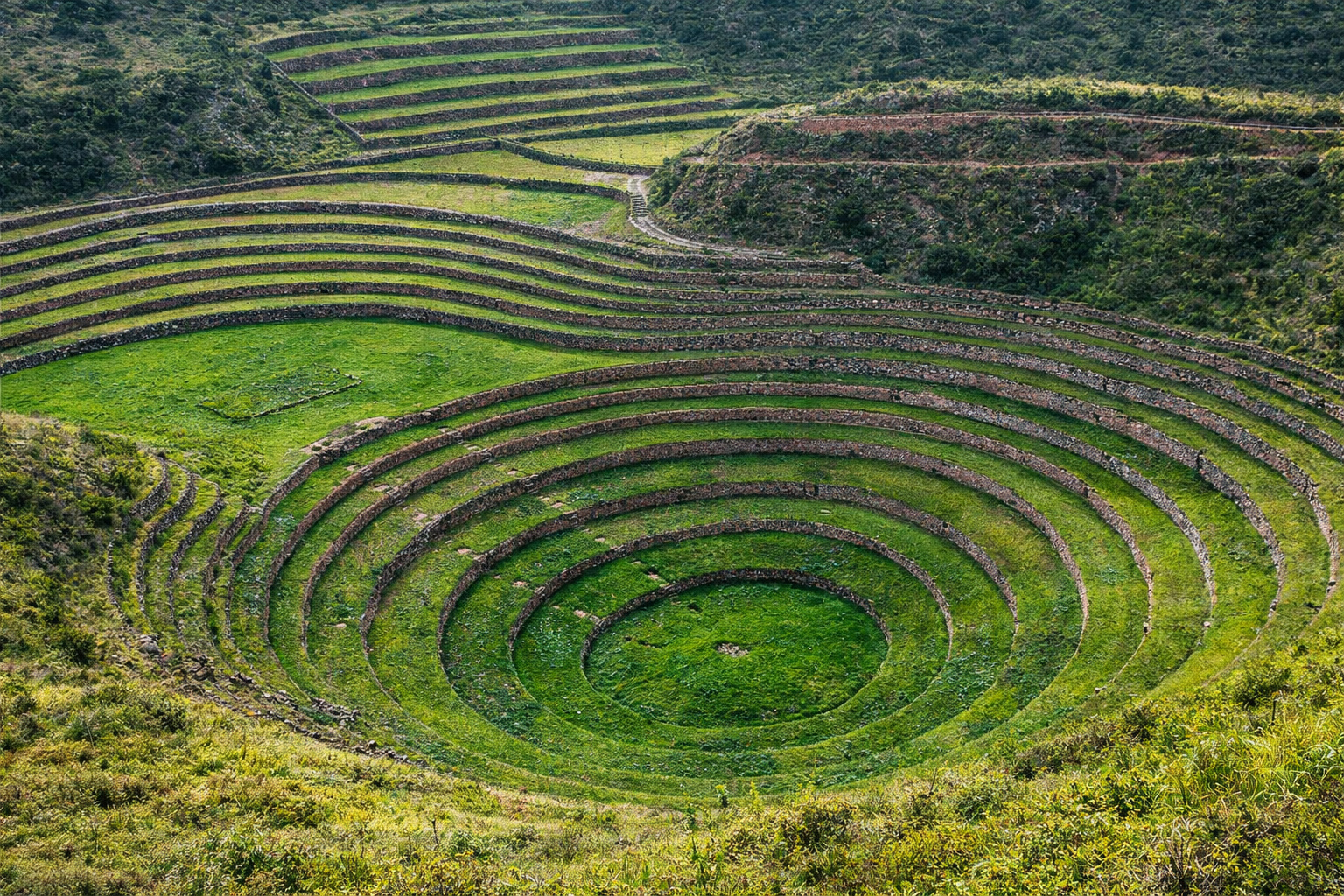
Among the most emblematic examples of Inca innovation is the archaeological site of Moray, located in the Sacred Valley. In this location, the terraces form concentric circles, creating distinct microclimates.
According to archaeological studies, the temperature difference between the upper and lower levels can reach 15 °C. For this reason, researchers believe that Moray functioned as an experimental agricultural laboratory.
There, the Incas tested techniques of hybridization, domestication of species, and crop rotation. Additionally, analyses indicate that soil samples from various regions of the empire were brought to the site. Thus, it was possible to adapt plants to different climatic conditions before cultivating them on a large scale.
Social Organization Ensured Continuous Maintenance of the Terraces
However, the efficiency of the terraces did not depend solely on engineering. Similarly, social organization played a fundamental role. The land was divided into three parts: one for the emperor, another for religious cults, and a third for the local population.
In addition, systems like the mit’a organized collective labor, mobilizing communities for the maintenance of the terraces and public works. On the other hand, the mitma promoted planned migrations, strengthening new agricultural frontiers.
Thanks to this structure, the empire was able to react rapidly to extreme weather events, such as droughts and floods, ensuring productive stability over time.
Legacy of the Terraces Inspires Sustainable Solutions in the Modern World

Even after the arrival of Spanish colonizers in the 16th century, many terraces remained in use. Currently, farmers from the Sacred Valley, the Colca Canyon, and other Andean regions continue to utilize these ancestral techniques.
In recent years, international organizations like the UN have begun to highlight the terraces as a model of sustainable agriculture. This is because the system provides practical answers to contemporary issues, such as water scarcity, soil erosion, and climate change.
Moreover, researchers are studying the adaptation of terrace design for other mountainous regions of the planet. In this way, Inca knowledge can expand its global impact.
Technique, Aesthetics, and Innovation Integrated into the Landscape
Finally, the terraces also impress with their visual aspect. While serving a productive function, they display geometric patterns that unite efficiency, organization, and aesthetics.
In summary, the Inca legacy demonstrates that effective agricultural solutions do not depend exclusively on modern technology. On the contrary, by combining engineering, observation of nature, and collective effort, this people created a sustainable model that has transcended centuries and continues to inspire the world.
Do you believe that modern agriculture should learn more from the ancestral knowledge of indigenous peoples?







La ANDENERIA o terrazas agrícolas en el Peru, tuvieron su mayor apogeo y desarrollo en la Epova PREINCA: uno de los mayores legados son los Sistemas de ANDENERIA desarrollados por la Cultura viva PUQUINA y que se extendió desde el Gran Valle de PUQUINA hacia el norte hasta Arequipa y parte de Ayacucho, al sur hasta Moquegua y Tacna y hacia el Este hasta el Cusco y Puno. Es verdad que los Incas lo perfeccionar, pero e escalas de investigación muy local.
Los conocimientos ancestrales deben tomarse en cuenta para seguir innovando la agricultura moderna,