





 Portuguese
  English
  Spanish
  6 min of reading
  0 comments


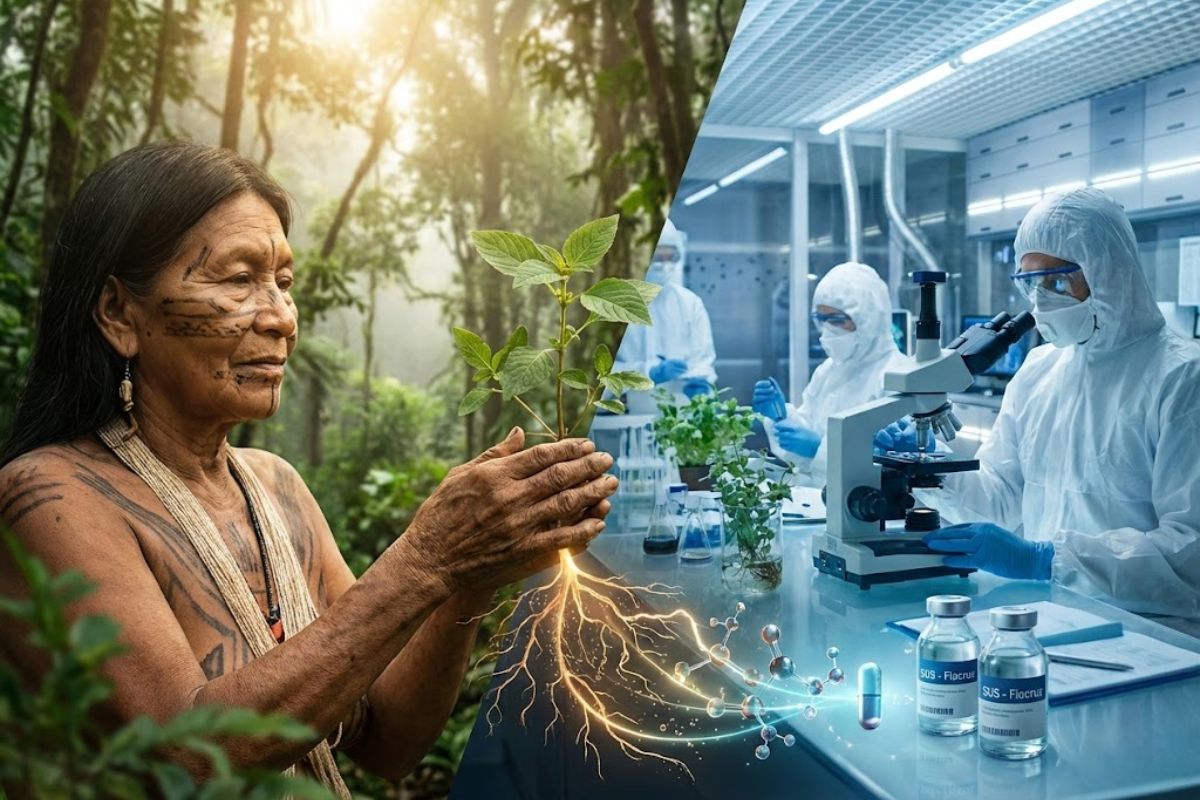
The First Industrial Drug Made With The Plant Phyllanthus Niruri, Used For Centuries By Indigenous Peoples Against Urinary Disorders, Is Being Developed By Farmanguinhos/Fiocruz With Support From The UNDP And The MMA, Funded By The GEF, To Reach The SUS In Two Years, After Evaluation By Anvisa With Dose, Control And Quality
What used to circulate as tradition, family advice and backyard remedies is now entering a formal route to become a drug of the Unified Health System. The plant Phyllanthus niruri, commonly known as quebra pedra, is being worked on at Farmanguinhos/Fiocruz within a project with UNDP and the Ministry of the Environment and Climate Change, with an investment of R$ 2.4 million for studies, infrastructure, and standardization.
At its core, the proposal touches on a typical Brazilian tension: how to transform an ancestral use into a reliable, accessible, and safe product, without selling “miracle” and without putting people at risk. The promise is not a magic cure, but a path for preventing kidney stones with guaranteed quality, traceability, and regulatory evaluation before reaching SUS units and pharmacy shelves.
From Territory To Laboratory: What Changes When The Drug Becomes Public Policy

The development of this drug arises from an articulation among three fronts with well-defined roles.
-
Motorola launched the Signature with a gold seal from DxOMark, tying with the iPhone 17 Pro in camera performance, Snapdragon 8 Gen 5 that surpassed 3 million in benchmarks, and a zoom that impresses even at night.

-
Satellites reveal beneath the Sahara a giant river buried for thousands of kilometers: study shows that the largest hot desert on the planet was once traversed by a river system comparable to the largest on Earth.

-
Scientists have captured something never seen in space: newly born stars are creating gigantic rings of light a thousand times larger than the distance between the Earth and the Sun, and this changes everything we knew about stellar birth.

-
Geologists find traces of a continent that disappeared 155 million years ago after separating from Australia and reveal that it did not sink, but broke into fragments scattered across Southeast Asia.

Farmanguinhos/Fiocruz assumes the development of the product; the UNDP acts in the technical, financial, and logistical coordination; and the MMA enters with a Technical Cooperation Agreement aimed at stimulating research and new phytotherapeutics derived from Brazilian biodiversity for SUS.
It is a design that tries to avoid improvisation and place the theme in the realm of public policy, with rules and responsibilities.
In this transition, one point becomes the center of the debate: treating traditional knowledge as technology, with consent and benefit sharing.
Carina Pimenta, the national secretary of Bioeconomy at the MMA, summarizes this logic by defending that when traditional knowledge is recognized and accessed with prior informed consent, innovation gains purpose.
The partnership with APOINME appears as a milestone precisely for recognizing holders of this knowledge and seeking a path compatible with Anvisa’s standards.
Why Drug Standardization Matters More Than The Fame Of The “Tea”
The home use of quebra pedra is common, but the team involved in the development itself highlights the central problem: home preparation lacks consistent control.
Species swaps, adulterations, and variation in active ingredients are real risks when there is no traceability of the raw material or standardization of the process.
This can result in both ineffectiveness and unwanted effects, especially when consumption becomes routine without guidance.
The proposal for the industrial phytotherapeutic is precisely to invert this logic. Instead of relying on “a tea of any origin,” the drug would go through production stages with defined parameters, quality control, and regulatory compliance.
In practice, this means known dosage, stability, standardization of the active pharmaceutical ingredient, and a final product with guaranteed quality, reducing the margin of uncertainty that exists in informal consumption.
What Science Describes: Kidney Stone Prevention Is Not “Breaking Stone”
The fame of the popular name is misleading. Even with the nickname, quebra pedra is not described as being capable of dissolving large stones.
What studies indicate is another path: contributing to preventing the formation of stones and helping in the elimination of small crystals, with action also related to relaxing the urinary system. This difference is essential to understand why the project talks about prevention and not “instant solution.”
In the body, the components associated with the plant would act favorably to create a urinary environment less conducive to lithiasis: increasing citrate, magnesium, and potassium in the urine while reducing calcium oxalate and uric acid. In straightforward language, it’s as if the body has less “raw material” and fewer ideal conditions for crystals to grow.
It’s not a miracle, it’s physiology with limits, and that’s why the standardization of the drug matters: it reduces the gap between what research observes and what a person actually consumes.
The Study With 56 Patients And The Care With What It Really Indicates
One of the most cited data points on this topic comes from a study by the University of São Paulo conducted in 2018.
The work followed 56 patients with urinary stones of up to 10 mm and observed that daily use of the plant for 12 weeks contributed to the elimination of urinary stones.
The study was published in the National Library of Medicine, which helps give visibility to the debate outside the “I heard it” circuit.
At the same time, it is here that maturity needs to be developed: results under monitored conditions are not an automatic authorization for indiscriminate use. In the very example, the patients were monitored daily, which reduces risks and allows adapting practices in the face of any reaction.
Researcher Maria Behrens from Farmanguinhos/Fiocruz emphasizes that the product’s focus is to innovate by acting at different stages of stones in the urinary tract, but always within what can be demonstrated and standardized. The difference between evidence and exaggeration is exactly what a regulated drug tries to protect.
Investment, Production Chain, And Sustainability: The Path Until The Drug Reaches The SUS
The project foresees about R$ 2.4 million from the Global Environment Facility (GEF) for various fronts: machinery adaptation, purchase of equipment and inputs, contracting services, technical visits, and laboratory studies.
This type of investment may seem like “behind the scenes,” but it is what enables transforming a plant into a pharmaceutical product with repeatability and quality, something that cannot be sustained solely with good intentions.
In addition to the manufacturing itself, the ambition is to boost the entire production chain, from the sustainable cultivation of the raw material to the development of the active pharmaceutical ingredient and the final product. The declared objective connects to the guidelines of the National Policy on Medicinal Plants and Phytotherapics: it is not enough to place an item in the SUS, it is necessary to create a model that does not pressure the environment, that has traceability, and that generates local value. Without a sustainable chain, the drug is not a solution: it becomes a new problem.
What Can Be Done While The Drug Does Not Arrive And Why Excess Hinders
As the process is still in its early stages and the expectation is about two years until completion, many people continue to resort to quebra pedra tea on their own.
What the available data suggests is caution: when talking about preventing kidney stones, habits tend to weigh more on the outcome than any shortcut, such as adequate hydration and balanced nutrition, particularly paying attention to excess sodium, animal proteins, and foods rich in oxalate.
In this interim, the safest guidance is to avoid turning the tea into continuous and prolonged use without professional supervision.
The point is not to demonize tradition, but rather to remember that everything excessive can worsen the condition or open the door to unwanted effects, and the difference between “monitored use in research” and “free use at home” is significant.
It is exactly this gap that a standardized drug, with dosage and control, tries to close when it enters the route of Anvisa and SUS.
Quebra pedra crosses a rare frontier: moving from ancestral knowledge recognized by indigenous peoples and traditional communities into a public machinery of research, funding, control, and regulation to become a drug with guaranteed quality.
If it works, the impact can be twofold: to enhance the prevention of kidney stones safely and to pave the way for other phytotherapeutics that unite science, territory, and public health without romanticization or improvisation.
And then comes the part that only those living the reality can answer: Have you ever had quebra pedra tea or know someone who uses it to prevent “kidney stones”? If there were a standardized drug in SUS with the same proposal, would you trust it more than homemade preparation or do you think tradition still speaks louder?








Seja o primeiro a reagir!