





 Portuguese
  English
  Spanish
  5 min of reading
  0 comments


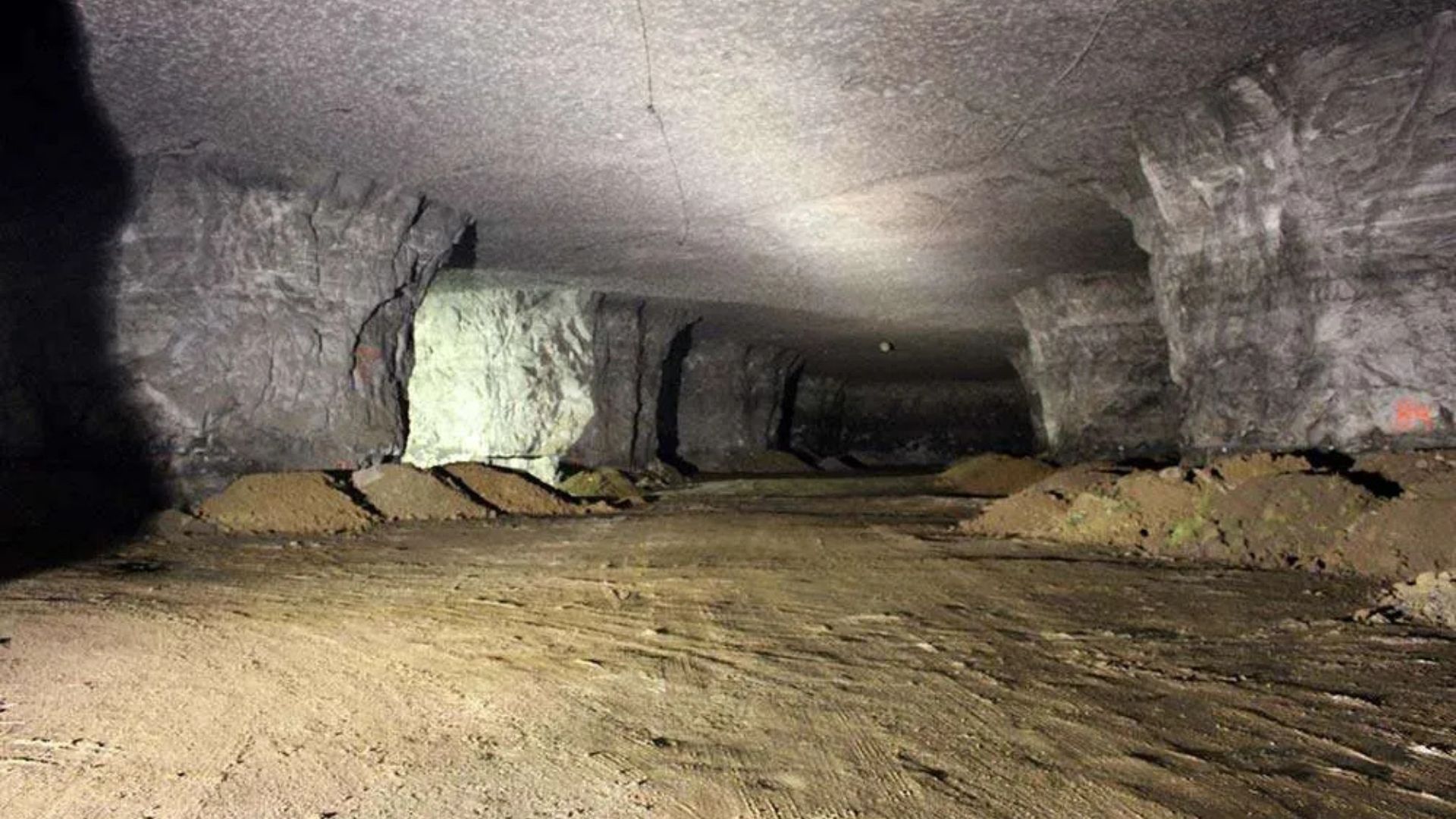
Subterranean Structure Created by Mining Transformed Louisville’s Subsoil into a Continuous Urban-Scale Space, Adapted for Tourism, Leisure, and Services, with Corridors Supported by Natural Pillars and Permanent Operation Away from Daylight, Arousing Curiosity About What Lies Beneath Major Cities.
Just a few minutes from downtown Louisville, Kentucky, there is a construction that draws attention precisely because it does not occupy the horizon.
Instead of rising upward, the Louisville Mega Cavern spreads out underground, housed within an old limestone mine and presented as a man-made “cave,” covering about 100 acres and approximately 4 million square feet of indoor area.
Created from decades of mineral extraction, the complex has transitioned from being merely an industrial space to also operating as a visitation destination.
-
Friends have been building a small “town” for 30 years to grow old together, with compact houses, a common area, nature surrounding it, and a collective life project designed for friendship, coexistence, and simplicity.

-
This small town in Germany created its own currency 24 years ago, today it circulates millions per year, is accepted in over 300 stores, and the German government allowed all of this to happen under one condition.

-
Curitiba is shrinking and is expected to lose 97,000 residents by 2050, while inland cities in Paraná such as Sarandi, Araucária, and Toledo are experiencing accelerated growth that is changing the entire state’s map.

-
Tourists were poisoned on Everest in a million-dollar fraud scheme involving helicopters that diverted over $19 million and shocked international authorities.


Instead of a vacant underground void with no public use, the area has been adapted to welcome tourists, host commercial operations, and offer adventure activities in corridors excavated over time.
Origin of the Mega Cavern and Limestone Mining in Louisville
The configuration of the Mega Cavern derives from a common method in limestone extraction, based on opening large halls while preserving parts of the rock itself as structural pillars.
This arrangement creates a ceiling supported by natural columns and defines wide corridors and large areas that can later be repurposed for other uses.

Due to its continuous internal support and large horizontal extent, the location is described in public records as a construction classified as a building.
Within this criterion, the frequently repeated comparison arises: the cavity is treated as the largest “building” in Kentucky, even though it has no facade or visible volume above the surface.
Instead of stacked floors, as occurs in conventional buildings, the space functions as a gigantic single subterranean level, spread out beneath areas close to the Louisville Zoo and major expressways.
The unusual scale, measured in acres, helps explain why the place is often described as something outside the standard urban norm.
Subterranean Tourism and Repurposing Urban Infrastructure
Converting a mine into public circulation space requires much more than aesthetic interventions or the installation of lighting.
In subterranean environments, operation depends on well-defined routes, strict access control, clear signage, and emergency procedures compatible with a closed space devoid of natural light.
In addition to these requirements, the experience offered to visitors directly explores the geometry created by mining.
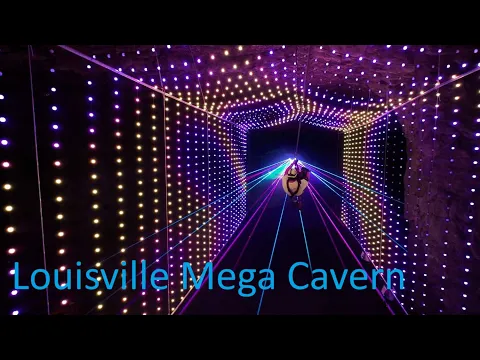
Indoor tours and attractions such as suspended pathways and ziplines are presented as ways to put the public in contact with the dimension of the subsoil and the repetition of limestone pillars that support the ceiling.

This tourist use has also gained attention from the public press in the United States.
In 2015, a photographic report by PBS NewsHour described the environment as an underground “playground” and emphasized that it is not a natural cave, but an excavated structure that has been converted for leisure and visitation.
Ventilation, Lighting, and Environmental Control Underground
In facilities located below ground, comfort and safety depend on factors that are often overlooked on the surface.
Among them is air quality, as the lack of natural ventilation requires systems capable of ensuring constant renewal and suitable conditions for visitors and workers.
Lighting, in turn, fulfills a function that goes beyond the visual aspect.
It contributes to spatial orientation, improves depth perception, and ensures that signs and indications are seen in advance in long corridors.
Without these precautions, the subterranean environment can confuse the sense of direction and increase risks during movement.
Another critical point involves the presence of water and humidity.
Excavated cavities may register seepage or accumulation in lower areas, requiring constant monitoring and drainage solutions to protect floors, electrical installations, and circulation routes.

When the space is opened to the public, these routines cease to be merely technical and become a central part of the project’s viability.
Constant Temperature and Sensation of a Large Subterranean Warehouse
While the surface of Louisville faces climate variations throughout the year, the subsoil presents a distinct dynamic.
The institutional communication of the complex highlights the constant temperature of around 58°F, maintained regardless of the heat or cold outside.
This thermal behavior appears as a practical draw for visitors and helps explain why the location functions as multi-use infrastructure, including storage and commercial areas, in addition to tourism.
From a sensory perspective, the stability reinforces the impression of being inside a large continuous environment, closer to a subterranean warehouse than to a natural cave.
The overall appearance, however, preserves the mark of industrial origin.
Unlike caves formed slowly by geological processes, the mine shows clear signs of planning, with repeated pillars, wide halls, and boundaries defined by the logic of extraction.
The result may seem natural in some sections, but the regularity of the design evidences the human method behind the structure.
Invisible Subterranean Structures Beneath Major Cities
The experience of Louisville fits into a broader movement of repurposing excavated areas observed in various countries.
In this specific case, the uniqueness lies in its location beneath a major city and the fact that the structure was not originally conceived to accommodate tourists.
Still, the space has transformed into a scene of visitation and curiosity, bringing to light a subsoil that normally remains invisible to those circulating the streets.
While traffic and routine continue on the surface, a cavity of unusual proportions remains active just below, supported by limestone pillars and systems that allow circulation, lighting, and operation in a closed environment.
If a space of this size can function as an attraction and infrastructure without being perceived by those passing on the street, how many other subterranean structures, created by mining or engineering, remain invisible beneath major cities around the world?







Seja o primeiro a reagir!