





 Portuguese
  English
  Spanish
  6 min of reading
  0 comments


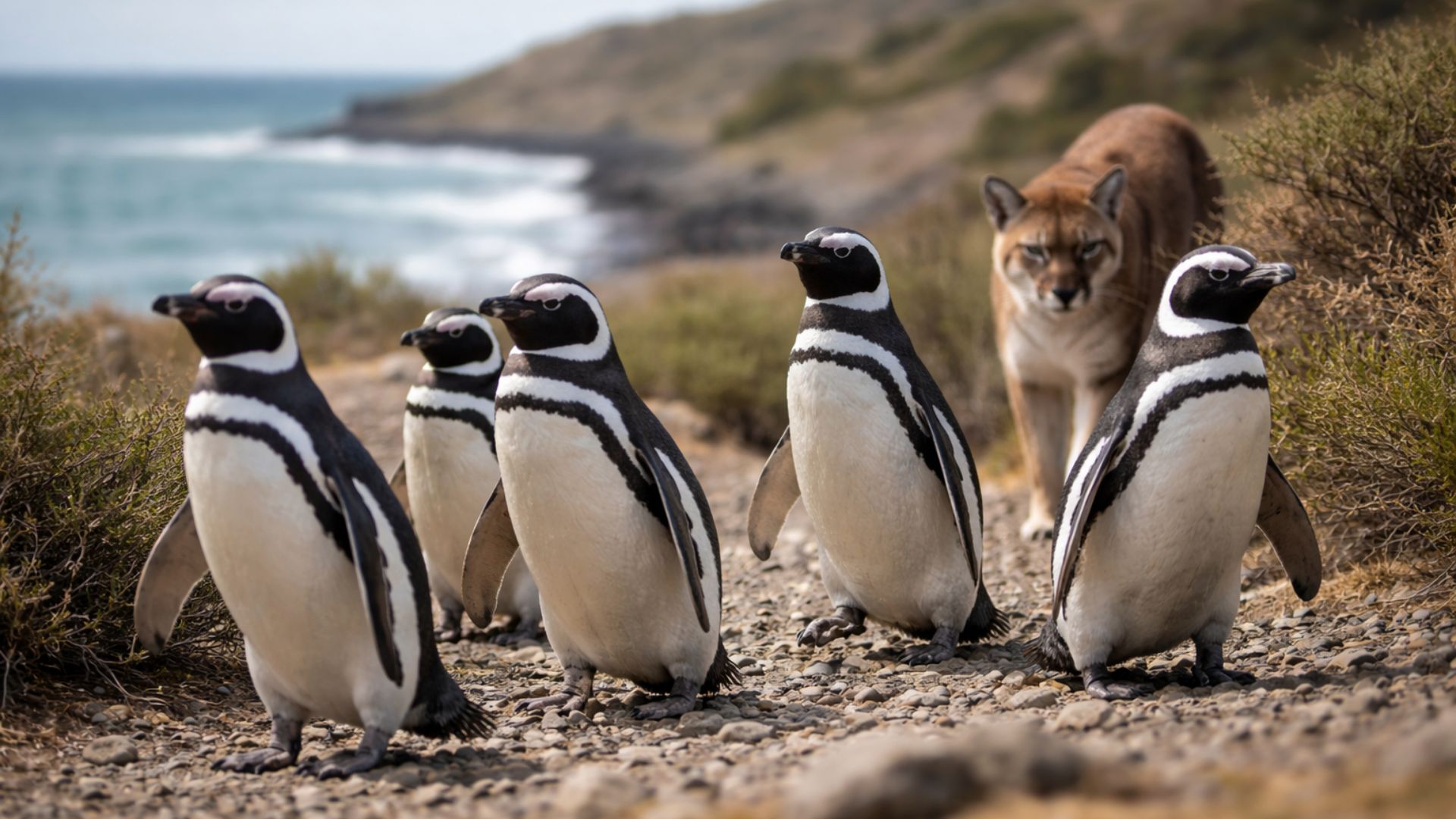
Recovery of Native Predator Alters Ecological Balance in Patagonia, Exposes Unexpected Consequences of Environmental Conservation and Places Scientists Before Complex Decisions About Wildlife Management in One of the Most Sensitive Ecosystems in the Southern Hemisphere.
A group of biologists monitoring a colony of penguins in Argentine Patagonia has begun to deal with an unusual impasse in conservation.
The recovery of the puma, a native predator that has started to roam more frequently in the region, coincided with a significant increase in attacks on penguins, which for decades have benefited from the near absence of land hunters in the area.
The situation gained international attention last Thursday (05) after researchers affiliated with the University of Oxford released results from a study estimating that, over a period of four years, pumas killed more than 7,000 penguins in a national park on the Patagonian coast.
-
Friends have been building a small “town” for 30 years to grow old together, with compact houses, a common area, nature surrounding it, and a collective life project designed for friendship, coexistence, and simplicity.

-
This small town in Germany created its own currency 24 years ago, today it circulates millions per year, is accepted in over 300 stores, and the German government allowed all of this to happen under one condition.

-
Curitiba is shrinking and is expected to lose 97,000 residents by 2050, while inland cities in Paraná such as Sarandi, Araucária, and Toledo are experiencing accelerated growth that is changing the entire state’s map.

-
Tourists were poisoned on Everest in a million-dollar fraud scheme involving helicopters that diverted over $19 million and shocked international authorities.

The count amounts to about 7.6% of an estimated population of 93,000 adult individuals, according to the analyzed data.
At the same time, the study indicates that predation alone is not expected to lead to the colony’s disappearance under realistic conditions.
Concerns remain because the species has limited reproduction and, above all, because the survival of younger individuals may decline for various reasons over time, reducing the natural replenishment of the population.
Penguins Thrived in an Area Without Large Terrestrial Predators

The observed colony established itself in a stretch of coastline where penguins found a rare advantage on solid ground.
For many years, the presence of large predators was low, which reduced adult losses during the breeding season.
In practice, the area functioned as a refuge, with many nests concentrated and predictable movements between sea and land. However, this type of stability has a fragile side.
Species that spend long periods without dealing with certain predators may become more exposed when the risk reappears.
In the case of penguins, the routine of going to and from the ocean, combined with movement on land, creates moments of vulnerability, especially when the colony is full and the flow of birds increases.
Meanwhile, the puma has regained space in the same territory, partly due to changes associated with human occupation and land use.
The species, historically hunted in various regions, has begun to be protected and is recovering in some areas, recolonizing former corridors.
The result, researchers point out, was the creation of more frequent contact between predator and prey in an environment that, for a long time, did not have this interaction with the same intensity.
Death Estimates Draw Attention from International Biologists

The study associated with the Oxford team calculated penguin mortality based on field records and the pattern of carcasses found in the colony during monitoring.
The estimate of more than 7,000 dead animals in four years draws attention not only for the absolute volume but also for the breakdown.
This mainly involves adult individuals, which weighs more heavily in population dynamics than occasional losses of chicks.
Still, researchers emphasize that the interpretation of the number needs to consider the size of the colony and the group’s ability to recover when breeding and juvenile survival conditions remain at favorable levels.
In population models, extinction appeared only in hypothetical scenarios combining a sharp decline in juvenile survival and very low reproductive performance.
This result shifts the focus to factors that also affect the species at sea and along the coast. Nevertheless, the scientific alert is direct.
If the colony goes through consecutive bad years, with lower reproductive success and fewer young reaching adulthood, the additional pressure from predation may worsen the decline and accelerate losses.
In ecology, this cumulative stress is often more dangerous than any isolated component.
Excessive Killing Concerns Researchers

One aspect that has troubled the team is the occurrence of the so-called “excessive killing”, when a predator kills more prey than it consumes.
In monitoring, some carcasses showed clear signs of predation, but were left largely intact, suggesting that the objective was not solely to feed.
Lead researcher Melisa Lera, a key author of the study and a member of the wildlife conservation research unit at the University of Oxford, described what she found in the field.
“The number of carcasses with signs of predation that we found in the colony is impressive. The fact that they were left intact means that pumas killed more penguins than necessary. This aligns with what ecologists describe as ‘excessive killing’.”
This behavior is not treated as an anomaly from a biological standpoint.
It is a possible ecological response when prey is abundant and vulnerable.
In such environments, the chance of capture can be so high that the hunting impulse remains activated, even without an immediate need for consumption.
For scientists, the central question is not to judge the predator, but to measure the demographic impact and understand if the colony can compensate for losses over the seasons.
Protection of Predators and Risk to Prey Create Ethical Dilemma
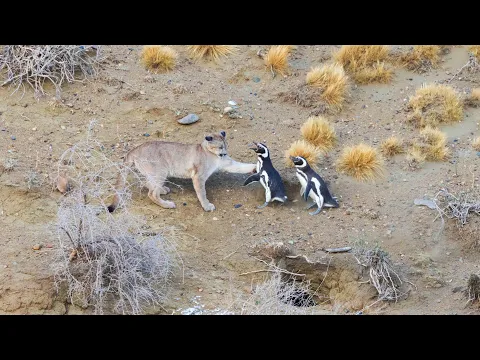

The impasse arises at the point where two legitimate agendas intersect.
On one hand, there is the protection of a large native species that has been threatened and faces historical pressure from conflicts with human activities.
On the other hand, there is a colony of penguins that has begun to occupy the territory and may be under increasing risk, especially if other environmental variables reduce chick production and the survival of younger individuals.
In practice, managing the puma population to reduce attacks is not a simple decision.
The measure may collide with conservation rules of the park itself and with the idea of allowing natural processes to occur.
On the other hand, ignoring the problem also raises questions, as the approach between predator and prey has been favored by human-induced changes in the environment and protection decisions that have altered the local balance.
The tension escalates because the impact is visible and concentrated.
Carcasses found near nests produce immediate reactions and increase public pressure for quick responses.
At the same time, population dynamics depend on long-term series and less perceptible factors, such as mortality at sea and reproductive success in consecutive years.
Future of the Colony Depends More on Reproduction Than on Predation
When projecting scenarios, researchers point out that the viability of the colony is more sensitive to reproductive success and juvenile survival than to predation itself.
In other words, puma attacks may reduce population growth and create significant losses.
Still, the colony’s persistence will depend primarily on how many chicks are born, how many survive, and how many reach adulthood.
This kind of result shifts the debate beyond the image of the predator on land.
If the young face more obstacles to survive, or if the number of chicks per pair declines, the system becomes less capable of absorbing additional shocks.
In this context, any extra mortality, including that caused by pumas, tends to weigh more and accelerate negative trends.
Even without forecasting an imminent disappearance, the team considers the episode a warning about the unexpected consequences of human interventions.
When areas change use, when species recover after protection, or when predators return to areas from which they were displaced, new interactions can emerge forcefully.
With the return of the puma to the Patagonian coast and the persistence of large colonies of penguins on land, which conservation strategies should take priority when protecting a native predator may mean increasing pressure on an equally vulnerable prey?









-

-

-

-

6 pessoas reagiram a isso.