





 Portuguese
  English
  Spanish
  5 min of reading
  0 comments


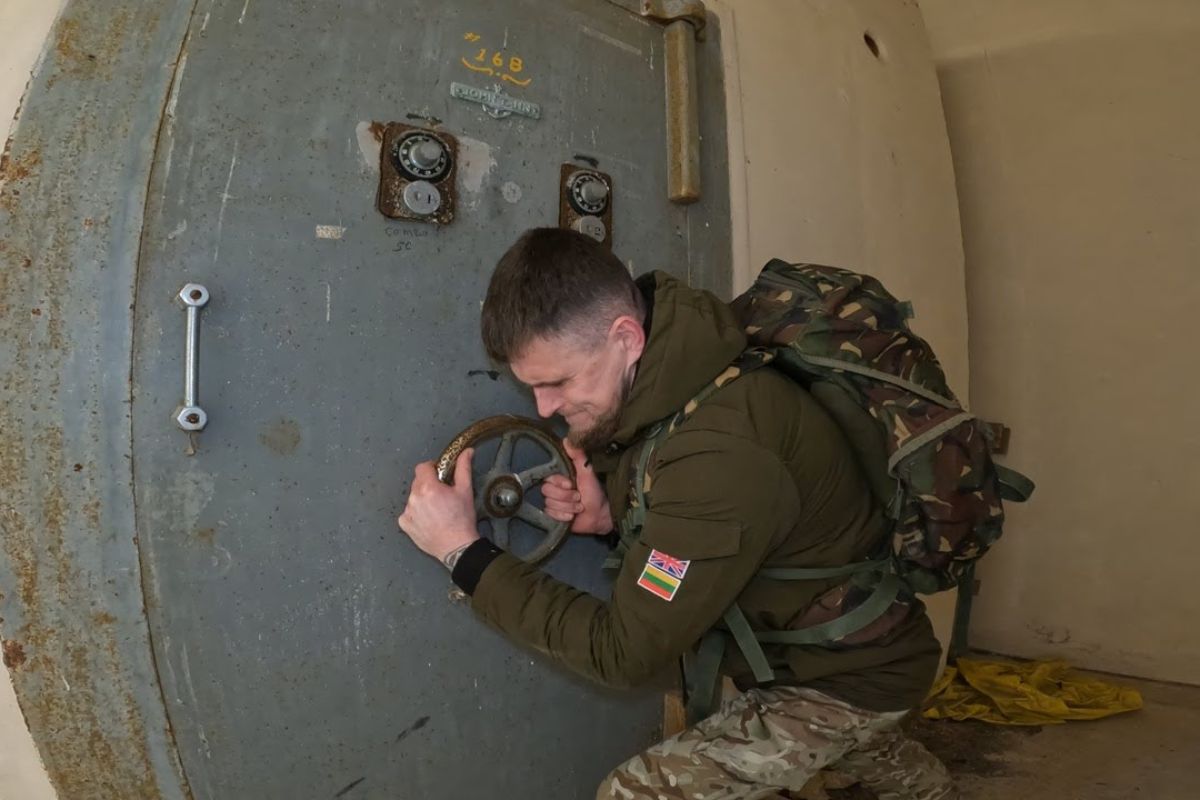
In Suffolk, The Former Military Base in the United Kingdom That Became MOD Woodbridge Blends Layers of World War II and the Cold War. The Explorer Enters RAF Bunkers, Registers Empty Ammunition Boxes, Water Solutions, and Equipment, and Finds Marks on the Floor That Suggest Recent Use Today.
The former military base in the United Kingdom, in Suffolk and under British territory, is described as RAF Woodbridge: built in 1943, it played a role in World War II and later served, during the Cold War, as a base for the United States Air Force (USAF). The official closure occurred in 1993, with the name MOD Woodbridge, referencing the UK Ministry of Defence (MOD).
What seemed like a visit to silent ruins turned into an inventory survey: inside the bunkers, pallets of supplies, numbered boxes, storage items, and signs that not everything stopped emerge. The presence of abandoned military equipment, along with traces on the floor, poses an objective question: what really was left behind after the official closure?
Timeline and Function: From 1943 to Deactivation in 1993

The reading of the site begins with the timeline. The former military base in the United Kingdom was established in 1943, amid the war effort, and maintained relevance with new layers of mission over the decades.
-
Friends have been building a small “town” for 30 years to grow old together, with compact houses, a common area, nature surrounding it, and a collective life project designed for friendship, coexistence, and simplicity.

-
This small town in Germany created its own currency 24 years ago, today it circulates millions per year, is accepted in over 300 stores, and the German government allowed all of this to happen under one condition.

-
Curitiba is shrinking and is expected to lose 97,000 residents by 2050, while inland cities in Paraná such as Sarandi, Araucária, and Toledo are experiencing accelerated growth that is changing the entire state’s map.

-
Tourists were poisoned on Everest in a million-dollar fraud scheme involving helicopters that diverted over $19 million and shocked international authorities.


The shift to U.S. use, cited as a phase of the Cold War, explains why storage structures and bunkers remain arranged in rows and repeated blocks.
The closure in 1993 does not automatically end everything that exists within the perimeter.
Walking between bunkers, the explorer finds references painted over and boxes with markings, a typical pattern of control routines.
When the label disappears, the doubt increases: is it waste, operational leftover, or support for an area still active nearby?
Bunkers as Depositories: The Inventory That Contradicts the Idea of Emptiness

Instead of clean corridors, the bunkers display volume.
There are pallets with water treatment tablets, powdered supplies, and stacked storage boxes, along with containers resembling lubricants and labeled items.
For those entering expecting only cold walls, the accumulation of material changes the meaning of “abandoned.”
The list includes ammunition boxes, thousands of empty boxes that once contained 5.56 mm blank ammunition, and various used smoke grenades.
The explorer avoids touching chemical materials and registers discomfort at finding items suggesting training logistics, not just scrap.
What draws attention is not an isolated object, but rather the whole, with the appearance of planned storage within the bunkers.
Marks on the Floor, Traces, and the Suspicion of Recent Activity

The most sensitive technical detail appears on the floor.
The explorer reports marks and traces that would indicate vehicle passage “not long ago,” in addition to areas with tracks suggesting repeated movement.
In a former military base in the United Kingdom, this type of signal alters the reading of risk and context, as it refers to use after closure.
The proximity of a sector described as active MOD reinforces caution.
The explorer lowers noise, avoids traveling through main paths, and prefers to cross between bunkers to limit exposure.
When the line between abandonment and operation becomes blurred, the presence of military equipment, boxes, and supplies cease to be mere curiosity and becomes evidence of a dynamic still in progress.
Military Equipment, Water, and Chemicals: Why Water Treatment Appears on Pallets
Among the most recurrent findings are tablets and solutions associated with water treatment, as well as numbered containers with references.
In military environments, this usually connects to logistical autonomy: potable water, hygiene, and sanitary control are critical in operations and training, especially in facilities with high turnover.
The cold climate around -4°C, with light snow during the visit, adds an involuntary preservation component.
Low temperatures can reduce immediate degradation but also increase physical risks for those entering unprepared, such as slips and falls on wet surfaces.
The combination of chemicals, water, and military equipment in bunkers raises the hypothesis of old stocks mixed with more recent replenishments.
What Was “Left Behind” and the Line Between Curiosity and Safety
The explorer mentions training objects and boxes with references covered in paint, as well as items that appear to have been used and discarded.
In a former military base in the United Kingdom, the focal point is not to romanticize ruins, but to understand the mechanism: abandoned materials can be just waste, but they can also indicate disposal routes, recycling, and temporary storage.
There is also the ethical and legal barrier. He states that he cannot take anything, and this detail matters: in places linked to military structures, even when deactivated, removing items can constitute a violation and increase risk.
The most useful record is not the “trophy,” but rather the evidence that bunkers, RAF, military equipment, and the Cold War still intersect in the same physical space.
After the Official Closure, What Remains Visible
The visit to the former military base in the United Kingdom ends with more questions than answers because the inventory inside the bunkers challenges the narrative of total closure.
Among empty ammunition boxes, water supplies, and remains of training, what emerges is a portrait of incomplete transition, where the Cold War still appears as material memory.
Beyond the fascination, the point is about public policy and transparency. In your opinion, finding military equipment in RAF bunkers changes the trust in “closed for good,” or is this just the usual logistics of the post-Cold War? If you were a resident of the area, would you advocate for a public inventory of what remained, or total isolation for safety?










-

-

-

-

-

25 pessoas reagiram a isso.