





 Portuguese
  English
  Spanish
  3 min of reading


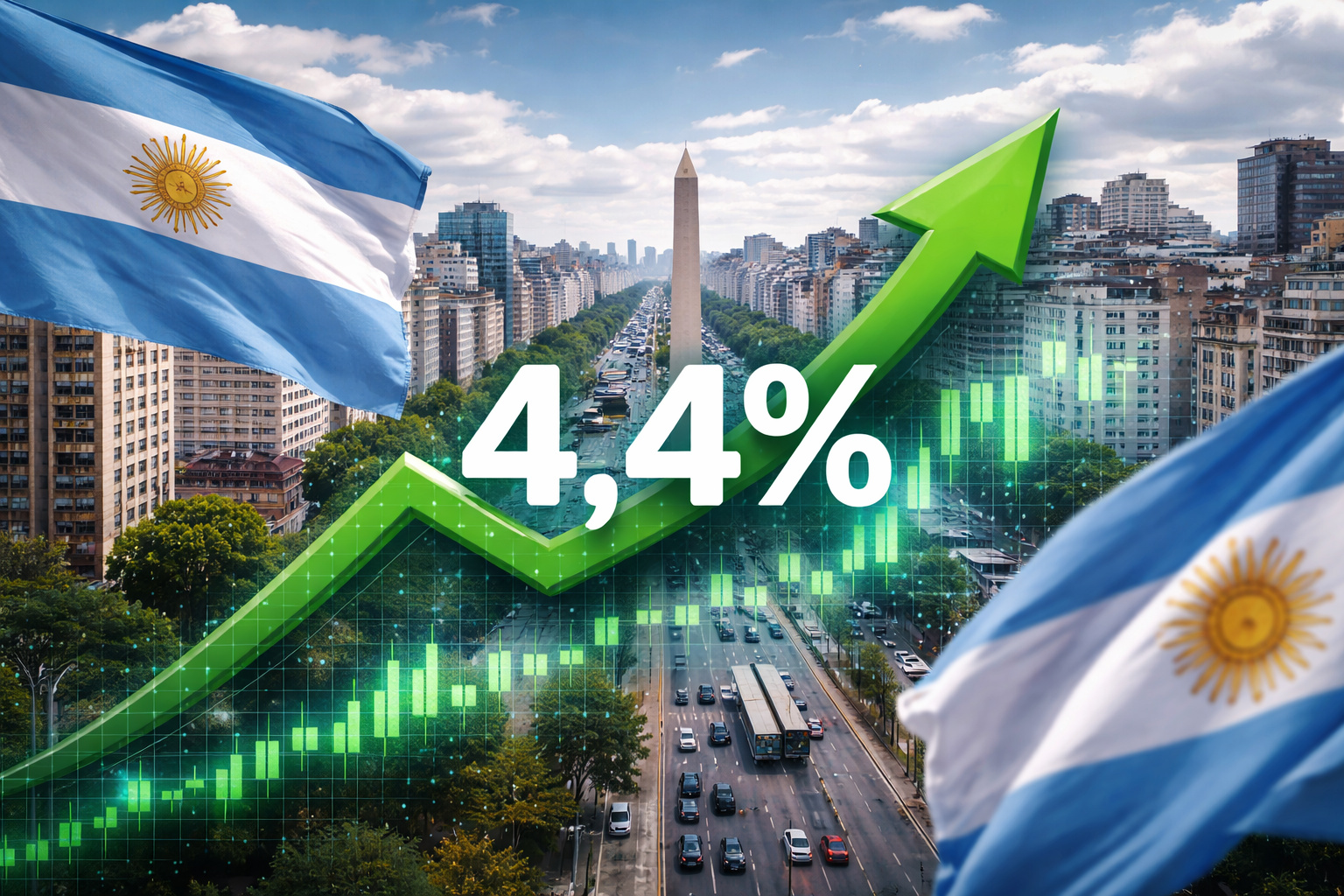
The Argentina registered economic growth of 4.4% in 2025, signaling a recovery after a prolonged period of instability. This result occurs in the early years of President Javier Milei’s term, marked by severe fiscal adjustments and profound changes in the conduction of economic policy.
According to data released by official sources and reported by the economic press, the expansion was driven by a combination of inflation control, reorganization of public accounts, and gradual recovery of productive activity. Although growth was not homogeneous across sectors, the number represents a significant reversal compared to previous years.
Falling Inflation Changes the Economic Scenario
One of the main pillars of the government’s strategy was combating inflation, which has ranked among the highest in the world for years. Throughout 2024 and 2025, the Milei administration adopted harsh measures such as subsidy cuts, fiscal adjustments, and reductions in public spending.
-
The government requests the Federal Revenue Service for a new system to automate the income tax declaration, reducing errors, time, and bureaucracy for millions of Brazilians.

-
Pix in installments, international Pix, and contactless payment without internet: the Central Bank revealed the new features coming to the tool that is already used by almost every adult in Brazil.

-
Mercado Livre has just started selling medications with delivery in up to three hours to your door, and this move could completely change the way Brazilians buy medicines on a daily basis.

-
In Dubai, rising tensions from the war in the Middle East are causing super-rich individuals to leave the Gulf and direct their fortunes to a new financial refuge in Asia.

As a result, inflation slowed significantly. This movement helped to restore part of the economic predictability, a condition considered essential to stimulate investments and consumption.
Moreover, the decline in inflation contributed to improving market expectations and reducing price distortions that hindered economic activity.
Two Initial Years of Adjustments and Social Costs
Despite the growth recorded in 2025, the first two years of the Milei government were marked by strong social impact. The fiscal adjustment brought recession in specific sectors, a loss of purchasing power, and increased pressure on low-income families.
Nevertheless, the government maintains that the measures were necessary to correct structural imbalances accumulated over decades. According to the economic team, the 4.4% growth indicates that the economy is beginning to respond to the adjustments.
At the same time, analysts point out that the recovery is still uneven and depends on the continuation of reforms.
Expectations for 2026 Are More Ambitious
For 2026, the Argentine government projects a more consistent economic recovery, banking on increased investment, recovery of credit, and expansion of exporting sectors.
The official expectation is that macroeconomic stabilization will allow sustained growth, with lower inflation and greater integration into the international market. In this scenario, Argentina seeks to regain credibility with foreign investors and multilateral organizations.
However, experts warn that performance will depend on the external scenario, political stability, and the government’s ability to maintain support for reforms.
Growth Still Faces Structural Challenges
Despite the progress in 2025, the Argentine economy continues to face significant challenges. Poverty remains high, the labor market is still adjusting, and the industry operates below potential in some areas.
Furthermore, the sustainability of growth depends on the recovery of domestic consumption and the strengthening of exports. Therefore, economists argue that the coming years will be decisive to confirm whether the observed growth represents a lasting turnaround or just a temporary relief.
Sign of Recovery, but with Caution
The growth of 4.4% in 2025 reinforces Milei’s government narrative that the Argentine economy is beginning to emerge from a long crisis. At the same time, this data does not eliminate uncertainties or erase the social costs of the adjustment.
Thus, Argentina enters 2026 with expectations of recovery, but also with the challenge of transforming positive numbers into concrete improvements in the living conditions of the population.








Seja o primeiro a reagir!