





 Portuguese
  English
  Spanish
  4 min of reading
  0 comments


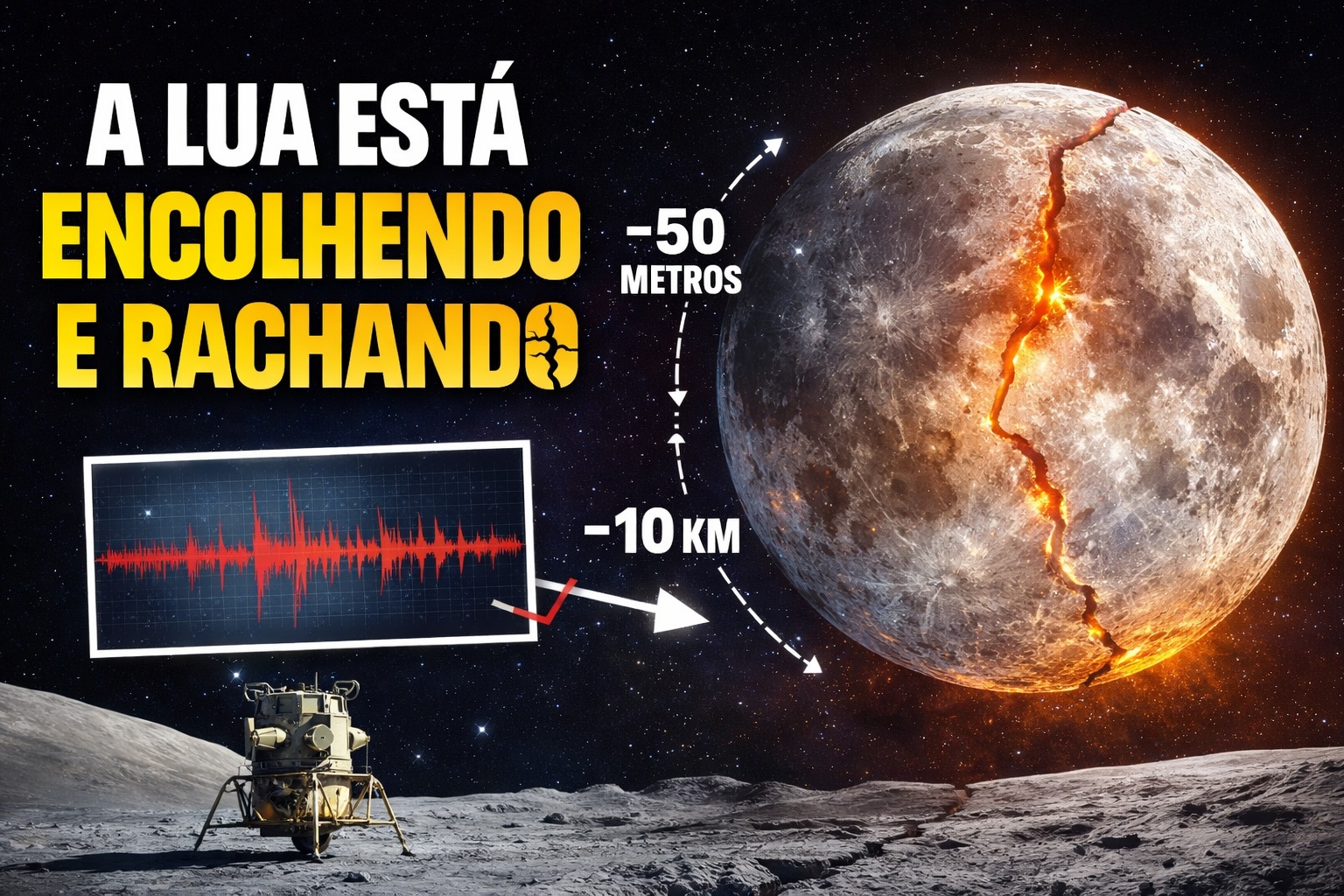
Seismic Data From Apollo Missions Reveal That the Moon Shrunk About 50 Meters as It Cooled, Creating Geological Faults and Continues to “Crack” Slowly to This Day.
For a long time, the Moon was treated as a completely dead body from a geological standpoint: cold, rigid, and unchangeable. However, this image began to crumble when scientists revisited data collected in the 20th century and cross-referenced it with modern measurements. The result was surprising even for specialists: the Moon not only changed over time but is still changing now, in a slow, silent, and invisible process to the naked eye — it is literally “cracking.”
This finding does not come from theoretical speculation, but from real seismic records, obtained by instruments left on the lunar surface by astronauts from the Apollo missions between the late 1960s and early 1970s. These sensors continued operating for years, recording thousands of small lunar quakes.
The Thermal Contraction That Shrunk the Moon
Unlike Earth, which maintains its interior heat due to tectonic activity and radioactive heat, the Moon began cooling relatively early in its history. Without active tectonic plates and much smaller in size, the lunar internal heat gradually dissipated over billions of years.
-
Motorola launched the Signature with a gold seal from DxOMark, tying with the iPhone 17 Pro in camera performance, Snapdragon 8 Gen 5 that surpassed 3 million in benchmarks, and a zoom that impresses even at night.

-
Satellites reveal beneath the Sahara a giant river buried for thousands of kilometers: study shows that the largest hot desert on the planet was once traversed by a river system comparable to the largest on Earth.

-
Scientists have captured something never seen in space: newly born stars are creating gigantic rings of light a thousand times larger than the distance between the Earth and the Sun, and this changes everything we knew about stellar birth.

-
Geologists find traces of a continent that disappeared 155 million years ago after separating from Australia and reveal that it did not sink, but broke into fragments scattered across Southeast Asia.

This cooling caused a direct physical phenomenon: thermal contraction. As the lunar interior cooled, its volume decreased. Studies indicate that, since its formation, the Moon has shrunk about 50 meters in radius. It may seem small on a human scale, but for an entire celestial body, this reduction creates immense stresses in the crust.


Since the lunar surface is rigid and does not “dent” easily, the only way to accommodate this contraction was through fractures and faults, creating real geological scars.
Lunar Faults Spanning Tens of Kilometers
High-resolution images obtained by modern probes have revealed thousands of these structures, known as lunar thrust faults. They extend for tens of kilometers, with escarpments that can reach several meters in height.
These faults occur when a portion of the crust is pushed over another, a direct result of the global compression of the satellite. Unlike impact craters, these structures have linear shapes and consistent patterns, clearly associated with internal forces.
The most impressive part is that many of these faults cut through relatively young craters, indicating that they formed in geologically recent periods and not just in the distant past.
The “Moonquakes” Detected by the Apollo Missions
Between 1969 and 1972, astronauts from the Apollo missions installed seismometers on the lunar surface. These instruments detected over 28,000 seismic events, classified into different types.
The most intriguing were the shallow moonquakes, tremors that occur a few kilometers below the surface. Unlike earthquakes on Earth, these lunar quakes:
- last much longer, reaching several minutes,
- occur without water or tectonic plates,
- and are directly associated with crustal compression faults.

Some of these moonquakes reached magnitudes equivalent to 5 on the Richter scale, strong enough to displace rock blocks and slightly alter the local surface.
Evidence That the Moon Is Still “Cracking”
The combination of old seismic data with modern images showed something crucial: the processes have not ceased. The faults remain active, albeit at an extremely slow pace. The Moon continues to cool, millimeter by millimeter, and its crust is still adjusting to this shrinkage.
Technically, this means that the Moon:
- is not geologically “dead”,
- is still accumulating internal stresses,
- and releases this energy through small tremors.
Although these events pose no risk to Earth, they are extremely relevant for future manned lunar missions. Permanent bases, habitable modules, and infrastructure will need to consider these instability zones.
Why This Changes Our View of the Moon
For decades, the Moon was seen merely as a cosmic fossil. The realization that it is still undergoing structural adjustments changes this narrative. It becomes a natural laboratory to study how small rocky bodies thermally evolve over billions of years.

Moreover, understanding this process helps scientists interpret similar signals in:
- Mercury,
- icy moons,
- and even rocky exoplanets.
The Moon serves as an accessible record of processes that, in other worlds, can only be inferred from a distance.
A Silent Body, But Far From Static
When we look at the night sky, the Moon seems eternal and unchanging. But in reality, it is undergoing a continuous transformation process, almost imperceptible on a human scale.
As it cools, contracts, and fractures, the satellite reveals that even the most familiar bodies in the Solar System harbor active dynamics hidden beneath the surface.
It is not breaking apart catastrophically, nor is it about to disintegrate. But it is indeed slowly “cracking”, releasing tensions accumulated over billions of years — all of this happening silently above our heads.







-

-

7 pessoas reagiram a isso.