





 Portuguese
  English
  Spanish
  6 min of reading
  1 comment


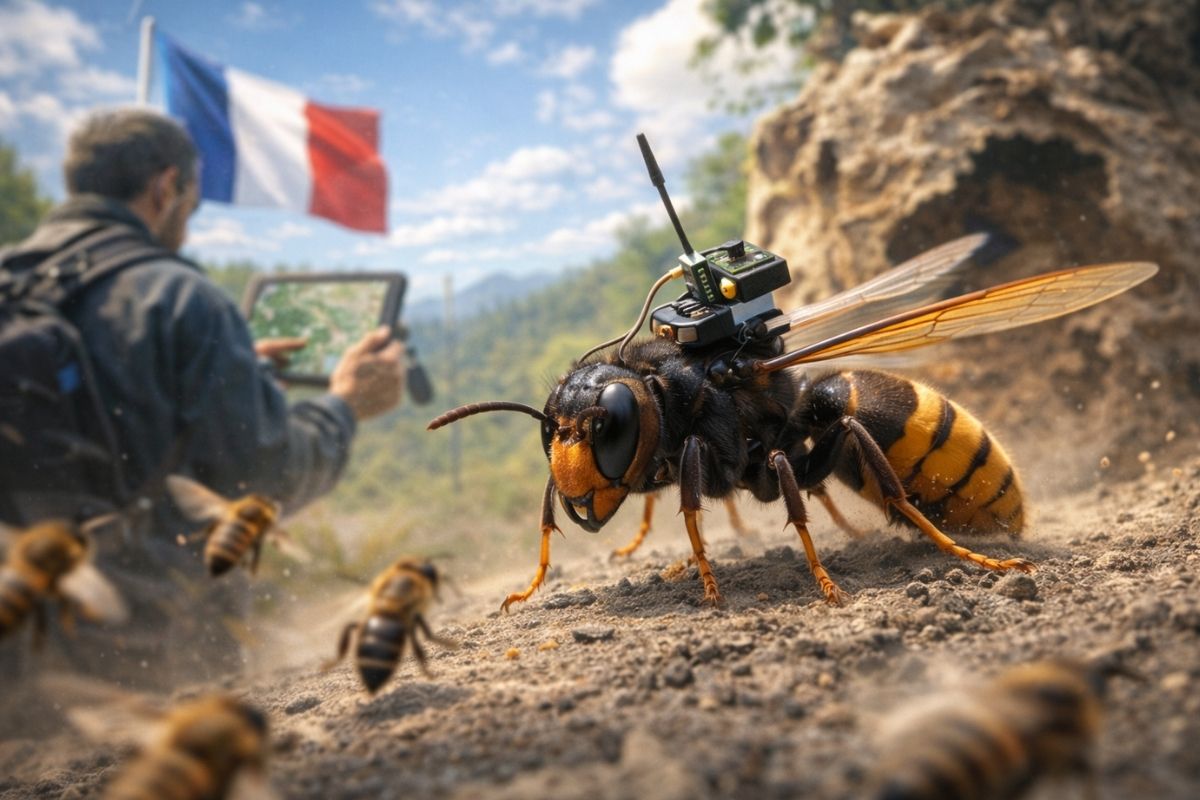


In France, Asian Wasp with Radio Tracking Takes Teams to Asian Wasp Nests, Protects Honeybees, and Strengthens Control of Asian Wasp.
A new technology has turned the Asian wasp into an unwitting ally in the fight against its own species. Using radio transmitters developed by a former Airbus engineer, teams in France are able to follow the flight of the insects to hidden nests in trees and urban structures, tackling the problem directly at its source.
The innovation arrives at a critical moment: the Asian wasp has established itself as an invasive predator, surrounding hives, capturing honeybees, and disrupting entire ecosystems. By allowing each marked wasp to function as a living tracker, the technology reduces search time, increases the location rate of colonies, and becomes the main French weapon against a discreet, mobile, and difficult-to-see enemy.
What Is the Asian Wasp and Why Does It Represent a Threat
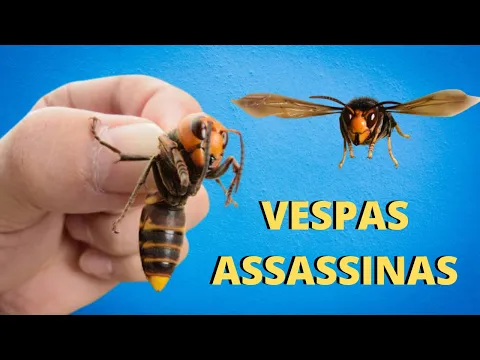
The Asian wasp (Vespa velutina) is an invasive predator that feeds on honeybees and other insects. It often remains in front of apiaries for long periods, lurking, <strong blocking the exit of bees to collect nectar and pollen.
-
Motorola launched the Signature with a gold seal from DxOMark, tying with the iPhone 17 Pro in camera performance, Snapdragon 8 Gen 5 that surpassed 3 million in benchmarks, and a zoom that impresses even at night.

-
Satellites reveal beneath the Sahara a giant river buried for thousands of kilometers: study shows that the largest hot desert on the planet was once traversed by a river system comparable to the largest on Earth.

-
Scientists have captured something never seen in space: newly born stars are creating gigantic rings of light a thousand times larger than the distance between the Earth and the Sun, and this changes everything we knew about stellar birth.

-
Geologists find traces of a continent that disappeared 155 million years ago after separating from Australia and reveal that it did not sink, but broke into fragments scattered across Southeast Asia.

The result is a dangerous combination: weaker hives, reduced honey production, and direct impact on plants that depend on pollination.
Over time, the presence of the Asian wasp affects not only beekeepers but the entire ecological web of the region.
By competing with native predators and putting pressure on the bees, it causes ecological imbalances that spread through the food chain and environmental services, such as pollination itself.
In several European countries, simple manual control of nests and the punctual removal of colonies have proven insufficient.
In parallel, the Asian wasp has adapted well to rural and urban environments, building nests in the tops of tall trees, hard-to-reach structures, and inconspicuous locations. This makes combat reactive and expensive: it requires extensive observation time, constant movement, and experienced teams just to find out where the problem really is.
How Technology Transforms the Asian Wasp into a Living Tracker

In this scenario, the turning point came when a former Airbus engineer applied knowledge of engineering and telecommunications to entomology.
The central idea seems simple but required fine-tuning: to use the Asian wasp itself as a living tracker, attaching a radio transmitter to the insect and following the signal to the nest.
To work, the transmitter needs to be tiny, very lightweight, and have enough battery life for the Asian wasp to fly normally back to the colony.
The device is fixed to the insect’s thorax with a light adhesive, without perforations, so as not to limit flight or alter behavior. In the field, technicians and beekeepers use portable receivers, often connected to simple apps, to follow the route.
The practical effect is a change of scale. Instead of sweeping large areas with binoculars or trying to follow the Asian wasp solely by its flight path, teams now walk guided by the radio signal.
The search radius shifts from broad and uncertain to a guided path, where each step reduces the circle of uncertainty until reaching the nest.
Why Locating the Correct Nest Changes the Game
A single Asian wasp colony can send individuals to forage for food at distances greater than a kilometer.
This means that the nearest visible nest to an apiary is not necessarily the one responsible for most attacks. Without tracking, beekeepers can waste time and resources destroying secondary nests while a hidden nest continues to pressure the hives.
With radio technology, it becomes possible to map how many Asian wasp colonies are actually active in a given area and which of them are linked to the attack hotspots.
From the path recorded by the signals, teams identify the most dangerous nests, assess any overlap in foraging areas, and prioritize the destruction of the colonies that have the greatest impact on apiaries and local wildlife.
This precision avoids a blind rush. Instead of dispersed interventions, long displacements, and multiple attempts, public and private resources can be concentrated on the surgical elimination of the most relevant nests, reducing costs and increasing the effectiveness of each operation.
How It Works in Practice: Tracking the Asian Wasp
In the field, the use of technology follows a sequence designed to be replicated by different teams, without relying solely on specialists.
First, beekeepers or technicians set up attraction points near attack areas, using sugary baits, honey, or other substances that interest the Asian wasp.
Individuals that become accustomed to regularly visiting the same feeding site become ideal candidates for marking.
Next, a wasp is carefully captured, the radio microchip is attached to the thorax with light glue, and the insect is immediately released.
The logic is simple: the more natural the behavior of the Asian wasp after marking, the more reliable the return path to the nest will be.
With the transmitter activated, operators turn on the portable receiver and begin to follow the signal. As the intensity increases, they adjust their route, climb slopes, navigate around buildings, and narrow the perimeter.
In many cases, the signal leads to tops of tall trees, forest edges, or urban structures where the nest of the Asian wasp would be practically invisible without tracking.
Benefits for Beekeepers, Cities, and Ecosystems
The adoption of tracking systems for the Asian wasp allows for quicker responses during critical times of the year when attacks on hives intensify.
Knowing where the nests are, beekeepers can plan management more strategically, reinforcing physical protections, adjusting management schedules, and coordinating with local authorities for the safe removal of colonies.
For communities and public administrations, the technology creates an additional tool for managing biological risk.
Reports from residents, records from beekeepers, and field data become integrated into maps of Asian wasp nests, helping to set priorities, organize control campaigns, and communicate risks for specific regions.
More accessible and locally maintainable equipment allows regional groups of beekeepers, associations, and municipal services to continuously uphold the method.
Each marked Asian wasp effectively becomes an unwitting guide to an invading colony, shortening the path between the problem and the solution.
An Important Turning Point, but Not the End of the Threat
Despite the advancement, tracking alone does not eliminate the Asian wasp. It increases the efficiency of control, reduces the number of active colonies per season, and decreases the pressure on bees, but the invasive species continues to require constant monitoring, coordination between regions, and regular campaigns.
The real gain lies in transforming a difficult-to-see enemy into a trackable target, with less trial and error and more data-driven action.
The invention of the former Airbus engineer, now applied in French territory, shows how the combination of engineering, radio, and animal behavior can turn the tables in a complex ecological battle.
By converting the Asian wasp into a living tracker, the technology paves the way for other countries to adapt similar solutions and strengthens a clear message: without innovation, the defense of bees and ecosystems remains at a disadvantage.
In the face of a threat like the Asian wasp, which attacks bees, impacts hives, and pressures entire ecosystems, do you believe that tracking technologies like this should also be adopted and funded in other countries, even if they are still in the improvement phase?







Yes all affected countries should participate in controlling this pest.