





 Portuguese
  English
  Spanish
  5 min of reading
  4 comments


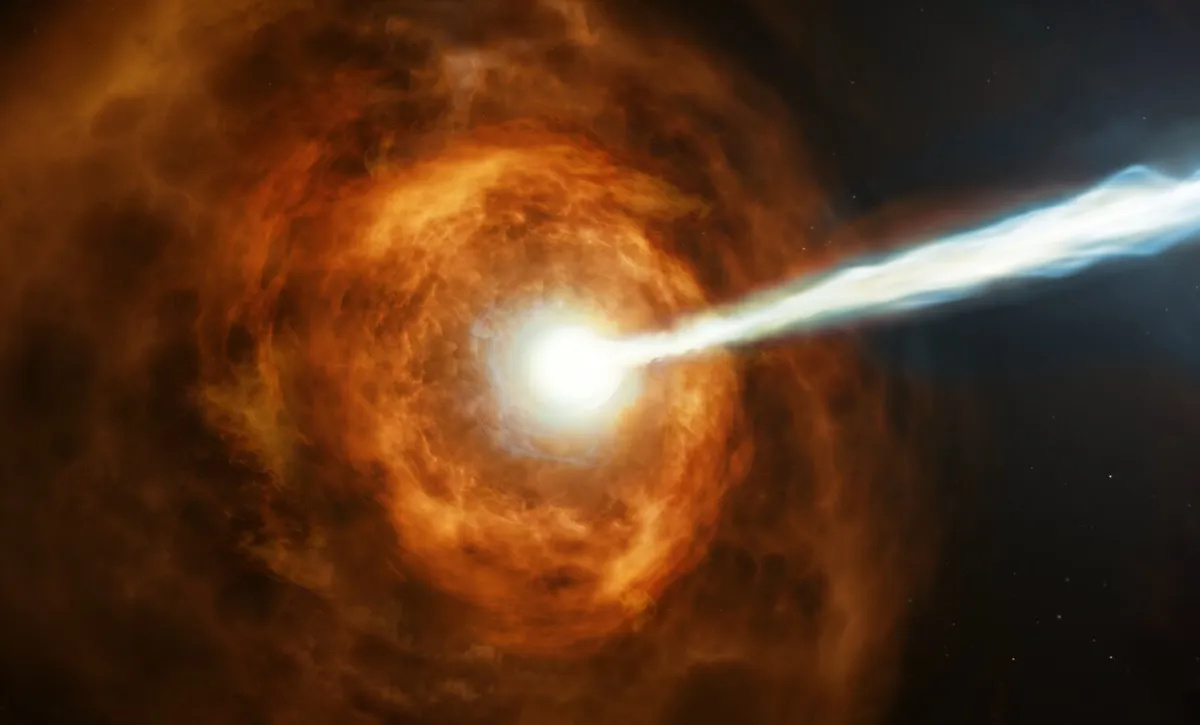


Detected in 2025 by a network of five high-energy telescopes, the signal associated with the gamma-ray burst GRB 250702B remained active for about seven hours, reaching 25,000 seconds in duration and surpassing all previous records, forcing astronomers to revise the physical models used to explain extreme GRBs.
Astronomers identified in 2025 a high-energy signal coming from space that remained active for about seven hours, totaling approximately 25,000 seconds, an unprecedented duration for gamma-ray bursts, a rare phenomenon that helps to understand extreme processes of the Universe.
Gamma-ray bursts, known by the acronym GRB in English, are intense sources of high-energy radiation detected on Earth in the form of gamma rays. These events represent some of the most energetic phenomena ever observed in the cosmos and typically last only seconds or minutes.
These signals were first identified in the 1960s, when US military satellites designed to detect nuclear detonations on Earth recorded intense gamma-ray emissions coming from the sky. At that time, their origin was unknown, leading to the emergence of the term gamma-ray bursts.
-
Motorola launched the Signature with a gold seal from DxOMark, tying with the iPhone 17 Pro in camera performance, Snapdragon 8 Gen 5 that surpassed 3 million in benchmarks, and a zoom that impresses even at night.

-
Satellites reveal beneath the Sahara a giant river buried for thousands of kilometers: study shows that the largest hot desert on the planet was once traversed by a river system comparable to the largest on Earth.

-
Scientists have captured something never seen in space: newly born stars are creating gigantic rings of light a thousand times larger than the distance between the Earth and the Sun, and this changes everything we knew about stellar birth.

-
Geologists find traces of a continent that disappeared 155 million years ago after separating from Australia and reveal that it did not sink, but broke into fragments scattered across Southeast Asia.

Only years later did astronomers begin to understand the physical processes capable of generating this type of signal. Since then, the systematic observation of these events has become a central part of high-energy astrophysics.
Detection of the Unusual Seven-Hour Signal
In 2025, astronomers detected an exceptional event termed GRB 250702B, which lasted about seven hours. The signal drew attention for significantly exceeding the typical duration associated with gamma-ray bursts known until then.
Researcher Eliza Neights, from NASA’s Goddard Space Flight Center, studies the physics behind gamma-ray bursts and was directly involved in the identification of this event. According to her, the recorded pattern was highly unusual.
The monitoring of GRBs is mainly conducted by wide-field space telescopes capable of observing large areas of the sky simultaneously. These instruments continuously scan space and identify any bright pulse that stands out against the background noise.
Neights serves as a “burst advocate” on NASA’s Fermi Gamma-ray Space Telescope Burst Monitor. In this role, she performs about six shifts per month, automatically analyzing data sent whenever the instrument detects a possible gamma-ray signal.
During one of these shifts, in early 2025, the system recorded GRB 250702B. The observed pattern indicated three gamma-ray bursts seemingly originating from the same region of the sky, something considered out of the usual pattern.
Absolute Record Among Gamma-Ray Bursts
The combined analysis of data from five high-energy telescopes confirmed that GRB 250702B lasted approximately 25,000 seconds. This temporal extension established a new record among gamma-ray bursts observed to date.
On average, known GRBs have durations of at most a few minutes. Before this event, the record-holder had reached about 15,000 seconds. The scale difference made the signal from GRB 250702B a direct challenge to existing physical models.
The extreme duration cannot be explained by the mechanisms traditionally associated with gamma-ray bursts. For this reason, the event requires a physical explanation not yet confirmed by previous observations, opening a new avenue for investigation.
The exceptional nature of the signal was also reinforced by optical observations conducted by large ground-based instruments such as the Very Large Telescope of the European Southern Observatory, which contributed to the characterization of the event.
Known Processes Behind GRBs
There are two main processes recognized as responsible for most observed gamma-ray bursts. The first involves the collapse of a massive star that is rapidly spinning, giving rise to a compact object, possibly a black hole.
In this scenario, the formation of highly energetic jets occurs during the stellar collapse. When these jets are aligned with Earth, telescopes detect the signal as a gamma-ray burst.
The second known process is associated with the merger of two neutron stars, extremely dense stellar remnants that orbit each other until they collide. This event also results in the formation of a compact object and the emission of detectable jets.
However, both mechanisms produce signals with significantly shorter durations than the seven hours observed in GRB 250702B, indicating that another process may be involved.
Helium Fusion Hypothesis for the Extreme Signal
The explanation considered most natural for GRB 250702B is a phenomenon known as helium fusion. This process occurs when a black hole with a mass similar to that of a star orbits a helium star.
Helium stars are objects that have lost their outer hydrogen layers, leaving a dense core predominantly composed of helium. It is believed that these stars go through phases of expansion throughout their evolution.
During this expansion, the orbiting black hole may become immersed in the stellar envelope, rapidly consuming the star. This process transfers a large amount of angular momentum to the black hole.
As a consequence, an energetic jet may form that is sustained over a long period, capable of generating a gamma-ray signal with extreme duration, compatible with the 25,000 seconds observed in GRB 250702B.
Rarity and Observation Challenges
Events with such long durations are considered difficult to detect. Although they may be less common than other types of GRB progenitors, they also present observational characteristics that complicate their identification.
These signals tend to be weaker and less abrupt than short, intense bursts, which reduces the maximum distance from which they can be observed by current telescopes.
Furthermore, many instruments are optimized to identify brief, bright pulses, meaning that prolonged signals may go unnoticed or be incompletely classified.
These factors help explain why so few long-duration bursts have been recorded to date, despite their scientific relevance.
Next Steps in the Investigation
Eliza Neights is also involved in the development of the Compton Spectrometer and Imager, known as COSI, a gamma-ray survey instrument scheduled for launch in 2027.
The goal is to prepare COSI to detect and analyze GRBs, ensuring it is capable of identifying signals of extreme durations similar to GRB 250702B.
There are hopes that the new telescope will allow for more observation of such events and deepen the understanding of the physical processes responsible for these exceptional explosions, expanding knowledge of the energy limits of the Universe and the mechanisms that produce each observed signal.
The interview with Eliza Neights detailing these discoveries was published in the February 2026 edition of BBC Sky at Night magazine, solidifying GRB 250702B as a milestone in the research on gamma-ray bursts and the analysis of long-duration cosmic signals.







Legal ótima notícia
Interessante, estão fabricando hulks no espaço.
Muito interessante pesquisar fenômenos no espaço sideral, mas gasta se milhões e milhões em pesquisas que a meu ver não vai mudar quase nada para o nosso planeta, enquanto isso o mundo se acabando com fome, doenças, recursos se acabando, violência, acho que estudar eventos naturais é interessante, mas penso que seria muito melhor focar em melhorar nosso planeta, pesquisar formas de aumentar os recursos naturais ainda existentes para que a humanidade possa sobreviver com dignidade …
Na verdade, não sabemos se essas observações irão ou não “mudar o nosso planeta”, porque a depender do que for descoberto, pode ser possível aplicar o conhecimento adquirido aqui, criando tecnologias antes impensadas.