





 Portuguese
  English
  Spanish
  4 min of reading
  0 comments


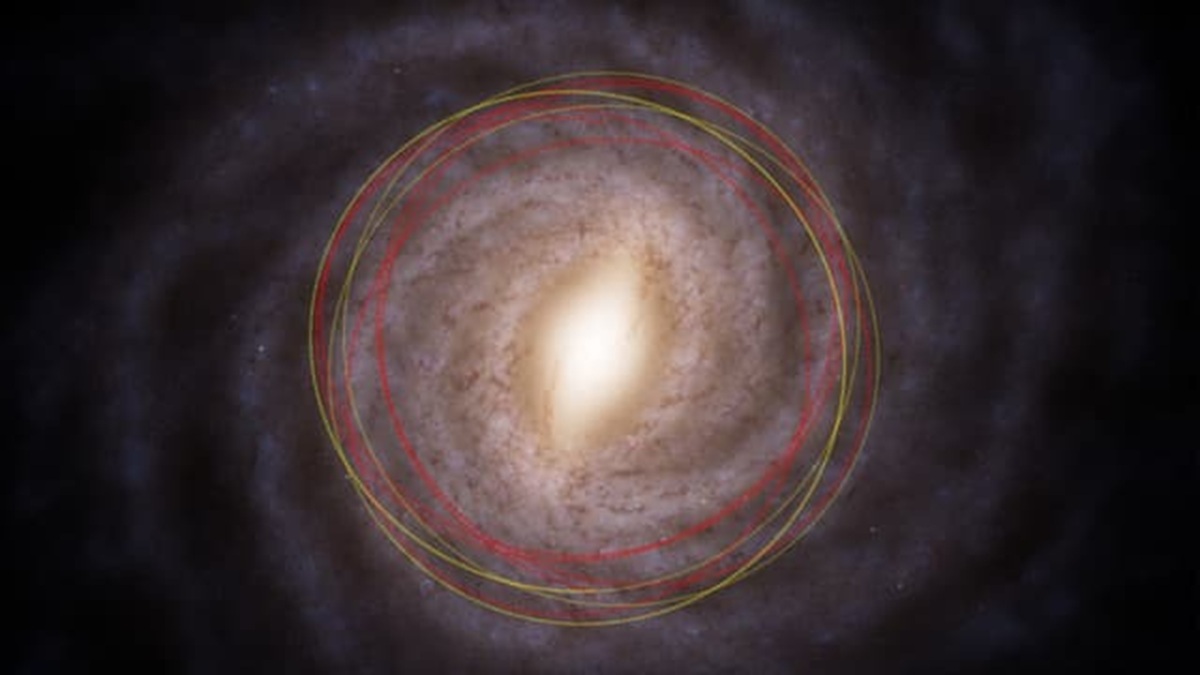
An Object Coming From The Depths Of Space Has Just Surprised Science. Discovered By Astronomers At The University Of Oxford, Comet 3I/ATLAS May Be More Than Seven Billion Years Old — Long Before The Formation Of Our Solar System.
Researchers at the University of Oxford announced the discovery of a comet that may have formed long before the birth of the solar system.
Called 3I/ATLAS, it was identified in early July and is intriguing the scientific community with its estimated age of more than seven billion years.
An Unexpected Discovery
The comet was located on July 1, 2025, by the ATLAS research telescope in Chile. It was about 670 million kilometers from the Sun when it was detected.
-
Motorola launched the Signature with a gold seal from DxOMark, tying with the iPhone 17 Pro in camera performance, Snapdragon 8 Gen 5 that surpassed 3 million in benchmarks, and a zoom that impresses even at night.

-
Satellites reveal beneath the Sahara a giant river buried for thousands of kilometers: study shows that the largest hot desert on the planet was once traversed by a river system comparable to the largest on Earth.

-
Scientists have captured something never seen in space: newly born stars are creating gigantic rings of light a thousand times larger than the distance between the Earth and the Sun, and this changes everything we knew about stellar birth.

-
Geologists find traces of a continent that disappeared 155 million years ago after separating from Australia and reveal that it did not sink, but broke into fragments scattered across Southeast Asia.

The surprise was great: it was an interstellar object, meaning it came from outside the solar system, and it seemed to follow a completely different trajectory than the other two known visitors.
Matthew Hopkins, a PhD from the University of Oxford, was about to go on vacation when he received the data. He had defended his thesis just a week earlier. “Instead of the calm Wednesday I had planned, I woke up to messages like ‘3I!!!!!!!!!!’,” he said. The discovery gave him the chance to test his predictive model in real-time.
Visitor From Another Part Of The Galaxy
3I/ATLAS is the third interstellar object detected in our solar system.
The previous two were ʻOumuamua in 2017 and 2I/Borisov in 2019. But the new comet is even more intriguing. It appears to have come from a completely different region of the galaxy: the thick disk of the Milky Way.
This disk contains ancient stars that orbit above and below the galactic plane, unlike the Sun and most stars, which are in the thin disk.
This could indicate that the comet has a much more remote origin in time and space.
Chris Lintott, a professor of astrophysics at Oxford, stated that there is a two-thirds probability that 3I/ATLAS is older than the solar system. If confirmed, the comet would have been wandering through interstellar space for billions of years.
Comet Activity And Composition
Initial observations indicate that 3I/ATLAS is active. It is already releasing gases and dust as it approaches the Sun, as its frozen surface is heated.
This suggests a composition rich in water ice. It is also believed to be larger than previous interstellar objects.
Hopkins emphasized that, unlike common comets like Halley, which formed within the solar system no more than 4.5 billion years ago, interstellar visitors can be much older. And 3I/ATLAS appears to be the oldest ever recorded.
The Model That Predicted The Arrival
The team used the Ōtautahi-Oxford Model to predict and track the comet. This model is the first to apply real-time predictive analysis to an interstellar object.
It was tested just as the group was preparing for the start of operations at the Vera C. Rubin Observatory.
The Rubin, which is expected to begin operations soon, could detect between 5 and 50 interstellar objects in the coming years, according to the model.
With the discovery of 3I/ATLAS, scientists are more optimistic. Rosemary Dorsey from the University of Helsinki said that it is now possible that up to 50 similar objects could be found, some close in size to 3I.
Visibility For Amateur Astronomers
In addition to being an important scientific discovery, 3I/ATLAS may be visible to the public. Amateur astronomers with medium-sized telescopes will be able to observe it between late 2025 and early 2026.
This possibility further increases interest in the comet. For science, it is a window into the remote past of the galaxy. For the public, it will be a rare chance to see a visitor from another star system crossing the skies.
A Comet That Defies Time
3I/ATLAS emerges as a landmark in research on interstellar objects.
Its likely origin in an ancient star from the thick disk of the Milky Way, its estimated age of more than seven billion years, and its visible activity make it a unique comet.
The discovery strengthens expectations regarding the future operations of the Rubin Observatory and points to a new phase in the exploration of celestial bodies coming from outside the solar system.







Seja o primeiro a reagir!