





 Portuguese
  English
  Spanish
  6 min of reading
  13 comments


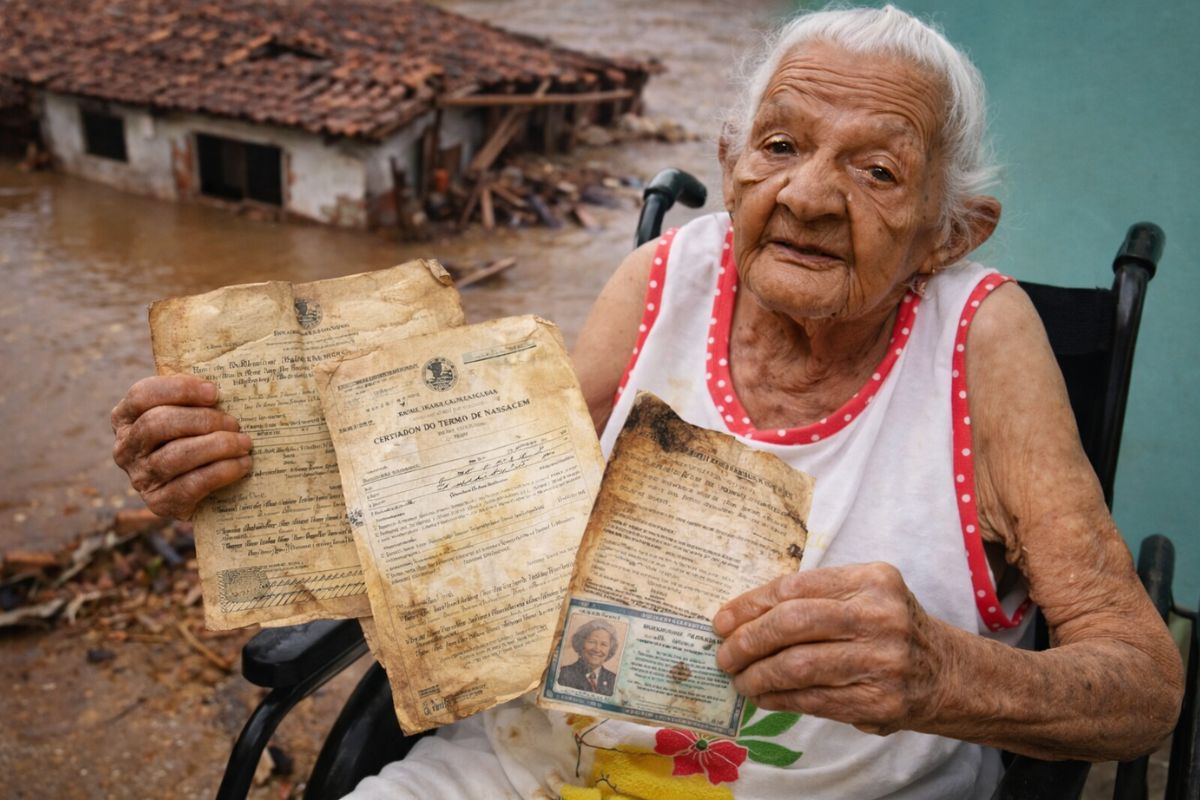


At 119 Years Old, Deolira Glicéria Pedro da Silva Lives in Itaperuna, Rio de Janeiro, Presents Documents That Point to Birth on March 10, 1905, Seeks Validation from Guinness World Records, and Faces the Biggest Obstacle in the Process: the Loss of Original Records in Past Floods in the Fluminense Region.
Deolira Glicéria entered a delicate dispute between paper, memory, and global recognition. Two months before what the family claims to be her 120th birthday, the Brazilian has begun seeking analysis from Guinness World Records based on documents indicating a birth date of March 10, 1905, in the rural area of Porciúncula, in the interior of Rio de Janeiro.
The case draws attention because it mixes an extraordinary number with a documentary fragility that weighs during the decisive moment. If the records are accepted, the name of Deolira Glicéria could alter the top of the world ranking. If not, the claim remains surrounded by doubt, despite doctors, family members, and researchers arguing that she has certainly surpassed 100 years.
The Race to Turn Declared Age into Official Recognition

The efforts surrounding Deolira Glicéria gained momentum in January 2025 when the elderly woman, resident of Itaperuna, publicly appeared as a candidate for the title of the world’s oldest living person.
-
Friends have been building a small “town” for 30 years to grow old together, with compact houses, a common area, nature surrounding it, and a collective life project designed for friendship, coexistence, and simplicity.

-
This small town in Germany created its own currency 24 years ago, today it circulates millions per year, is accepted in over 300 stores, and the German government allowed all of this to happen under one condition.

-
Curitiba is shrinking and is expected to lose 97,000 residents by 2050, while inland cities in Paraná such as Sarandi, Araucária, and Toledo are experiencing accelerated growth that is changing the entire state’s map.

-
Tourists were poisoned on Everest in a million-dollar fraud scheme involving helicopters that diverted over $19 million and shocked international authorities.


The family claims she will turn 120 years old on March 10, and the thesis relies on preserved documents despite the loss of part of the original material over time.
Today, Guinness recognizes another Brazilian, Inah Canabarro Lucas, a nun from Rio Grande do Sul, as 116 years old. This is precisely what turns Deolira Glicéria’s case into something larger than a family story.
This is not just about rare longevity, but about trying to overturn a record already recognized internationally, something that relies less on narrative and more on documentary robustness.
The family considers this stage decisive. Granddaughter Doroteia Ferreira da Silva claims that the papers in hand indicate that the grandmother is indeed the oldest person in the world.
At the same time, Guinness stated that it could not confirm the receipt of the application, citing the high volume of similar requests coming from different countries.
This detail exposes the extent of the filter. Guinness does not work merely with impressive claims, but with rigorous verification and comparison among files, dates, certificates, and historical coherence.
It is in this funnel that the story of Deolira Glicéria enters its most challenging phase.
The Documents That Support the Age and the Part That Disappeared
The records presented by the family show that Deolira Glicéria Pedro da Silva was born on March 10, 1905, in Porciúncula, in a rural area of the state of Rio de Janeiro.
Today, she lives in Itaperuna, in a house where she is cared for by her granddaughters Doroteia, 60, and Leida Ferreira da Silva, 64. This family network helps support the routine of someone who is, in theory, about to cross the 120-year mark.
The problem is that an important part of the original documentation was lost in major floods that occurred in the region nearly twenty years ago.
This absence does not automatically destroy the claim, but weakens the type of proof that international organizations typically require to validate records of this magnitude.
In the universe of super-centenarians, losing old documents is losing ground precisely when the analysis demands total tying.
Researcher Mateus Vidigal from the University of São Paulo studied the case as part of a project aimed at the super-elderly population in Brazil and claims that Deolira Glicéria has not been excluded from the analysis.
Still, he acknowledges the fragility that accompanies the process: documents approved by verification organizations like Guinness are lacking, and this directly weighs on the recognition attempt.
This distinction matters. A person may be regarded as extremely elderly in medical and academic environments, but that does not automatically guarantee record validation.
Between having sufficient evidence for study and having sufficient proof for a record, there is a huge bureaucratic distance, and it is on this that the case currently rests.
What Doctors and Researchers Observe in the Case of Deolira Glicéria
Geriatrician Juair de Abreu Pereira, who monitors Deolira Glicéria and assists the family in the process, states that she is in good general health for her condition and does not use medication.
In a country where the average life expectancy is 76.4 years, this information stands out because it places her more than four decades above the national standard.
Longevity, according to the doctor, is related to simple habits such as healthy eating, adequate sleep, and preserved family relationships.
The routine reported at home indicates a non-average old age: she maintains a good relationship with relatives and enjoys eating bananas.
It is a picture that contrasts with the usual burden of chronic diseases that often surround much younger ages.
The granddaughters reinforce this perception of domestic astonishment. While younger relatives deal with high blood pressure and diabetes, the elderly woman appears as someone who has traversed more than a century without carrying the same clinical package that afflicts a large part of the Brazilian population. This, in itself, helps explain the medical and academic interest surrounding the case.
But neither doctors nor researchers treat the subject irresponsibly.
The central point remains to separate two different questions: one is whether Deolira Glicéria represents an extraordinary case of aging; the other is whether the available documentation can support the exact age claimed before an international institution.
The first question seems to gain strength; the second remains open.
Between the National Symbol and International Doubt
The case of Deolira Glicéria also touches on another type of sensitivity: that of a country already at the top of the world ranking of longevity and that can, in theory, continue there under another name.
The fact that the current recognized record-holder is also Brazilian increases public interest and transforms the dispute into something that goes beyond the intimacy of a family from the Fluminense countryside.
However, this symbolic aspect does not resolve the harsher part of the analysis. Guinness does not validate ages based on emotion, photos, or isolated testimony.
What matters is the documentary chain, and it is precisely there that the floods of nearly twenty years ago continue to interfere with the present.
A story can be moving, plausible, and even clinically impressive without being able to overcome the formal proof required by a world ranking.
At the same time, the case does not disappear because of this barrier. It remains relevant because it shows how local disasters can affect, decades later, the reconstruction of individual trajectories.
When old records disappear, not only paper is lost. The possibility of accurately closing biographies that have spanned more than a century is also lost.
In the end, Deolira Glicéria finds herself at a rare point: too close to a gigantic title to be ignored, but still dependent on a validation she does not control alone.
It is the combination of exceptional longevity with incomplete proof that makes this story so strong and so uncertain at the same time.
At 119 years old, Deolira Glicéria Pedro da Silva is trying to transform surviving documents, medical support, and academic interest into official recognition from Guinness World Records.
The family points to a birth on March 10, 1905, in Porciúncula; the current routine unfolds in Itaperuna; and the biggest obstacle remains the loss of part of the original records in past floods.
The case raises an uncomfortable question about how the world validates extreme old age when the documentary past has been broken by events beyond the individual’s control. In your view, in a case like Deolira Glicéria’s, what should weigh more: the rigidity of the archives, the coherence of the remaining documents, or the joint assessment of doctors, researchers, and family when the claimed age spans such a long time?










Em Catalão-Goiás, temos uma idosa que nasceu em 1903.E está com 122 anos e deverá completar 123 anos em 1º de junho de 2026.
É muito simples comprovar: provavelmente a 20 anos atrás já era aposentada e embora foram pedidos documentos o INSS tem a cópia de todos.
Naquela época não existia INSS. Você sabia que a Previdência Social existia somente para algumas categorias de trabalhadores? Elas foram unificadas nos anos 60 e a Previdência Rural surgiu nos anos 70!
Pela lata dessa veia precisava nem de documento kkkkk
A sua lata tá pior que a dela e vc não tem 220 anos.