





 Portuguese
  English
  Spanish
 4 min of reading
  9 comments


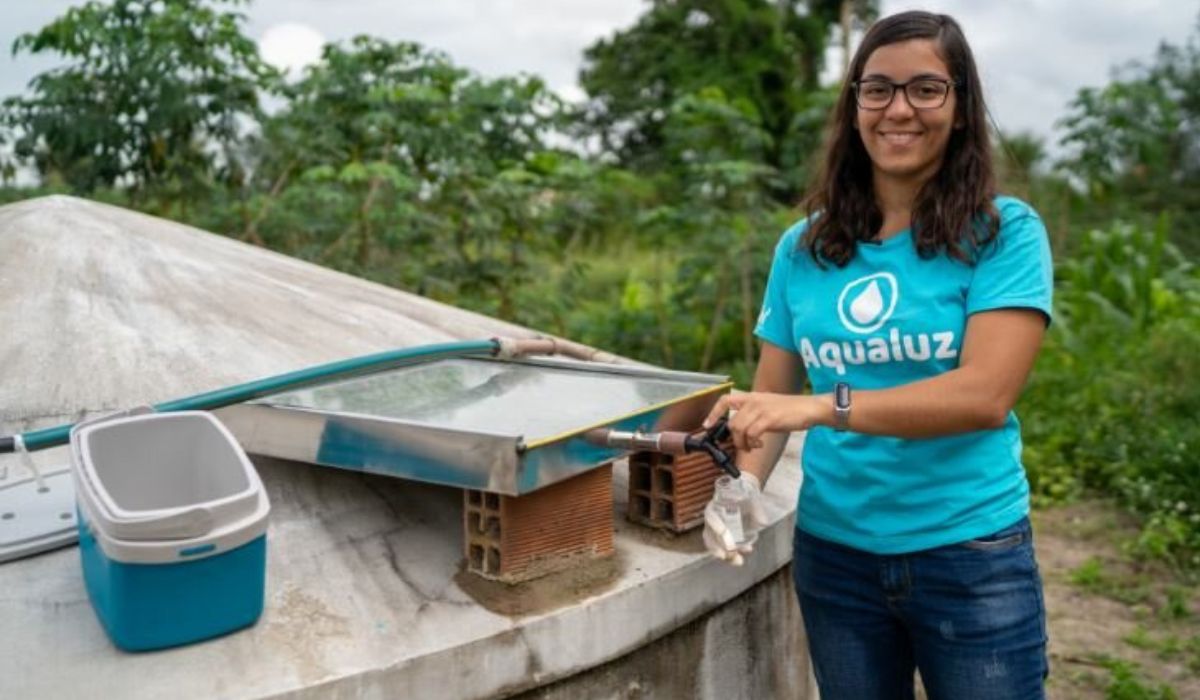


Technology Created in the Brazilian Semi-Arid Region Captured International Attention by Proposing a Method of Water Disinfection Using Only Solar Light, Targeted at Rural Communities with Limited Access to Sanitation and Basic Infrastructure.
A technology developed from observations made in the Brazilian Semi-Arid region led to a water disinfection system that uses only solar light and dispenses with the use of chlorine.
The equipment, called Aqualuz, was conceived during the adolescence of the Bahia native Anna Luísa Beserra Santos and gained international recognition in 2019 by winning the Young Champions of the Earth award from the United Nations Environment Program.
The system was designed to operate in a recurring context in rural areas of the Northeast: the presence of cisterns for rainwater storage, combined with difficulties in ensuring that this water is safe for human consumption.
-
Motorola launched the Signature with a gold seal from DxOMark, tying with the iPhone 17 Pro in camera performance, Snapdragon 8 Gen 5 that surpassed 3 million in benchmarks, and a zoom that impresses even at night.

-
Satellites reveal beneath the Sahara a giant river buried for thousands of kilometers: study shows that the largest hot desert on the planet was once traversed by a river system comparable to the largest on Earth.

-
Scientists have captured something never seen in space: newly born stars are creating gigantic rings of light a thousand times larger than the distance between the Earth and the Sun, and this changes everything we knew about stellar birth.

-
Geologists find traces of a continent that disappeared 155 million years ago after separating from Australia and reveal that it did not sink, but broke into fragments scattered across Southeast Asia.

The aim of Aqualuz is to reduce risks associated with microbiological contamination in places where conventional water treatment and sanitation infrastructure are not fully available.
Access to Water in the Semi-Arid and the Limits of Cisterns
In several rural communities in the Northeast, rainwater harvesting policies have increased access to minimal volumes during drought periods.
Nevertheless, the existence of stored water does not guarantee, by itself, that it is safe to drink.
Contamination issues can occur during collection, storage, or daily use of cisterns, according to technical reports and surveys conducted by institutions related to environmental health.
It was from this realization, observed during visits to the interior of Bahia, that Anna Luísa began to explore alternatives for water disinfection.
Instead of resorting to solutions dependent on electricity or chemical products, the student sought to explore a widely available resource in the region: solar radiation.
Solar Water Disinfection as the Basis of the System
The operation of Aqualuz is based on principles already known from solar water disinfection, a technique studied and applied in different countries with high sunlight incidence.
In this process, the stored water is channeled to a transparent compartment, where it remains exposed to sunlight for a determined period.

According to technical descriptions of the project, this time can reach approximately four hours, depending on the weather conditions.
During exposure, the combination of ultraviolet radiation and increased temperature helps reduce pathogenic microorganisms.
Sanitation specialists point out that the effectiveness of this method is associated with factors such as water transparency and solar intensity, which requires prior care to avoid high turbidity levels.
Structure of Aqualuz and Use in Isolated Areas
The proposal of Aqualuz includes components aimed at adapting the solar technique to the daily routine of families.
The system is designed to operate without electricity and without the need for frequent maintenance, making it compatible with isolated areas.
Additionally, materials released by the project providers indicate that the equipment has signaling to inform when the water has undergone the necessary exposure time to the sun.
According to institutional information from SDW for All, an initiative linked to the development of Aqualuz, each unit was designed to have an estimated lifespan of up to 20 years.
The reported treatment capacity is up to 10 liters per hour under adequate usage conditions, a volume considered sufficient to meet the basic needs of a family, according to parameters used in water access projects.
UN Recognition and International Projection
The project gained exposure outside the school environment by being selected in 2019 for the Young Champions of the Earth award.
At the time, Anna Luísa was chosen as the representative of Latin America and the Caribbean, becoming the first Brazilian to receive the award.
The United Nations Environment Program presented Aqualuz as an example of a solution developed from local challenges, focused on reducing health risks associated with contaminated water.


Although the invention is often associated with the age of its creator at the time of recognition, public records indicate that the development of the system went through different improvement stages until it reached practical application in communities.
The process included testing, technical adjustments, and the structuring of an initiative aimed at field implementation.
Installation in Communities and Social Reach
Information released by partner organizations indicates that Aqualuz has been installed in rural communities across different states, particularly in the Northeast.
The most cited figures indicate that thousands of people have begun using the system as an alternative to improve the quality of the water consumed, although the exact update of these data depends on more recent and consolidated surveys.
Part of the implementation model involves training local residents for the installation and monitoring of the equipment.
According to the project providers, this strategy aims to reduce the dependence on external support and facilitate the continuity of use.
Sanitation technicians observe that this type of approach is common in social technologies directed at contexts with infrastructure limitations.
Social Technology and Public Sanitation Policies
Experts in public sanitation policies emphasize that solutions like Aqualuz do not replace formal water supply and treatment systems.
These technologies are seen as complementary measures, capable of reducing immediate risks in areas where access to treated water is still irregular or nonexistent.
The experience reported with Aqualuz illustrates how local grassroots initiatives can contribute to addressing specific problems, especially in rural areas.
At the same time, the structural challenge of universal access to potable water in the Semi-Arid remains tied to public investments, long-term planning, and continuous sanitary monitoring.






Como é gratificante ler notícias assim! Que o Senhor Jesus abençoe e guarde sempre e sempre essa moça de inteligencia brilhante!
Agora sim da pra comer miojo de picanha sem gosto de terra
Parabéns, Anna! Muito sucesso na sua jornada! Que Deus te abençoe 🙏🏼