





 Portuguese
  English
  Spanish
  6 min of reading
  18 comments


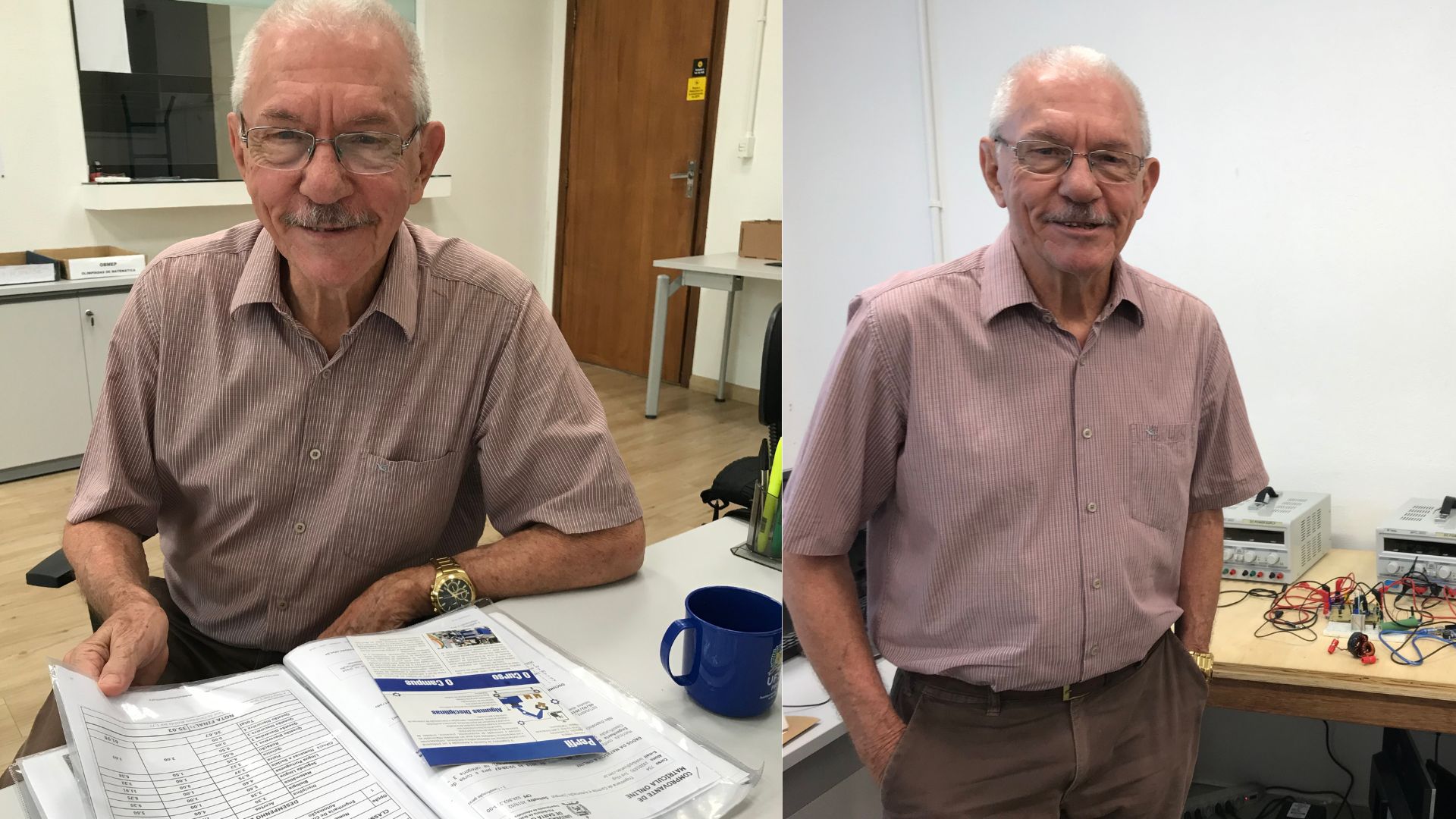


Stories of Returning to Studies Gain Strength When Acceptance Comes in a Competitive Federal University Course and Break Expectations About Age and Routine. The Case of Ivo Klug in Santa Catarina Brings Together Discipline, Academic Restart, and Curiosity by Placing a 79-Year-Old Freshman in Engineering.
At 79, Blumenau (SC) resident Ivo Klug secured a spot in one of the most competitive courses at a federal university and became recognized as the oldest candidate approved in the entrance exam at the Federal University of Santa Catarina.
Approved for Control and Automation Engineering at the Blumenau campus, he serves as an example that returning to academic life can happen even after a long professional and family trajectory, in a routine usually associated with retirement and established commitments.
Discipline Before the Entrance Exam and Return to Campus
The entry into the course was not the result of a sudden impulse, but of a path built with method, study, and progressive approach to the university environment.
-
Friends have been building a small “town” for 30 years to grow old together, with compact houses, a common area, nature surrounding it, and a collective life project designed for friendship, coexistence, and simplicity.

-
This small town in Germany created its own currency 24 years ago, today it circulates millions per year, is accepted in over 300 stores, and the German government allowed all of this to happen under one condition.

-
Curitiba is shrinking and is expected to lose 97,000 residents by 2050, while inland cities in Paraná such as Sarandi, Araucária, and Toledo are experiencing accelerated growth that is changing the entire state’s map.

-
Tourists were poisoned on Everest in a million-dollar fraud scheme involving helicopters that diverted over $19 million and shocked international authorities.

Even before taking the entrance exam, Klug attended the campus and enrolled as a special student in a Physics course, an experience that helped him test the rhythm of classes, the evaluation dynamics, and his own readiness to resume formal content.
Upon passing the course, with performance officially recorded by the institution, he solidified his decision to compete for a regular spot and prepare for the selection process exams.
Second Degree and Choice for Control and Automation
Ivo Klug’s academic journey does not start at UFSC.

He had already completed a degree in Mechanical Engineering at the Federal University of Paraná decades earlier and accumulated additional training throughout his life, including courses and a postgraduate degree.
The choice for Control and Automation, however, was justified by a specific interest in the area and the desire to study in-depth topics related to control systems, processes, and automation, a field that has expanded significantly with industrial modernization and the digitalization of operations.
Long Exam, High Competition, and Emotion in the Result
In the UFSC entrance exam, the challenge carried double weight: in addition to the competition typical of engineering courses, there was a need to adapt to a very different exam format from his time as a student.
The university’s traditional selection process consists of several days of application, with extensive content requirements, reading, and physical endurance to navigate long assessment sessions.
Klug reported that the exam was tiring, recognizing the difficulty and demanding nature of the model, even though he performed well in Mathematics, a subject commonly decisive for candidates in the technological field.
When he received confirmation that he was accepted, the reaction was not discreet.
He described an immediate emotional moment upon checking the result and realizing he had secured the spot, a reaction that summarizes the tension of returning to compete in a competitive selection and the joy of reconnecting with a goal that, for many, seems reserved only for the younger generation.
The acceptance, officialized by the university, highlighted him as a symbol of active longevity associated with study, without turning the achievement into a promise or rule, but documenting a real and verifiable case.
Family, Routine, and a Restart Without Rupture
The family component also traverses the story.
Ivo Klug is married to Vera Regina and has three children, along with grandchildren, in a household that has accompanied different phases of his life.
This context appears in contrast to the stereotype that academic life demands a rupture with already established responsibilities.
In his case, the return to campus took place within a story already filled with decades of work, commuting, and professional experiences, with stints at companies and trips abroad reported in interviews given to the university.
Organization, Records, and Study Routine
In narrating his own path, Klug presented an uncommon organization profile for someone returning to study after so long.
He maintained records of dates, courses, and career stages in a folder, consulted whenever doubts about the details of his own trajectory arose.
This care for documentary memory reinforced the practical dimension of the project: it was not just about “returning to study,” but about resuming the role of a student with discipline, planning, and readiness to face current academic demands, which include frequent evaluations, deadlines, and performance tracking.
Blumenau Campus and Access to Public Higher Education
Entry to UFSC occurred at the Blumenau campus, a unit created to increase the university’s presence in the Itajaí Valley and bring federal education opportunities interior to Santa Catarina.
By choosing to study in his own city, Klug also reduced logistical barriers common for those who want to attend a public university far from home.
The choice was also linked to a positive perception of the structure, professors, and academic environment—decisive elements for a student who, upon returning, needs to feel welcomed and, at the same time, challenged.
Why the Story Sparks Curiosity
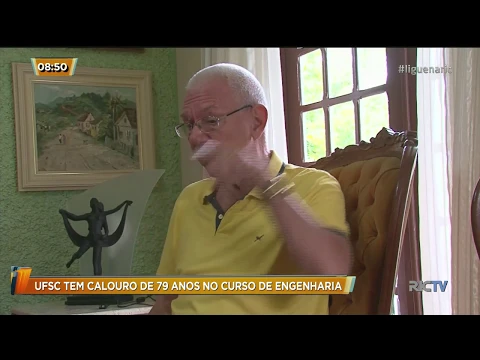

The story draws attention for combining two layers of curiosity that tend to engage readers.
The first is age, when placed side by side with a competitive entrance exam and a math-based degree.
The second is the inversion of the expected social role for someone nearly 80 years old, who exchanges the routine of established work for the routine of exams, laboratory, classroom, and technical content.
The fact that it involves a second degree in Engineering reinforces the deliberate nature of the decision, aimed at learning and updating, not just a symbolic achievement.
Special Student, Pathways to Entry, and Adaptation
At the same time, the case exposes a less-discussed aspect of public higher education: the existence of intermediate pathways that can bring candidates closer to the university environment before regular enrollment, such as the possibility of taking courses as a special student, when authorized, to experience the formation and evaluate compatibility with the course requirements.
This type of strategy, when available and utilized within institutional rules, can serve as a bridge for those who have been out of school for many years and fear the initial shock of content and pace.
Generational Encounter in the Classroom
Inside the classroom, the return of a student with nearly eight decades of life also produces an inevitable generational encounter.
Although the university does not lower its standards because of age, the presence of an older student tends to provoke curiosity among peers and professors, as well as reestablish the idea that learning is not limited to a short phase of youth.
In Klug’s case, the notoriety came less from speeches and more from the very act of going through the same selection and evaluation stages as the other candidates, with official results and public records of performance.
Public University and Different Profiles of Students
Ivo Klug’s acceptance into Engineering at UFSC, in a competitive entrance exam with high demands, reinforces a simple and verifiable fact: public universities can receive very different student profiles, including those who decide to restart later in life, with a full history behind them and a new notebook in their backpack.
How many people who pass by a university every day, but think it’s “no longer for them,” would be surprised to discover that it is still possible to start anew?









Enquanto nossos idosos mostram interesse pela educação e superar obstáculos como chacotas e até descriminação,nossos jovens vem se entregando as drogas ou coisas do tipo.
Parabéns ao Sr. citado na matéria. Tem todo o nosso apoio. Parabéns!!!
Bom dia Ivo Klug ✨️🌟🙌🙌🌿🌻☕️
Sou Luís Carlos Sodré Pinto, 74 anos, Curso o sétimo período de FILOSOFIA LICENCIATURA, pela UNOPAR EAD , Macaé – RJ.
SOU TÉCNICO MOTORES DIESEL aposentado.
Sempre quis Cursar FILOSOFIA, tenho-a como base para uma cultura de ÉTICA E MORAL.
Estou me saindo bem e, depois de formado, quero Cursar DIREITO, e com fé em DEUS vou conseguir.
DEUS O abençoe e ilumine nessa linda caminhada com plenos êxitos.
PARABENS!!! ✨️🌟🙌🙌
Parabéns! nunca é tarde pra ninguém é sô querer e ter força de vontade